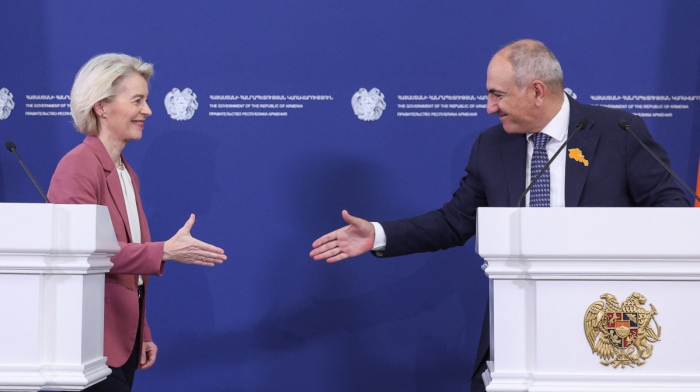
ANEWZ can exclusively report that European Commission President Ursula von der Leyen is expected to visit Azerbaijan on 1 July.
The visit follows her recent trip to Armenia and would be her first visit to Azerbaijan since July 2022, when she travelled to Baku to sign the EU-Azerbaijan strategic energy partnership.
Talks are expected to focus on EU-Azerbaijan relations, energy cooperation and regional developments.
EU Commissioner for Enlargement Marta Kos will accompany von der Leyen during the regional visit, which comes as Brussels seeks to strengthen transport, energy and digital links across the South Caucasus.
EU launches new connectivity platform
The regional tour follows the launch of the EU's new Connectivity Agenda Platform, an initiative designed to coordinate infrastructure projects along the Middle Corridor, also known as the Trans-Caspian International Transport Route (TITR).
The trade route links China, Central Asia, the South Caucasus, Türkiye and Europe and has become increasingly important as the EU looks to diversify trade and transport connections.
Speaking at the launch of the platform in a video posted on X, Kos said it would bring together separate initiatives under a common strategy.
"The Connectivity Agenda Platform will allow us to link individual initiatives and develop a common vision for developing connectivity in the wider region. It will also help shape a portfolio of priority projects that truly make a difference," she said.
The platform is also intended to make it easier to finance projects by bringing together governments, international financial institutions and private investors around a shared investment agenda.
Although the Middle Corridor passes through both Azerbaijan and Georgia, neither country was represented at ministerial level during the launch event, despite playing a central role in the route.
Cutting transport times
The European Commission sees the corridor as an important alternative to traditional trade routes between Europe and Asia.
However, transport remains slow because of limited infrastructure, capacity constraints and administrative hurdles. Cargo travelling from the China-Kazakhstan border to Romania can currently take up to 45 days.
"We want to reduce this time to 15 days – this is significantly faster than shipping by sea to Europe," Kos said.
She identified missing rail and road links, limited capacity and differences in border procedures as some of the main challenges. The EU plans to support investment in transport infrastructure, digital customs systems and greater regulatory alignment between countries along the route.
According to Kos, agreements signed under the initiative include more than €80 million in EU funding and could help mobilise more than €2 billion in investment across transport, energy and digital infrastructure.
Renewed engagement with Azerbaijan
Von der Leyen last visited Azerbaijan in July 2022, when she met President Ilham Aliyev in Baku to sign a strategic energy partnership aimed at increasing natural gas supplies to the European Union following Russia's invasion of Ukraine.
Since then, energy cooperation has remained a key pillar of EU-Azerbaijan relations, alongside growing interest in regional connectivity and trade.
Her upcoming visit is expected to focus on bilateral relations, energy cooperation and regional developments, as the EU seeks to deepen engagement with countries along the Middle Corridor.
Read more:














What is your opinion on this topic?
Leave the first comment