Armenia has said that the newly inaugurated "Trump Route for International Peace and Prosperity" (TRIPP) will remain a strictly bilateral initiative between Yerevan and Washington for the time being.
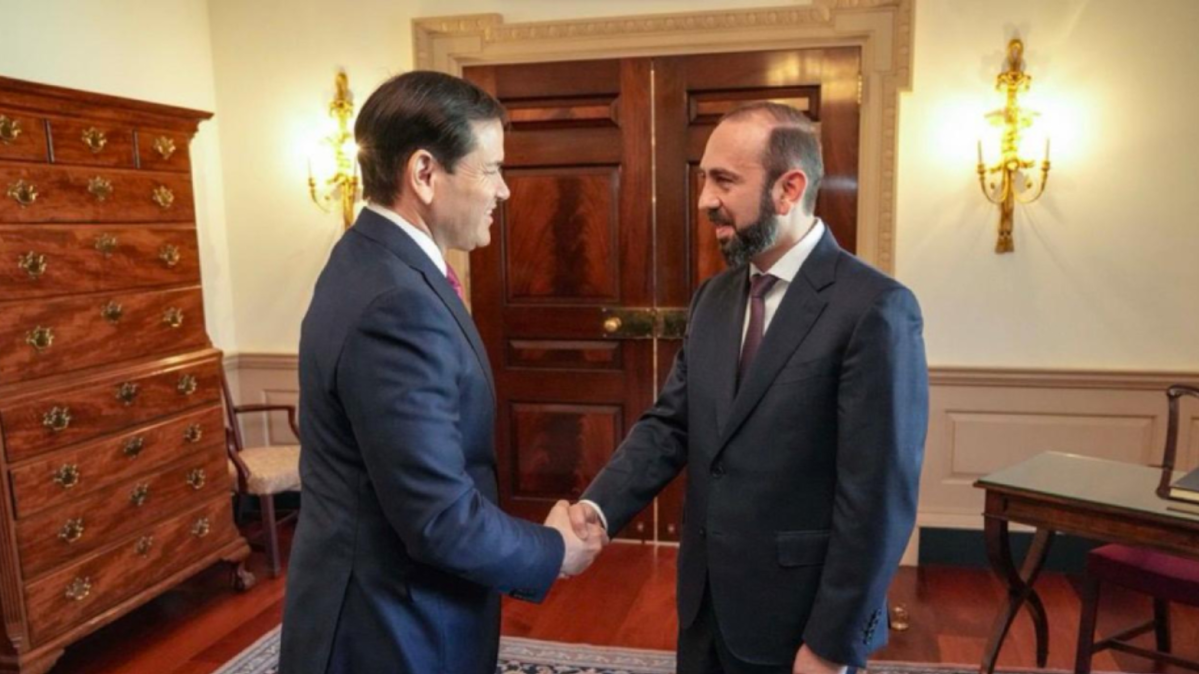
Speaking live from the U.S. capital following the signing of the implementation documents, Armenian Foreign Minister Ararat Mirzoyan clarified the boundaries of the ambitious infrastructure project.
While the agreement marks a significant deepening of economic ties between Armenia and the United States, Mirzoyan confirmed that neither Türkiye nor Russia were subjects of the negotiation process.
When pressed on Ankara’s potential role, Mirzoyan emphasised that TRIPP is fundamentally an Armenian-American business venture.
However, he offered a pragmatic assessment of the South Caucasus’s geography, noting that any large-scale "unblocking" of trade routes is logistically impossible without Turkish involvement.
"In the broader context... a major logistical transition will not be secured without the participation of the Turkish side," Mirzoyan stated.
He highlighted the strategic importance of the Gyumri-Kars railway — a connection currently dormant due to the closed border — as the only viable rail route for goods moving through Türkiye into Europe.
The Foreign Minister revealed that discussions with Ankara are currently constructive and expressed hope for results in the near future.
While Türkiye is not a signatory to TRIPP, Mirzoyan suggested it is "logical" for them to eventually become part of the wider communications network, perhaps as a continuation of the infrastructure established by the US-backed project.
Tensions with Russian Infrastructure
The exclusion of Russia from the talks highlights the shifting geopolitical landscape in the region. Mirzoyan stated that Russian participation was not discussed for the same reasons as Türkiye: the framework of TRIPP is specific to U.S.-Armenia cooperation.
However, the Minister assured that Yerevan does not intend to isolate Moscow entirely from regional transit schemes. "In the greater unblocking involving immediate or distant neighbours... we do not intend to leave the Russian Federation outside the framework," he said.
A critical point of contention remains the railway infrastructure itself. Armenia’s rail network is currently managed by the South Caucasus Railway (SCR), a subsidiary of Russian Railways (RZD).
Mirzoyan addressed the ultimatum previously voiced by the Armenian Prime Minister: if the Russian side is unwilling to restore missing rail sections at Yeraskh and Gyumri, the Armenian government is prepared to undertake the construction independently.
"The political and economic vision regarding infrastructure has been presented, and it is necessary that the missing sections are restored quickly," Mirzoyan explained. "This has been conveyed to the Russian side. If there is no reaction, there will be other scenarios."










What is your opinion on this topic?
Leave the first comment