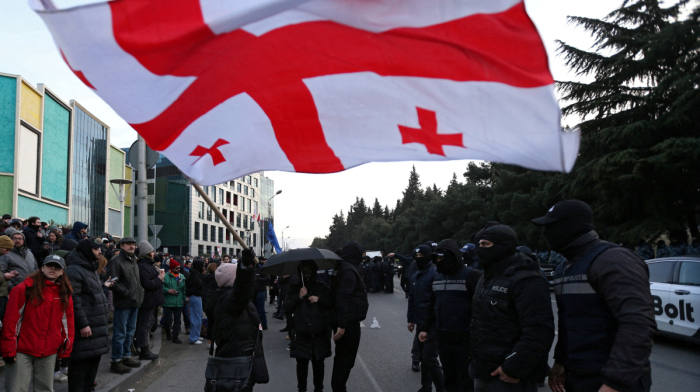
Georgia's Parliament Speaker Shalva Papuashvili has accused Brussels of using visa policy as a political weapon rather than a technical instrument.
His latest remarks signal not only growing frustration within the ruling Georgian Dream party, but also a notable shift in how the government is preparing society for the possibility that visa-free travel with the EU may no longer be untouchable.
Speaking to journalists in Tbilisi, Papuashvili criticised what he described as Brussels’ attempt to portray visas as a “curse” and visa-free travel as a benevolent gift.
According to him, such framing reveals more about the EU’s own bureaucratic culture than about any real hardship for Georgian citizens.
“If a visa is treated as a curse, that suggests Europe believes its own embassies are so bureaucratic and dysfunctional that people should fear applying,” Papuashvili argued, pointing out that Georgians routinely obtain visas to countries like the United Kingdom, Ireland, and the United States without major obstacles.
The Speaker dismissed repeated warnings from Brussels about possible restrictions as exaggerated and politically motivated.
He emphasised that visas for holders of diplomatic passports have existed for years and have not caused serious disruption, describing the current rhetoric as pressure rather than policy.
Beyond the visa issue itself, Papuashvili also questioned the credibility of the European Commission’s latest visa monitoring report.
He accused Brussels of double standards, claiming that chapters on corruption and human rights were removed for Ukraine and Moldova despite visible challenges in both countries. Such selectivity, he said, undermines the EU’s moral authority and exposes political bias in its assessments.
Until recently, Georgian Dream leaders flatly rejected suggestions that visa-free travel could be suspended, framing the debate as opposition-driven speculation. Now, while continuing to criticise Brussels, the government appears to acknowledge that the issue is real — and potentially consequential.
For the European Union, visa liberalisation is explicitly conditional, tied to democratic governance, rule of law, and institutional reforms.
For Georgian authorities, however, the discussion is increasingly framed as one of dignity and sovereignty, rather than compliance alone.
As both sides harden their rhetoric, visa policy is no longer just a technical matter, it has become a symbol of broader tensions shaping EU–Georgia relations.









What is your opinion on this topic?
Leave the first comment