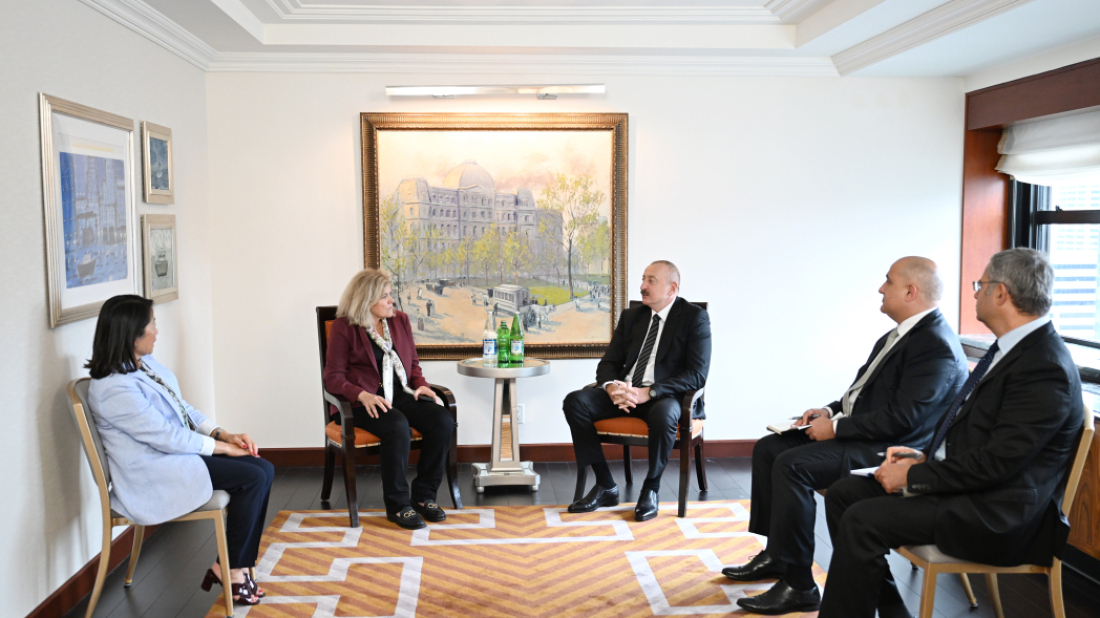
On 24 September, within the framework of the 79th session of the United Nations General Assembly, President of the Republic of Azerbaijan Ilham Aliyev held meetings in New York with the heads of some of the world’s most influential financial and investment institutions.
The Azerbaijani leader first met Jenny Johnson, President and Chief Executive Officer of Franklin Templeton, a U.S. -founded company that currently manages assets worth around 1.6 trillion U.S. dollars.
The discussions focused on the global investment climate, access to capital markets in emerging economies, and the role of international partnerships in driving economic transformation.
Jenny Johnson praised Azerbaijan’s recent economic initiatives, noting that the country’s stable and favourable investment environment creates important opportunities for international capital. She emphasised that this provides a solid basis for long-term partnerships.
President Ilham Aliyev, for his part, underlined Franklin Templeton’s close cooperation with the State Oil Fund of Azerbaijan, describing it as an important factor in deepening the country’s capital markets, enhancing the region’s investment potential and supporting sustainable development. He also highlighted the company’s expertise in alternative investments and its successful projects in various countries of the region, pointing out that there is significant scope for expanded cooperation.
It was noted that Franklin Templeton’s longstanding experience in capital markets, infrastructure, real estate and renewable energy could contribute to Azerbaijan’s economic and financial agenda, as well as to the implementation of the country’s “green transition” strategy.
Founded in 1947 in the United States, Franklin Templeton operates nearly 70 offices in more than 30 countries and manages a wide range of investment products across over 170 countries.
Strategic dialogue with Global Infrastructure Partners
President Aliyev also met Adebayo Ogunlesi, Founder, Chairman and Chief Executive Officer of Global Infrastructure Partners (GIP), one of the world’s largest infrastructure investment management companies.
The meeting focused on opportunities for international cooperation in infrastructure and the role of joint investments in strengthening regional economic ties.
The Head of State recalled the successful partnership established between the State Oil Fund of Azerbaijan and GIP in 2024, particularly their joint investment in Italy’s leading high-speed rail operator Italo, which he described as an example of effective cooperation. President Aliyev further noted that the company’s experience in airport management, energy transition and artificial intelligence infrastructure opens up significant opportunities for future collaboration.
Adebayo Ogunlesi emphasised that Azerbaijan’s strategic geographical position and sustainable development priorities provide favourable conditions for long-term investments in infrastructure. He expressed his company’s interest in deepening cooperation with Azerbaijan in the fields of energy transition, transport and digital infrastructure.
Established in 2006 in the United States, Global Infrastructure Partners currently manages nearly 170 billion US dollars in assets and operates offices in New York, London, Singapore, Sydney and other major financial centres. The company’s renewable energy portfolio makes it one of the leading players in the sector in the United States.
Supporting Azerbaijan’s economic agenda
Both meetings highlighted the importance of strengthening Azerbaijan’s ties with international investment circles. They also underlined the role of such partnerships in the development of capital markets, the modernisation of infrastructure and the advancement of the country’s green energy agenda.
The discussions in New York further demonstrated Azerbaijan’s growing presence on the global economic stage and its commitment to sustained dialogue with international partners.
















What is your opinion on this topic?
Leave the first comment