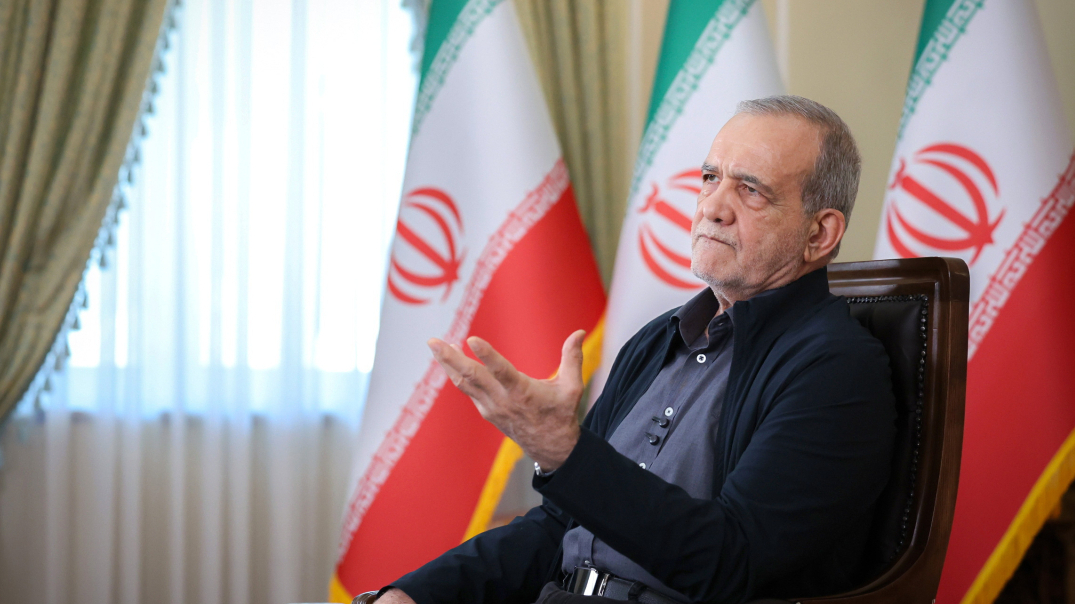
President Masoud Pezeshkian has defended his administration's economic performance under longstanding Western sanctions and severe wartime conditions, saying barter trade with neighbouring countries has expanded to help Iran cope with financial restrictions, according to his office.
"Naturally, we are designing different ways with our neighbors, expanding our trade with them," he said in a recorded address broadcast on state IRIB TV on Thursday (6 August) to mark the completion of two years in office, according to the presidential website president.ir.
"Since we do not have the possibility of transferring money, naturally some of the exchanges are done in the form of barter," the Iranian president added during the second of four televised speeches focusing on economic issues and public welfare.
According to Pezeshkian, Iran's relations with neighbouring countries have strengthened during his first two years in office, both in trade and security cooperation, particularly during the Israeli-U.S. war with Iran that began in February 2026.
Regional security cooperation
"One of the plans they (the enemies) had during this war, was to create unrest and tension from the northwest and southeast," he said, referring to reported U.S. plans to arm Kurdish separatists in neighbouring Iraq and militants across Iran's borders with Pakistan and Afghanistan.
"They planned (armed) agents to infiltrate across borders and create unrest in these areas, but the countries in the region did not allow anyone to easily enter from across the borders and create unrest," he added, referring to security cooperation with neighbouring countries.
Since the 1979 Islamic Revolution, which overthrew the pro-Western monarchy and adopted anti-U.S., anti-Israel and anti-Soviet foreign policy positions while supporting the Palestinian cause of an independent state, Iran has been subject to extensive sanctions.
The measures began after Washington severed diplomatic ties with Tehran and imposed unilateral U.S. sanctions following the takeover of the U.S. Embassy in Tehran in November 1979. Sanctions later expanded to include oil and gas embargoes, as well as financial and banking restrictions linked to Iran's nuclear programme despite it remaining under UN monitoring and safeguards.
Infrastructure projects continue
"Closer ties with neighbouring countries have helped expand trade despite financial restrictions. While banking limitations have made money transfers difficult, barter trade has become one of the alternatives for maintaining commercial exchanges," Pezeshkian said.
Addressing the impact of sanctions, he said restrictions on oil exports had reduced Iran's foreign currency earnings.
"The Government is working with economists, academics, business professionals, chambers of commerce, and industry representatives to minimize economic challenges," according to his office's website.
Acknowledging that not all problems had been resolved despite efforts to lessen the impact of economic challenges, he added: "Many foreign observers had expected Iran's economy to collapse under mounting pressure but had been surprised by its resilience."
Pezeshkian reiterated that expanding the country's rail network remains one of his administration's top infrastructure priorities.
"More than 600-kilometre Chabahar Port–Zahedan railway is scheduled to open in Government Week (23-29 August) despite delays caused by attacks on steel production facilities. The line will eventually connect to Sarakhs (bordering Turkmenistan), strengthening Iran's national transport corridor."
Cross-border rail links
Pezeshkian said the Astara-Rasht railway, which will connect Iran with neighbouring Azerbaijan as part of the International North-South Transport Corridor (INSTC), is progressing.
"The government has completed land acquisition. Its construction is expected to proceed with Russian financial participation."
"In addition, the Tehran–Cheshmeh Soraya railway linking Tabriz to Türkiye is moving toward selection of a contractor," he said.











What is your opinion on this topic?
Leave the first comment