Iran has warned it will respond “decisively” if subjected to military aggression, saying U.S. President Donald Trump’s rhetoric signals “a real risk of military aggression”.
Iran's UN ambassador Amir Saeid Iravani made the comment in a letter to the United Nations Secretary-General, António Guterres and the President of the Security Council, in which he said, “Iran will respond decisively and proportionately in the exercise of its inherent right of self-defence under Article 51 of the Charter of the United Nations.”
He was referring to Trump’s recent threats to use military force. “In such circumstances, all bases, facilities and assets of the hostile force in the region would constitute legitimate targets in the context of Iran’s defensive response,” he said.
“The United States would bear full and direct responsibility for any unpredictable and uncontrolled consequences,” the letter added, according to Iran’s Permanent Mission to the United Nations in New York.
It warned that, given the volatile regional situation and the continued movement and build-up of U.S. military equipment, such statements “must not be treated as mere rhetoric” and instead signal a genuine threat of military action.
Earlier this month, Tehran and Washington resumed a new round of nuclear negotiations mediated by Oman. The talks had been interrupted by Israel-U.S. airstrikes on Iran's nuclear sites last June.
Both sides remain divided. Washington demands “zero enrichment” and Tehran rejects the request to dismantle its civilian nuclear programme, which it describes as a “red line”.
Head of the Atomic Energy Organisation of Iran (AEOI) Mohammad Eslami defended the country’s right to a peaceful nuclear programme, calling the enrichment cycle for civilian purposes a “vital matter”.
“No one can deprive Iran of nuclear energy, and we are determined to move forward on this path. Our nuclear programme is in accordance with this fact and IAEA (International Atomic Energy Agency) regulations,” he said, amid Trump’s renewed warning of possible military action if no deal is reached within 10 to 15 days.
Speaking on the sidelines of the closing ceremony of the Second Festival of Development Narrative on Thursday, he added, “Whatever we want to do in the nuclear process, we need nuclear fuel, whether for power or research reactors. This is a vital matter.”
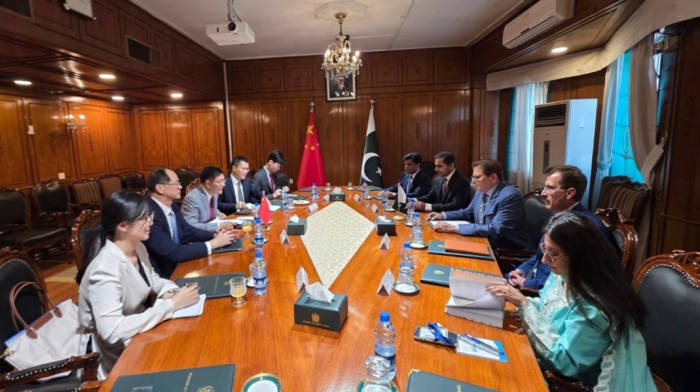
Deputy Foreign Minister for Legal Affairs Kazem Gharibabadi said on Friday that he had met the envoys of China and Russia in Tehran following the recent indirect talks in Switzerland 17 February.
“In a joint meeting with the ambassadors of the Russian Federation and the People’s Republic of China, we discussed the latest developments related to the nuclear talks in Geneva and some bilateral issues,” he wrote on X.
“The three countries will continue their close consultations and coordination on important issues within the framework of strategic relations,” added the Iranian diplomat, who is also a member of the negotiating delegation.
On Wednesday (18 February), the ambassadors of Iran, Russia and China to international organisations in Vienna met the IAEA director general Raphael Grossi, to discuss recent developments related to Iran’s nuclear programme.
The meeting concluded with the submission of a joint letter stressing trilateral coordination and continued engagement, according to the state IRNA news agency. No further details were released.
China and Russia, both permanent members of the UN Security Council with veto power, have backed Iran’s right to nuclear enrichment for civilian purposes.
Tehran urged the Security Council and the secretary-general to act “without delay”, warning the world body not to allow threats of force or acts of aggression to become normalised instruments of foreign policy.








What is your opinion on this topic?
Leave the first comment