Israeli Prime Minister Benjamin Netanyahu hinted on Wednesday at his opposition to any role for Turkish security forces in the Gaza Strip as part of a mission to monitor a U.S.-backed ceasefire with the Palestinian militant group Hamas.
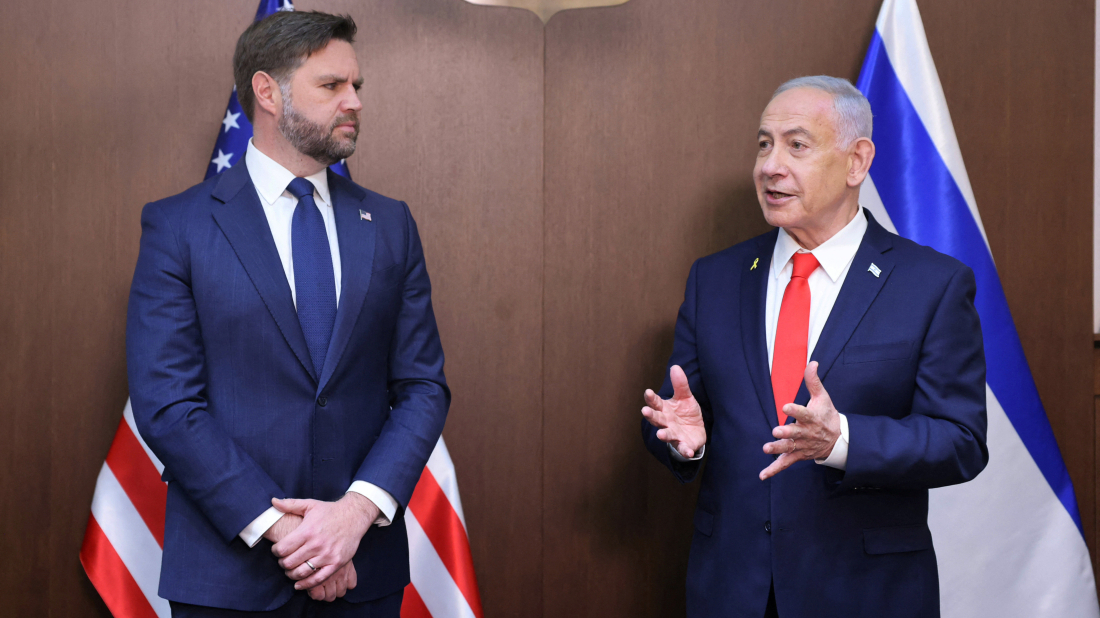
Speaking in Jerusalem alongside visiting U.S. Vice President JD Vance, Netanyahu said they had discussed the "day-after" for Gaza, including who could provide security in the territory shattered by two years of war.
Vance, who said on Tuesday U.S. President Donald Trump's ceasefire plan was going better than expected, reiterated his optimism. "I never said it was easy. But what I am is optimistic that the ceasefire is going to hold and that we can actually build a better future in the entire Middle East," he said.
With a fragile ceasefire in place for 12 days, focus has switched to the second phase of Trump's Gaza plan.
This requires Hamas to disarm and foresees the establishment of an internationally-supervised Palestinian committee to run Gaza with an international force supporting vetted Palestinian police.
Vance is one of several senior U.S. officials to visit Israel since Trump addressed the Israeli parliament last week and declared the Gaza war over. In another high-profile visit, U.S. Secretary of State Marco Rubio will arrive on Thursday and meet Netanyahu on Friday, the Israeli government spokesperson said.
A senior U.S. official said the visits by Vance and Rubio, as well as special envoy Steve Witkoff and Trump's son-in-law Jared Kushner this week, were aimed at maintaining momentum in the ceasefire.
NETANYAHU HAS 'STRONG OPINIONS' ON TURKISH ROLE IN GAZA
Responding to a question about the idea of Turkish security forces in Gaza, Netanyahu said: "I have very strong opinions about that. Want to guess what they are?"
Turkey's Foreign Ministry did not immediately respond to a request for comment, while the Defence Ministry declined to comment on the issue.
Vance said on Tuesday there would be a "constructive role" for Turkey to play but that Washington wouldn't force anything on Israel when it came to foreign troops "on their soil".
Once warm relations between NATO member Turkey and Israel hit new lows during the Gaza war, with Turkish President Tayyip Erdogan sharply criticising Israel's attacks on the enclave and elsewhere in the region, and Syria - which borders both states -emerging as an arena of intensifying rivalry.
Turkey, which helped persuade Hamas to accept Trump's plan, has said it would take part in the international task force to monitor the ceasefire implementation, and that its armed forces could serve in a military or civilian capacity as needed.
Hamas has resisted pressure to disarm, saying that it is ready to hand its weapons to a future Palestinian state.
Vance said: "We have a very, very tough task ahead of us, which is to disarm Hamas, but rebuild Gaza to make life better for the people of Gaza, but also to ensure that Hamas is no longer a threat to our friends in Israel."
BODIES BURIED IN GAZA
The ceasefire was followed by the release of remaining living hostages seized in Hamas' October 7, 2023 attacks on Israel, and the freeing of some 2,000 Palestinian prisoners by Israel.
But it remains fragile, with flashes of violence and recriminations over the pace of returning hostage bodies, bringing in aid and opening borders.
Hamas has reasserted control in Gaza since the ceasefire by deploying armed men on the streets and cracking down on groups that have challenged its grip.
Health authorities in Gaza said a Palestinian was killed by Israeli fire in Gaza City. The Israeli military was looking into the report, a spokesperson said.
Gazan authorities buried the bodies of 54 unidentified people handed over by Israel, the Gaza government media office said. Medics said 30 more bodies arrived at Nasser Hospital in Khan Younis after being released by Israel.
Israeli authorities have said the 54 bodies belong to militants who invaded Israel in the October 7 attacks or were killed in battle with Israeli forces in Gaza during the war.
Hamas has released the bodies of 15 out of 28 deceased hostages seized in 2023. Vance on Tuesday said some of the remaining bodies were buried deep under rubble, saying it would take "a little bit of time" to recover them and urged patience.
Israeli forces have killed at least 88 Palestinians, among them civilians, since the ceasefire began, according to the Gaza Health Ministry, and two Israeli soldiers were killed by Palestinian militants in southern Gaza over the weekend.
Hamas' attack on Israel that triggered the war killed around 1,200 people, according to Israeli tallies, with 251 dragged into Gaza as hostages. Israeli attacks have killed more than 68,000 Palestinians in Gaza since the war began, according to the Gaza Health Ministry.














What is your opinion on this topic?
Leave the first comment