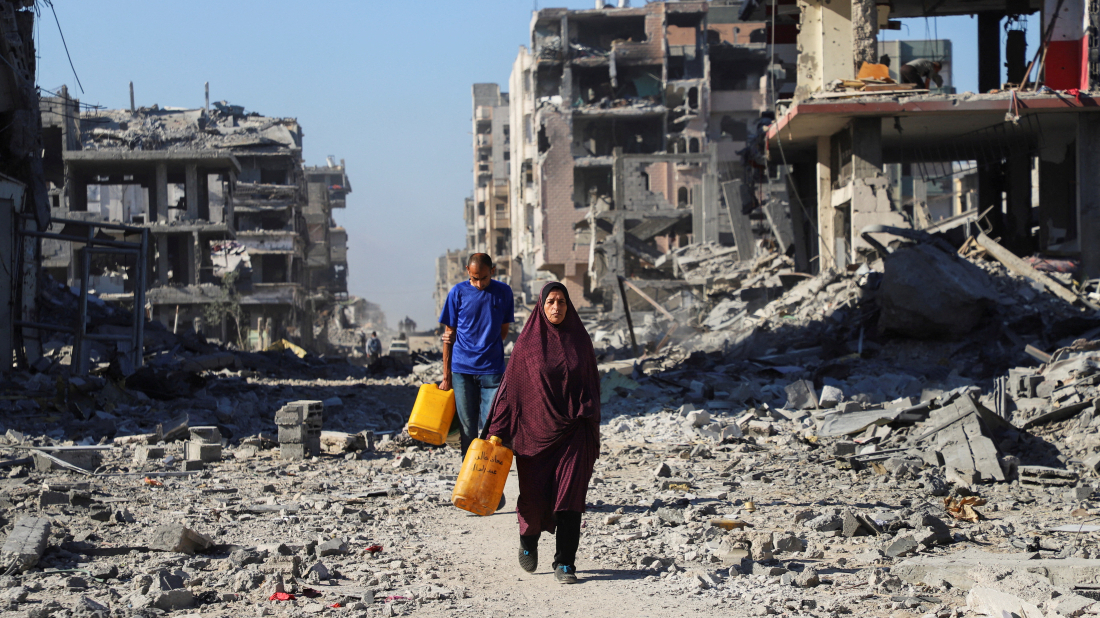
The United Nations has called for a dramatic boost in humanitarian aid for Gaza saying that the hundreds of relief trucks entering the strip were nowhere near enough.
Tom Fletcher, the United Nations Under-Secretary-General for Humanitarian Affairs and its top emergency relief coordinator, told Reuters in an interview that thousands of humanitarian vehicles must enter weekly to avert further catastrophe
"We have 190,000 metric tons of provisions on the borders waiting to go in and we're determined to deliver. That's essential life-saving food and nutrition," Fletcher said.
Fletcher also called for over 50 international NGOs, including Oxfam and the Norwegian Refugee Council, to be allowed to bring in aid, saying the issue has been raised with Israel, the United States and other regional partners.
"We cannot deliver the scale necessary without their presence and their engagement. So, we want to see them back in. We are advocating on their behalf," he said.
Fletcher said the looting of aid trucks - a frequent scourge while fighting continued - had dropped sharply in recent days as deliveries increased.
“If you’re only getting in 60 trucks a day, desperate, hungry people will attack those trucks. The way to stop the looting is to deliver aid at massive scale and get the private sector and commercial markets operating again.”
Some residents in the strip who spoke to Reuters bemoaned the situation as near hopeless, saying they had nothing to their names.
Umm al-abed al-Fioumi said "There is no work, no food, no drinks, no housing, and now winter is coming. By God Almighty, I'm telling you, I swear we don't have blankets. I have nothing, nothing at all. I left and my house was destroyed, and I'm still in the same situation, and now we're suffering".
The Rafah border crossing between Egypt and the Gaza Strip is expected to reopen to allow people to cross on Thursday with an EU mission set to deploy there, two sources told Reuters.
The sources did not specify what restrictions might be applied to those seeking to cross. The Israeli military and the office of the Israeli prime minister did not immediately respond to a request for comment.
Opening of the Rafah crossing is expected to boost supply of aid and humanitarian workers to the region.
Much needed aid trucks entered into Gaza earlier on Wednesday as a dispute over the return of bodies of deceased hostages stalled.
Israel had accused Hamas of returning bodied of dead hostages too slowly and threatened to keep the Rafah border shut as a result.
However, four more bodies were received by the IDF late on Tuesday night as Israeli officials confirmed that plans were underway to open the Rafah crossing to Gazans and allow 600 aid trucks in.
Dispute over the bodies of dead hostages continue to brew in the background as Israeli hostages say that one of the bodies returned was not that of a hostage.
Residents of Gaza expressed fear that this tussle over hostage recovery could derail the ceasefire deal.
Hamas had responded saying that some hostage bodies were still under the rubble in Gaza and that it needed heavy duty equipment to dig them up.
The International Committee of the Red Cross also said on Tuesday, it would make available equipment and personnel to aid the deceased hostage recovery process.
Subject to Israel's security approval, Gazans who had left the territory during the war will be allowed back in for the first time and others will be allowed to cross out through the Rafah crossing, Kan reported.
Some 600 trucks carrying mainly food and medical supplies, as well as equipment needed for repairing damaged infrastructure, will be allowed in, Kan said.
There was no immediate comment from Israeli or Palestinian officials.
Israel had threatened to keep the Rafah border crossing shut on Tuesday (14 October), citing Hamas' failure to meet its obligations under the Gaza ceasefire agreement and hand over bodies of deceased hostages that it was holding.
Hours later Hamas handed four coffins over to Israel through the International Committee of the Red Cross.
Three have so far been identified as Israeli hostages but there were doubts about the fourth body handed over, Israeli media reported.










What is your opinion on this topic?
Leave the first comment