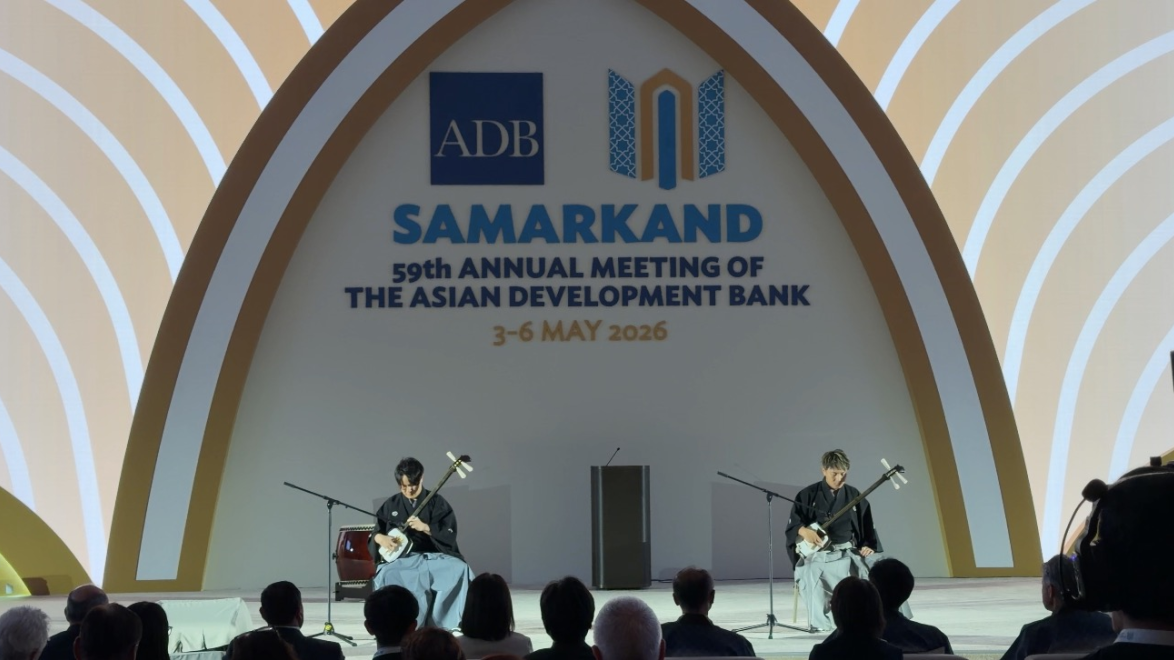
The 59th Annual Meeting of the Asian Development Bank concluded in Samarkand with new renewable energy agreements, discussions on economic resilience and the release of a major policy report on global value chains.
$116m wind power agreement signed
One of the key developments on the final day was the signing of a $116 million financing agreement between the Asian Development Bank (ADB) and ACWA Power for the construction of the 300-megawatt Bash-2 wind power project in Uzbekistan’s Bukhara region.
The financing package includes support from the ADB, commercial lenders and the Leading Asia’s Private Infrastructure Fund 2 (LEAP 2).
The project will comprise 39 wind turbines, transmission infrastructure and a new substation connected to Uzbekistan’s national power grid. According to the ADB, the initiative is expected to strengthen the country’s renewable energy capacity, improve energy security and support its transition towards low-carbon energy generation.
ADB representatives also noted that the Bank’s renewable energy portfolio in Uzbekistan now exceeds 2 gigawatts of supported capacity, including wind, solar and battery energy storage projects.
The project is expected to create at least 800 jobs during construction, alongside additional permanent roles during operation.
Focus on supply chains and economic resilience
The Asian Development Bank also presented its Asian Development Policy Report 2026, titled “Global Value Chains and Inclusive Development.”
The report highlighted that deeper regional integration has helped economies across Asia and the Pacific generate growth, create jobs and reduce poverty over recent decades.
At the same time, the ADB warned that geopolitical tensions, supply chain disruptions and rapid technological shifts continue to pose risks for developing economies, particularly those less integrated into global production networks.
ADB Chief Economist Albert Park noted that improving infrastructure, logistics and the business environment would be essential to increase competitiveness and help developing economies benefit from global trade and emerging technologies.
The report also stressed the importance of resilient supply chains, environmental sustainability and greater inclusion for small and medium-sized enterprises.
Next ADB meeting to be held in Japan
The annual meeting concluded with an official handover ceremony announcing that the 60th Annual Meeting of the Asian Development Bank will be hosted in Aichi-Nagoya, Japan, from 2 to 5 March 2027.

















What is your opinion on this topic?
Leave the first comment