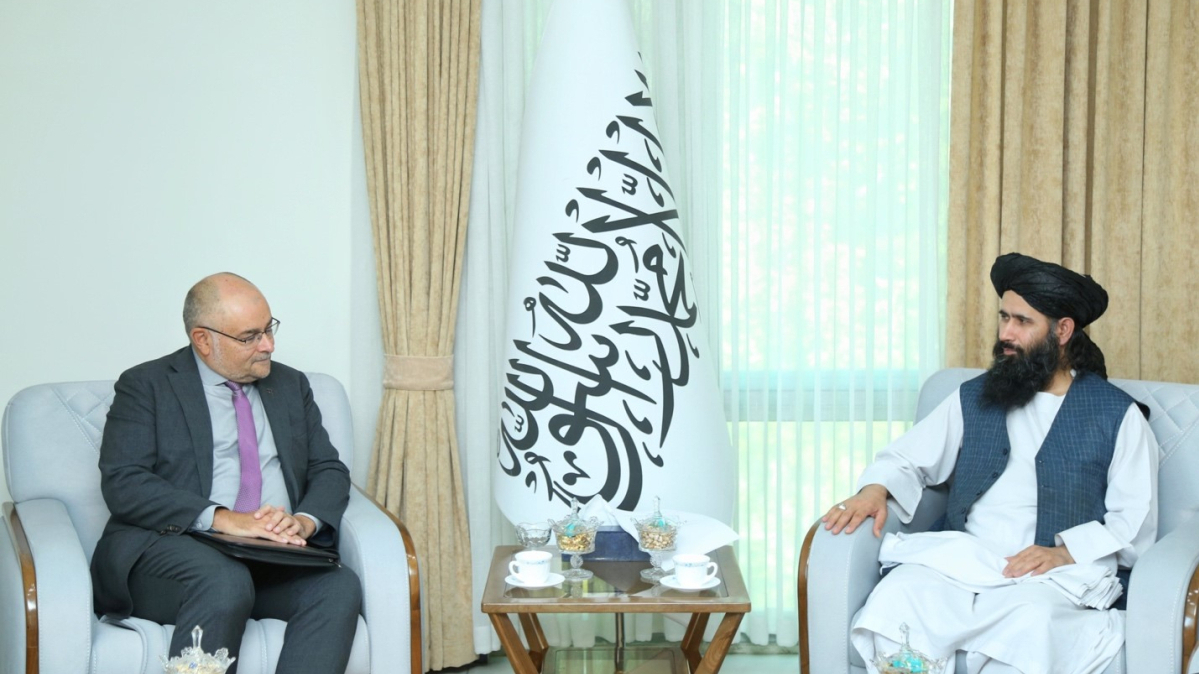
The European Union says its envoy Gilles Bertrand raised concerns over women’s rights, regional security and cross-border tensions during a visit to Kabul, while Afghan officials urged more development aid, trade access and continued dialogue.
Bertrand visited Kabul from 17 to 21 April and held talks with senior Afghan officials, diplomats, United Nations representatives, civil society activists and non-governmental organisations, according to the European External Action Service.
The visit appears to show that contact between the two sides is continuing, even as major disagreements remain over rights and international engagement.
According to Afghanistan’s Ministry of Foreign Affairs, Deputy Foreign Minister for Finance and Administration Dr Mohammad Naeem told Bertrand that EU aid should move towards long-term development so that it can create jobs and help address “people’s basic problems”.
The Afghan side also said dialogue should remain at the centre of relations. Summarising that position, the ministry said Naeem stressed that “dialogue and diplomacy” were the most effective ways to solve problems and that both sides agreed to maintain regular contact for better co-ordination.
Rights remain a key issue
Bertrand’s office, however, said human rights featured prominently in all his exchanges. The EU statement said restrictions on women and girls, including access to education, work and public life, remain a major obstacle to normalising relations.
It added that Afghanistan remains the only country where girls are banned from studying beyond sixth grade.
The EU also said Bertrand discussed tensions between Afghanistan and Pakistan, the threat posed by armed groups, the return of Afghan nationals from Iran and Pakistan, and the need for a resilient private sector.
In a closing line that summed up the bloc’s position, the statement said, “The European Union’s engagement in Afghanistan remains principled, pragmatic, and focused on the needs of the Afghan people.”
The wider backdrop remains severe. According to the United Nations Office for the Coordination of Humanitarian Affairs, 21.9 million people in Afghanistan are projected to need humanitarian assistance in 2026.











What is your opinion on this topic?
Leave the first comment