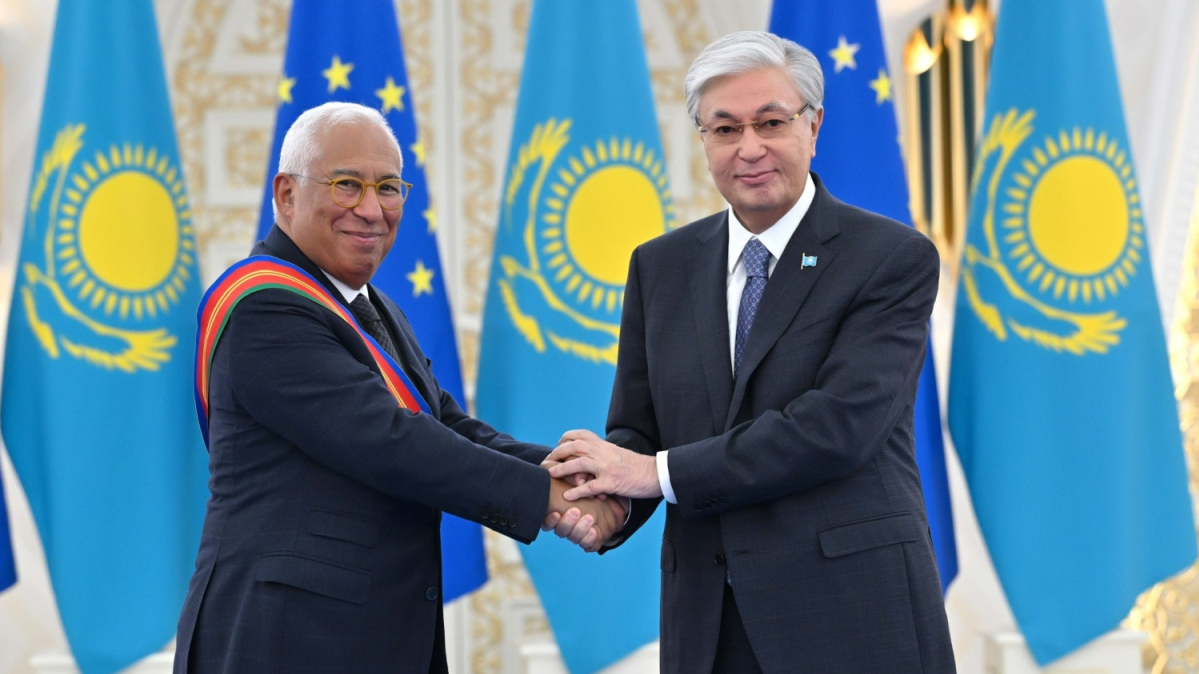
President Kassym-Jomart Tokayev has held high-level talks with the European Council President António Costa In Astana.
Costa’s first visit to Kazakhstan coincides with the 10th anniversary of the Enhanced Partnership Agreement between Kazakhstan and the European Union.
During the discussions, both sides agreed to elevate their interregional cooperation to a strategic level, emphasising their shared interest in strengthening economic ties and fostering a favourable investment climate.
President Tokayev described the meetings as “open and constructive,” highlighting the importance of developing transport corridors, particularly the Trans-Caspian route, alongside support for a €12 billion European investment package for Central Asia under the Global Gateway initiative.
Economic cooperation and investment facilitation formed a central focus of the talks.
Kazakhstan reaffirmed its commitment to ensuring a stable and transparent investment environment, which, combined with EU support, creates conditions for expanding the presence of European companies in the country.
A key area of collaboration was digital economy development: the two sides agreed to
- Expand access to satellite internet in rural regions,
- Launch the first joint Central Asia–EU innovation campus at Astana Hub
- Increase participation in the Horizon Europe programme
- Strengthen cybersecurity and digital connectivity.
According to President Tokayev, this digital partnership will enable Kazakhstan to integrate more deeply into global technology and data chains.
President Costa praised the reforms being implemented in Kazakhstan and underlined the country’s strategic importance for regional stability, including its active role in peace processes between Armenia and Azerbaijan.
Economic and trade indicators underscore the strength of this partnership: last year, trade between the EU and Kazakhstan reached approximately $50 billion, while total
EU investment in the country since 2005 is currently around the $200 billion mark.
Kazakhstan accounts for 80% of the EU’s trade with Central Asia, hosting over 4000 European companies across sectors such as energy, transport, digital technologies, and industry.
The discussions also placed significant emphasis on transport and regional affairs.
President Costa highlighted that stability in the Caucasus creates opportunities for expanding the Trans-Caspian corridor, linking Europe with Asia via the Black Sea and the Caucasus, while President Tokayev described Kazakhstan as a future Eurasian transport hub.
In addition to economic and infrastructure matters, the two leaders addressed preparations for agreements on visa facilitation and re-admission, which are expected to further strengthen people-to-people and business connections between the regions.
Overall, the meeting signalled both Kazakhstan’s and the EU’s readiness to deepen a partnership that combines economic initiatives, digital innovation, and transport integration, while simultaneously promoting stability and resilience across Central Asia and adjacent geostrategically significant areas.










What is your opinion on this topic?
Leave the first comment