The AnewZ Opinion section provides a platform for independent voices to share expert perspectives on global and regional issues. The views expressed are solely those of the authors and do not represent the official position of AnewZ
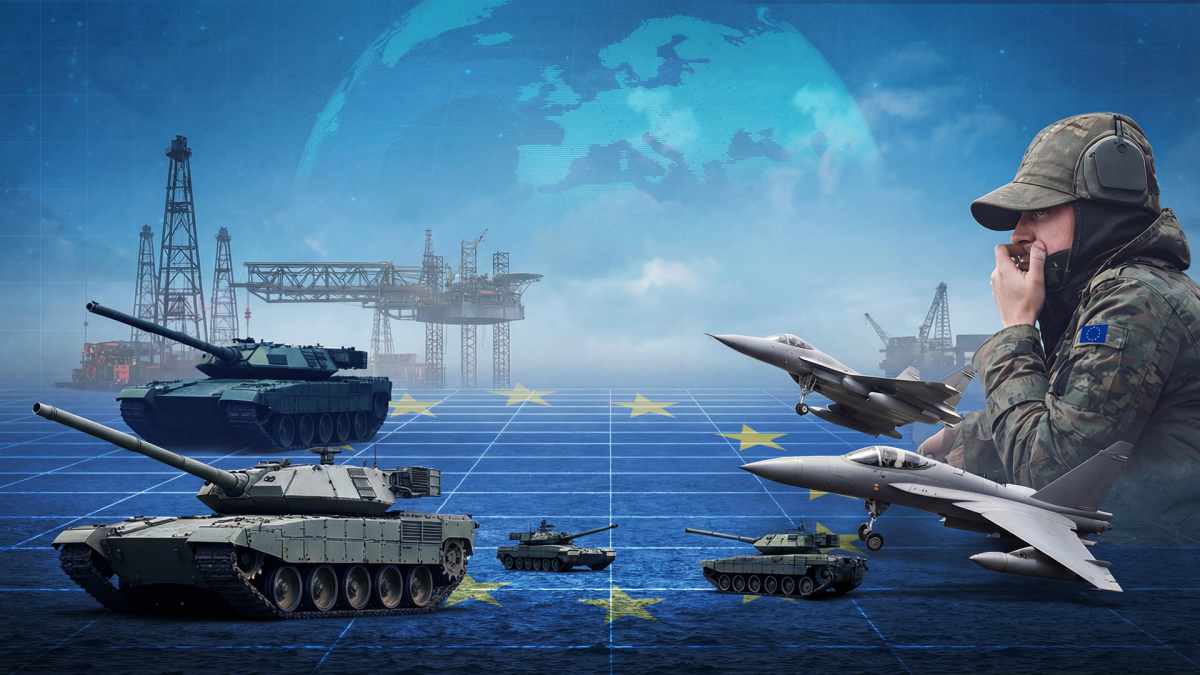
The strategic mood in Europe has changed dramatically. After decades of assuming that peace was the continent’s natural state, and that the United States would always supply the bulk of its protection, NATO’s latest spending figures have hit Europe like a splash of cold water. The alliance that for years Europeans prematurely declared obsolete has not only regained centrality but demands more from its members.
Today the United States still funds around two-thirds of NATO’s total military expenditure, a level of dependence that has become politically and strategically untenable. Washington’s shift toward a harder, interest-driven foreign policy, the repeated signals that allies must shoulder more of their own defence, and the U.S. strategic pivot toward the Indo-Pacific make one thing undeniable: Europe can no longer outsource its survival.
The timing is as harsh as it is clarifying. NATO states have agreed on new benchmarks that go far beyond what Europeans were accustomed to. The traditional 2 percent of GDP target—controversial and resisted only a few years ago—is now becoming the floor rather than the ceiling. Discussions among allies increasingly revolve around a 5 percent benchmark by 2035.
As of last year, twenty-three allies have already surpassed the 2 percent threshold, a dramatic rise from only six in 2021. But even this acceleration, impressive on paper, still leaves many of Europe’s militaries with deep gaps and a dangerous reliance on non-European suppliers.
The war in Ukraine served as an unfiltered X-ray of Europe’s vulnerabilities. For months, European armies struggled to provide basic ammunition stocks at scale, while U.S. intelligence, surveillance, logistics, satellite support and weapons systems remained irreplaceable. The early hesitation among several European governments to acknowledge the scale of the threat—and the social reluctance in some Western and Southern European societies to treat defence as a priority—reinforced the perception that Europe had grown complacent. Only when Washington began recalibrating its posture, reducing certain forms of assistance and reminding Europeans that American protection is not a permanent political guarantee, did many capitals realise that the strategic contract underpinning the transatlantic relationship was shifting.
Europe today confronts the consequences of decades of underinvestment in hard power. This is the context in which Europe is experiencing its belated awakening. Governments that once treated defence spending as a political taboo now speak openly of rearmament and strategic re-industrialisation. Societies accustomed to the belief that war belongs to another era are slowly accepting the idea that sovereignty demands readiness. Brussels, long cautious in defence matters, now promotes strategic autonomy as prerequisites for the continent’s survival.
The Lost Path: Europe’s Abandoned Defence Project
To understand the significance of this moment, one must look back at the project Europe once dared to imagine. In the early 1950s, the European Defence Community (EDC) was conceived as the political and military backbone of a united Europe. Coming immediately after the European Coal and Steel Community, it was intended not as a secondary policy but as a central pillar of integration. A supranational European army, shared command structures, common doctrine and joint procurement were not dreams: they were concrete institutional designs, signed in 1952 by France, West Germany, Italy, Belgium, the Netherlands and Luxembourg.
Then came the tragedy of 1954. Caught in a web of internal political anxieties, the French National Assembly refused to ratify the treaty. With one vote, Europe’s most ambitious strategic project collapsed. The EDC’s failure forced the newly formed Western European Union to assume a modest and ultimately insufficient defence role, while NATO became the default provider of Europe’s security. The Continent’s leaders, still traumatised by war and increasingly confident in America’s protection, never returned to the EDC vision. What might have been the foundation of a European strategic identity was abandoned before it even began.
Even after the end of the Cold War, when the Balkan wars revealed Europe’s inability to act autonomously, the political appetite for a true common defence remained weak. The EU created the Common Security and Defence Policy, built institutions such as the European External Action Service, and launched mechanisms like PESCO, but the scale of these efforts never matched the ambition of the original EDC.
Now history has returned with a vengeance. The Russian invasion of Ukraine, instability across the broader Middle East, hybrid threats, cyberwarfare and the technological acceleration of conflict compress decades of strategic complacency into an unavoidable lesson: Europe must react.
In this context, enlargement towards the Balkans is not only a political commitment but a strategic necessity, extending Europe’s security perimeter and stabilising a region historically prone to turbulence. Meanwhile, Europe’s eastern horizons stretch into the Black Sea, the Caucasus and Central Asia. Energy corridors, transport routes and new forms of partnership make it inevitable that Europe’s security architecture must adapt to this fuller geographical reality. The South Caucasus, emerging from decades of volatility, matters not only as a neighbourhood but as Europe’s bridge to Asia and a pivot of new geopolitical alignments.
Türkiye, Azerbaijan and the New Realities of Alliance and Autonomy
The redefinition of Europe’s defence identity is also informed by the behaviour of key regional actors. Türkiye, a central NATO member since 1952, embodies a model of strategic autonomy within an alliance framework. Ankara’s foreign policy often diverges from the preferences of Washington or Brussels, yet its military relevance remains. It has lifted its defence spending above 2 percent of GDP, plans to push it to 5 percent over the decade, and has built one of the most dynamic defence industries in Eurasia, producing more than 70 percent of its own equipment and aiming for 85 percent by 2030. Türkiye demonstrates that alliance membership does not require strategic subordination. In a multipolar world, autonomy inside alliances is emerging as the norm rather than the exception.
Azerbaijan offers another dimension of this evolving landscape. Although not a NATO member, it has been a committed partner for decades through the Partnership for Peace. Its “multi-vector” foreign policy—balancing relations with Western institutions, regional powers and neighbouring states—has given Baku a distinctly flexible diplomatic identity. The recent stabilisation of the South Caucasus gives Europe a valuable opportunity: a secure eastern frontier tied to energy connectivity, transport routes and complementary security frameworks. Azerbaijan’s cooperation with NATO, its interoperability programmes, and its willingness to deepen joint exercises signal the rise of a new kind of partner: neither inside nor outside the Western system but positioned at its strategic edges.
Türkiye and Azerbaijan, each in their own register, point toward a broader geopolitical truth: the age of rigid blocs is giving way to fluid alignments. Europe must adapt. The continent cannot afford to be only a consumer of security; it must become a producer. And in doing so, it can benefit from models of strategic autonomy that complement rather than undermine alliances.













What is your opinion on this topic?
Leave the first comment