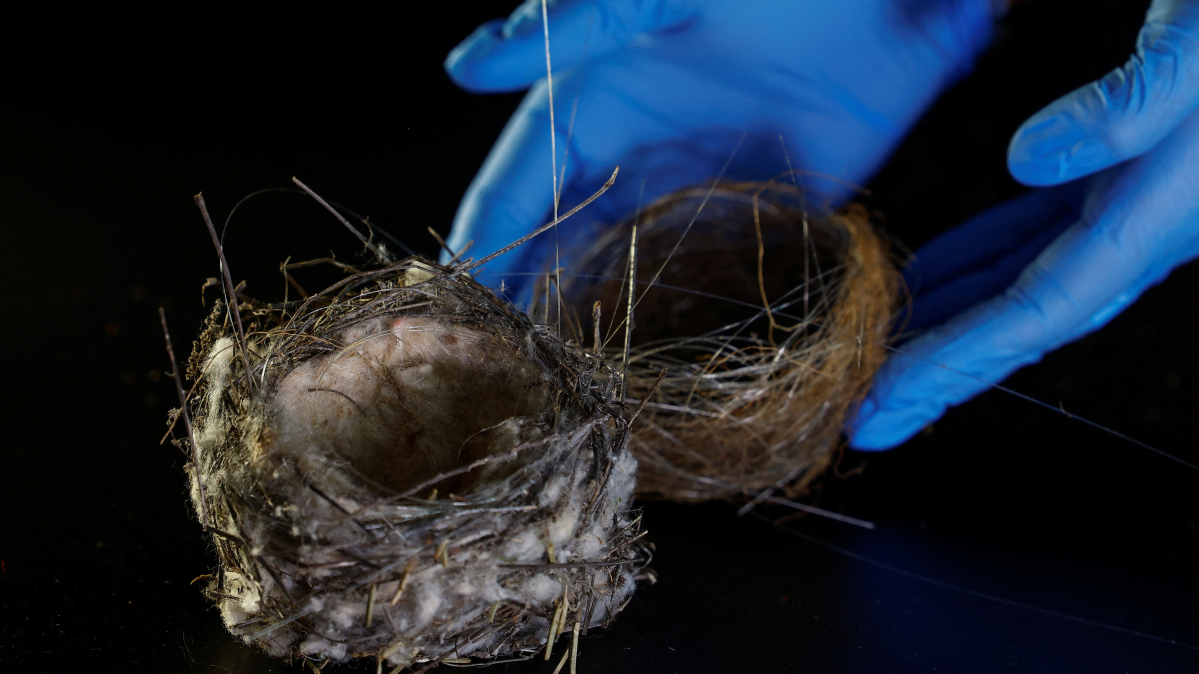
A bird’s nest woven from dry grass and fibre-optic cable near Ukraine’s front line is offering researchers an unusual glimpse into how more than four years of war are reshaping the natural environment.
Drone warfare traces on landscape
The nest, found in a combat zone, was built using discarded fibre-optic lines used by both Ukrainian and Russian forces to guide attack drones, a technology that has become central to the conflict.
Stretching across Ukraine’s 1,200 km front line, ultra-thin fibre-optic cables now litter trees, rooftops and fields, particularly in heavily contested regions such as Donetsk Oblast, Kharkiv Oblast and Zaporizhzhia Oblast.
The cables, which can extend for up to 20 km, are used to guide drones, making them resistant to electronic jamming and giving both sides an advantage on the battlefield.
What began in 2022 as a war dominated by tanks, armoured vehicles and artillery has increasingly evolved into a conflict shaped by drones, leaving behind a new layer of synthetic debris.
Yana Hrynko, a senior researcher at Kyiv’s War Museum, said the nests reflected how the character of war is evolving.
“Objects such as bird nests with fragments of optic fibre demonstrate the change in the nature of war,” Hrynko said.
Impact on wildlife
Hrynko said it remains unclear which bird species built the nests or how they gathered the long strands of cable.
Several Ukrainian servicemen said they had found similar nests and posted photos and videos online from frontline areas. One of the nests will remain in Kyiv as part of the museum’s war archive, while the second will be sent to the Netherlands for further study before being returned.
Dutch biologist Auke-Florian Hiemstra, who specialises in artificial nest materials, said Ukraine’s rich birdlife meant several species could be responsible. Researchers plan to analyse DNA traces left in the nest to identify its builders.
“I have never seen nests like this before, and I have seen many, many bird nests,” Hiemstra said.
He said the fibre-optic material could have mixed consequences, potentially helping birds build stronger nests while also increasing the risk of entanglement.
“And by documenting this nest, we’re also documenting the impact of war on nature in Ukraine,” he said.
Read more:













What is your opinion on this topic?
Leave the first comment