China's domestic automakers have a message for the boardrooms of premium German brands such as Porsche, Mercedes-Benz, and BMW: We are coming for your customers, and we are armed with superior technology at a fraction of the cost.
After years of relentlessly churning out the world's most technologically advanced yet fiercely affordable electric vehicles (EVs), Chinese manufacturing titans such as Geely and Nio are executing a strategic pivot. They are now unleashing a sweeping array of premium models packed with futuristic features, but priced significantly lower than the flagship offerings from their esteemed European rivals.
This upmarket offensive represents a major paradigm shift for a domestic industry that has spent the last three years mired in a brutal, margin-crushing electric vehicle price war. The emergence of these high-end domestic models poses an existential threat to legacy premium automakers, fundamentally challenging their dominance both in China, the world's largest automotive market, and increasingly, in their home territories abroad.
"The price war has turned into a value-for-money war," explained Bo Yu, Greater China Country Manager at automotive research firm JATO Dynamics. Consumers are no longer just looking for the cheapest EV; they are demanding luxury, space, and bleeding-edge software without the traditional luxury markup.
'Flood' of 9-Series SUVs at Beijing
The warning comes as this year's Beijing Auto Show officially kicks off on Friday. According to Cui Dongshu, secretary-general of the China Passenger Car Association (CPCA), the industry is set to debut 181 production models and 71 concept cars. Notably, Cui highlighted that the show floor will feature a "flood" of massive, premium "9-series" SUVs, explicitly designed to cater to the growing demand for large, luxury family vehicles.
This intense fight for the premium market spells trouble for German automakers, who have historically relied on the Chinese market to generate a disproportionate share of their global profits. The data paints a stark picture of decline. According to S&P Global Mobility, German automakers' cumulative sales in China have plummeted by nearly 25%, dropping to 3.85 million vehicles from a peak of 5.1 million in 2019. The bleeding has continued into the current year; Mercedes-Benz, BMW, and Volkswagen Group’s premium units, Porsche and Audi, all posted worrying sales declines in China during the first quarter of 2026.
This upmarket push is not confined to domestic borders; it is designed to intensify competition overseas. Following the brutal domestic price war that left the Chinese market saturated, local automakers are increasingly looking to export their excess capacity. Crucially, China's EV makers have demonstrated an ability to absorb recent European Union tariffs imposed on Chinese-made electric cars, still managing to keep their showroom prices comfortably below those of similar models from European rivals. Furthermore, Chinese-manufactured plug-in hybrids and traditional combustion-engine cars currently remain exempt from these specific EU duties, providing another lucrative avenue for export growth.
"I expect more Chinese companies to double down on premiumisation," noted Stephen Dyer, Head of Consultancy AlixPartners' automotive practice in Asia.
"To differentiate themselves at home, but also to prepare for going global," he added.
This global strategy is born out of domestic necessity. Car sales in China fell by approximately 18% year-on-year in the first quarter and are widely expected to remain flat or contract further for the foreseeable future, as the initial boom in New Energy Vehicles (NEVs) begins to ease following the fading of generous government purchasing subsidies.
'New king of the road'
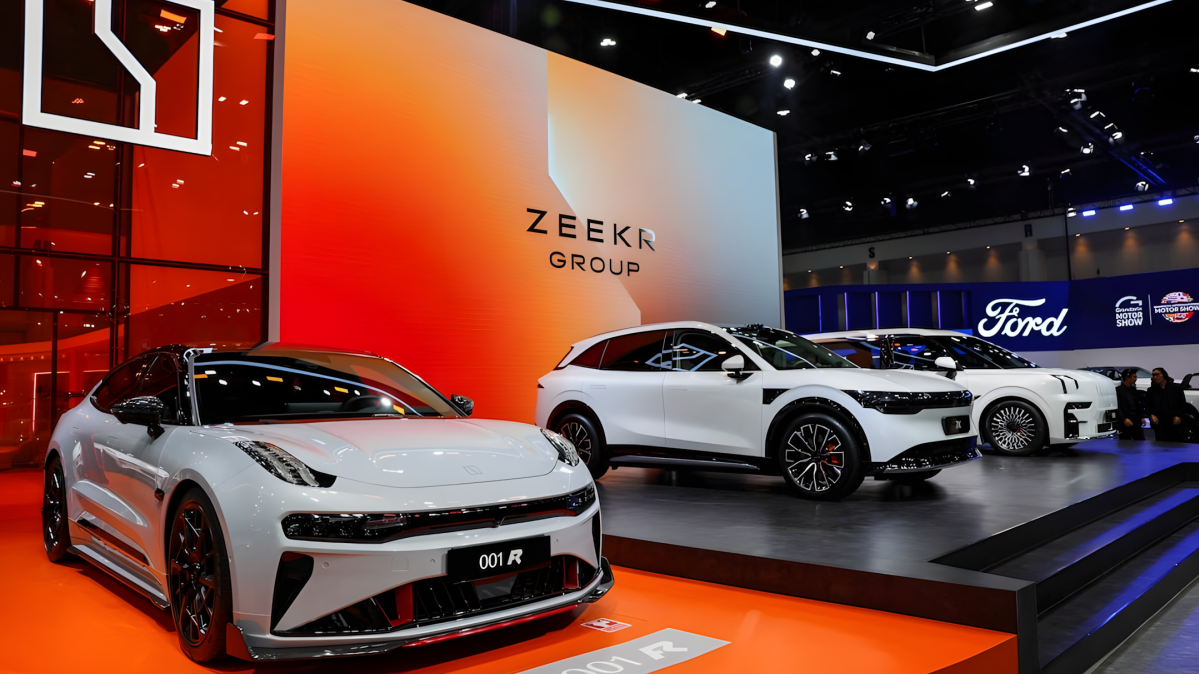
The technological gap that Chinese automakers are leveraging was demonstrated last week. Geely's dedicated premium brand, Zeekr, unveiled the 8X, a full-size, long-range plug-in hybrid SUV heavily laden with advanced safety, infotainment, and autonomous driving features.
The 8X boasts capabilities that sound like science fiction to traditional buyers: the vehicle's chassis can actively tilt upward microseconds before a side collision to protect passengers from the brunt of the impact. Furthermore, if the SUV is parked in a tight spot, the driver can simply wave at external sensors, and the vehicle will autonomously reverse out of the space to allow passengers easy, unhindered access.
During the launch event in Ningbo, roughly 200 kilometres south of Shanghai, Geely showcased a video of the 8X vanquishing both the Porsche Cayenne and the BMW X5 M in track speed trials. The pricie of the Zeekr 8X starts at just under $53,000, whilst the German premium models start at around $135,000 and $205,000, respectively.
"This is the new king of the road," Geely Automobile CEO Gan Jiayue boldly declared to the audience.
Tu Le, Managing Director of Consultancy Sino Auto Insights, pointed out that by launching large, highly profitable premium SUVs, Chinese automakers are also firing "a shot across the bow" of Detroit's "Big Three" automakers, General Motors, Ford Motor, and Stellantis. These American giants have long relied on oversized, high-margin SUVs as their primary cash cows.
While US customers currently face severe tariffs and political barriers preventing them from buying Chinese cars, many industry watchers expect those barriers to eventually erode. "Detroit's cash cow is no longer safe," Le warned.
"Unthinkable five years ago"
The rapid rise of Chinese premium cars aligns perfectly with shifting consumer demographics and evolving tastes within the domestic market. According to the CPCA's Cui, the average age of a Chinese car buyer has steadily increased from 30 to more than 40. These older, more established consumers have families and demand larger, premium models, leading to a precipitous fall in demand for entry-level, budget cars.
Crucially, Chinese consumers are increasingly drawn to the industry-leading software and integrated technology offered by domestic EV makers. Younger buyers, in particular, show little to no interest in the historical "heritage" and mechanical legacy that constitutes the core marketing strength of German premium brands in Europe.
"German brands are stuck in the past," stated JATO Dynamics' Bo. "But Chinese consumers want to embrace the future."
Felipe Munoz, an independent auto consultant, observed that while it was entirely "unthinkable five years ago" that wealthy Chinese consumers would actively prefer local premium models over established German luxury icons, the reality has fundamentally shifted.
"Foreign luxury and premium brands are now going to find it harder to survive in China," he stated.
However, Munoz cautioned that exporting this success to the continent remains the ultimate challenge. "The question is whether this will be the case outside China," he mused.
"In Europe, German premium brands are a deeply ingrained reference of quality, status, and reliability. That's going to be exceptionally hard to change," Munoz added.
But with a pricing advantage and undeniable technological momentum, the Chinese automakers at the Beijing Auto Show are betting heavily that they can.
















What is your opinion on this topic?
Leave the first comment