In a discovery that pushes the limits of our cosmic imagination, astronomers have revealed a colossal bridge of gas and stars stretching between galaxies, accompanied by the longest tail ever observed, an intergalactic structure on a scale that rewrites what we know about the Universe.
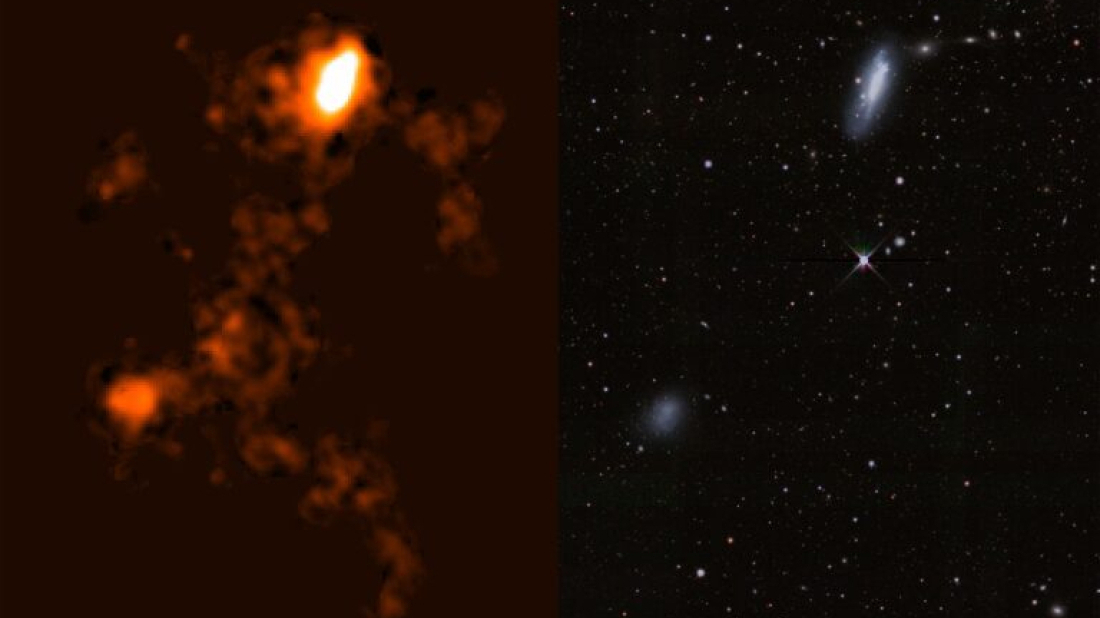
An international team led by Professor Lister Staveley-Smith at the International Centre for Radio Astronomy Research has uncovered an immense structure connecting the galaxies NGC 4532 and DDO 137. The newly mapped bridge spans about 185,000 light-years, while a vast tail of hydrogen gas extends for 1.6 million light-years, the longest of its kind ever observed.
The study, published in Monthly Notices of the Royal Astronomical Society, provides fresh insight into how galaxies interact and shed their gas. Modelling suggests that tidal forces between the galaxies, together with their proximity to the massive Virgo cluster, played a decisive role in shaping the system. As the galaxies orbit each other and fall toward the hot gas cloud surrounding the cluster, they experience intense ram pressure that strips and heats their gas over billions of years.
"The process is akin to atmospheric burn-up when a satellite re-enters the Earth’s upper atmosphere, but here it has unfolded over about a billion years," Professor Staveley-Smith explained.
He noted that the combination of high electron density and the galaxies’ infall speed accounts for why so much gas has been pulled into the bridge and surrounding regions.
The discovery was made using WALLABY, the Widefield Australian Square Kilometre Array Pathfinder (ASKAP) L-band Legacy All-sky Survey, which maps hydrogen across the sky with CSIRO’s ASKAP radio telescope.
Co-author Professor Kenji Bekki said neutral hydrogen was the key to the find. "Neutral hydrogen is the raw fuel for star formation, so mapping where it goes is fundamental to understanding galaxy evolution, especially in crowded environments," he said.
The system has striking similarities with the Milky Way and the Magellanic system, making it a valuable local laboratory for studying galactic interactions.
"These gas bridges show how fuel is moved, heated or removed," Professor Staveley-Smith added.
"By following these processes, we learn when and where stars may form or fail to form, and how the largest structures in the Universe live and change over time," he added.
The research highlights how powerful wide-field radio surveys can uncover hidden features that optical telescopes often miss, offering a deeper view into the forces that shape galaxies across cosmic time.














What is your opinion on this topic?
Leave the first comment