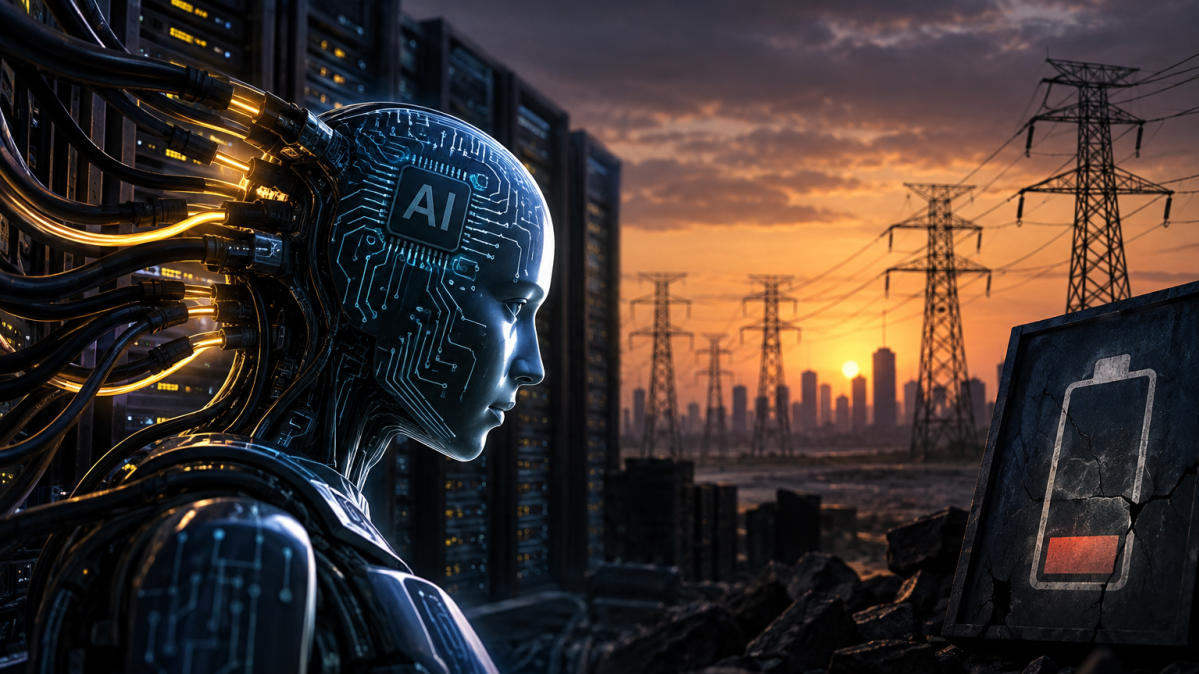
AI may live in the cloud, but the infrastructure powering it is anything but virtual. As data centres consume ever more electricity and water, the race is on to find new ways to keep the machines running.
In the film The Matrix, the machines solved their energy crisis by harvesting bio-electricity from billions of humans.
Real-world AI models require something far less dystopian, yet exponentially harder to scale: steady megawatts, high-volume cooling and physical transmission lines.
And the demand for all three is accelerating.
The International Energy Agency says electricity demand from data centres soared by 17 per cent in 2025, far outpacing global electricity demand growth.
The IEA expects electricity consumption from data centres to double by 2030, while power use from data centres focused on AI is set to triple.
Behind the AI tools we use every day are huge facilities packed with powerful computers -- data centres processing everything from cloud services to the increasingly demanding calculations behind artificial intelligence.
And those computers need power.
Lots of it.
Dr. Tazien Rashid, Assistant Professor at the School of Engineering and Physical Sciences at Heriot-Watt University Dubai, says AI is creating a new class of electricity demand at a pace that traditional infrastructure is struggling to match.
“AI is creating a new class of very large electricity loads at an unprecedented rate. The fundamental issue is that AI is turning data centres into very large, concentrated electricity loads, and demand is growing much faster than power infrastructure can be built.”
A single hyperscale facility can require hundreds of megawatts of electricity, Rashid says, while some planned facilities are approaching gigawatt scale.
AI may live in the cloud – but its electricity bill is very much on the ground.
When the grid can't keep up
The problem is not simply generating enough electricity. It is getting that electricity to where it is needed -- and doing it quickly enough.
Rashid says the challenge stretches across the entire power system.
“The challenge has several dimensions. First is generation capacity: we need substantially more electricity. Second is transmission and grid connection: even if generation exists somewhere on the grid, the local transmission and distribution infrastructure may not have sufficient capacity to deliver hundreds of megawatts to a particular site.
Third is reliability: AI data centres operate continuously and require highly reliable, high-quality power, so intermittent generation alone cannot necessarily satisfy the load without storage, firm generation or other balancing mechanisms.”
There is also a timing problem.
Rystad Energy says U.S. grid interconnection timelines have tripled since 2015, with large power users now facing waits of three to six years. For an industry racing to build the future at hyper-speed, waiting years for a grid connection is a rather inconvenient reality.
Rashid says the mismatch between data-centre development and power infrastructure can make grid connections a critical constraint.
“There is also a timing mismatch. A data centre can potentially be developed much faster than a new transmission line, substation or large power plant. Grid connection and electrical equipment can therefore become the critical path,” she says.
That is helping drive interest in generating electricity at the data centre itself.
Enter the fuel cell.
The power plant comes to you
Fuel cells generate electricity through an electrochemical process rather than conventional combustion.
For data-centre operators, the attraction is straightforward: instead of waiting entirely for the grid, power can be generated on-site.
Rystad Energy projects fuel-cell market revenues will rise from around $2.8 billion in 2025 to roughly $30 billion by 2030, as AI demand drives new investment in data-centre power.
But Rashid cautions against treating fuel cells as a silver bullet.
“Fuel cells are not a complete replacement for the grid,” she says.
There are still questions around fuel availability, hydrogen infrastructure, cost, emissions associated with the fuel and long-term scalability.
And that means the future may not be about replacing the grid — but supplementing it.
“I see fuel cells primarily as part of a diversified power strategy combining grid electricity, on-site generation, renewables and storage to provide reliable and resilient power for AI data centres.”
The idea is increasingly moving from theory to real-world projects.
In New Mexico, Oracle’s planned Project Jupiter AI data-centre campus is replacing its prior gas turbine and diesel generator design with a Bloom Energy fuel-cell microgrid.
Oracle says the updated design is expected to reduce nitrogen oxide emissions by approximately 92 per cent and significantly reduce ongoing water demand.
The company says the fuel-cell system requires an initial water fill and only limited water for maintenance, while the cooling and fuel-cell operations will not use public drinking water.
But electricity is only half the resource equation.
AI has another problem: it's thirsty
Data centres can consume significant amounts of water, primarily for cooling.
And as AI servers become more powerful, they generate more heat that needs to be removed.
Rashid says large facilities using evaporative cooling can consume millions of litres of water per day, although actual consumption varies significantly depending on the cooling technology.
That makes the issue particularly important in hot and water-stressed regions such as the Middle East.
But more computing does not automatically have to mean proportionally more freshwater consumption.
“AI does not necessarily have to mean proportionally higher water consumption,” Rashid says.
Direct liquid cooling, closed-loop systems, dry cooling, recycled water and improved thermal management can all reduce freshwater demand.
The challenge, Rashid says, is to treat power and water as part of the same system.
And that is where fuel cells could play a role.
There's no free lunch - or free hydrogen
Fuel cells may reduce some of the water demands associated with conventional power generation and cooling.
But they do not make the water question disappear.
Hydrogen production, particularly through electrolysis, can itself require water.
Rashid says the answer is to look at the entire system rather than a single technology.
“So, I would not say fuel cells eliminate water consumption. Rather, they can shift and potentially reduce the water footprint, especially when integrated with low-water cooling technologies and sustainably produced hydrogen.”
That distinction matters.
A technology can reduce water use at one point in the chain while creating demand somewhere else.
Rashid says the metric that matters is the whole system.
“The important metric is the total life-cycle water consumption of the energy and cooling system.”
For data-centre developers, that means the question is no longer simply where the electricity comes from.
It is how that electricity is generated, how the computers are cooled, where the water comes from — and what happens to the heat produced along the way.
The system has to get smarter
The scale of the AI buildout means there is no single technology capable of solving the infrastructure challenge on its own.
More generation will be needed.
So will grid expansion, storage, more efficient computing and new approaches to cooling.
And, crucially, the systems will have to work together.
Rashid says data centres can become more flexible by shifting non-critical workloads according to electricity availability, grid conditions and renewable generation.
Fuel cells and other forms of on-site generation can add resilience where grid capacity is limited.
But the ultimate challenge is bigger than simply finding more electricity.
“The objective should not simply be to provide more electricity.”
“We need to optimise the entire data-centre system power, computing, cooling, water and storage simultaneously.”
That systemic reality may sound far less cinematic than a Hollywood sci-fi blockbuster.
But the true bottleneck of the AI age is not sentient code taking over.
It is whether physical grids, power systems and water resources can keep the hardware running.
AI may be digital, but the infrastructure behind it is anything but.
Read more about AI:

















What is your opinion on this topic?
Leave the first comment