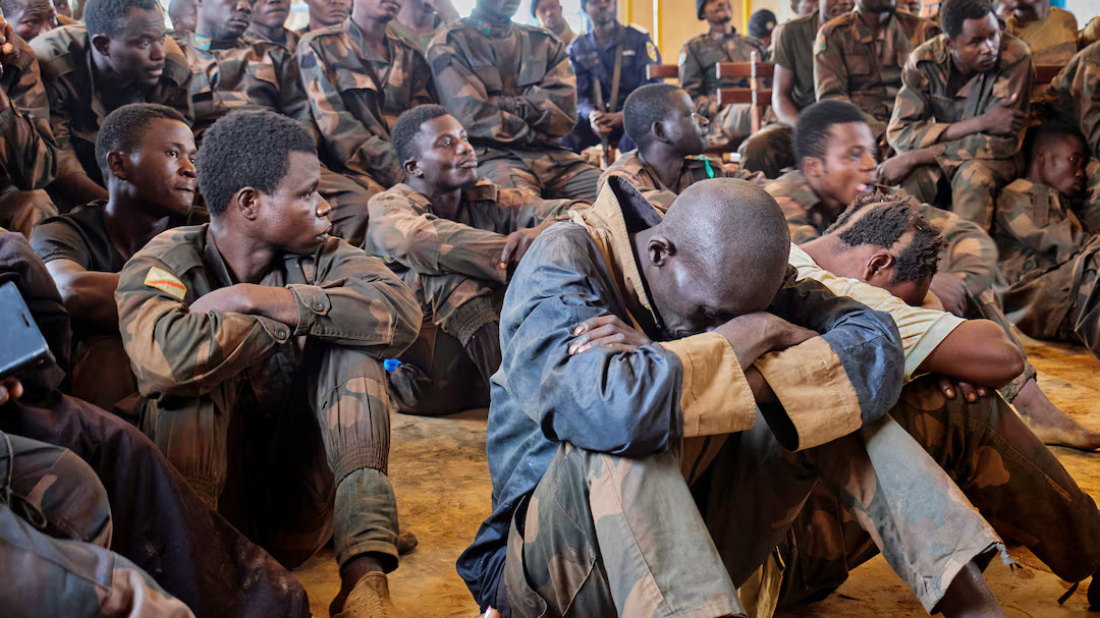
Congolese soldiers in a mix of fatigues and street clothes crowded into a chapel last week to stand trial for crimes including rape and murder allegedly committed as they fled in the face of a lightning rebel advance.
Their statements during the court martial proceedings highlighted the dysfunction of an army that has now lost more territory in eastern Congo than ever before to Rwanda-backed M23 fighters, though its woes go well beyond the rank and file.
Testimony collected from quick-fire trials of more than 300 soldiers, interviews with three senior army officers and a confidential U.N. memo seen by Reuters paint a grim picture of a fighting force hobbled by entrenched problems, opens new tab such as poor pay and corruption that reform efforts have failed to resolve.
The chaos of the past few weeks has further strained the army's weak chain of command, raising risks of abuses committed against civilians, said the confidential U.N. memo providing an update on the fighting.
While President Felix Tshisekedi's government has touted efforts to recruit new soldiers and acquire new weapons, the senior officers said this has meant little for soldiers on the front lines, who they described as underpaid and underequipped.
"We are criticized but we suffer like the rest of the population," said a colonel whose troops have fought in South Kivu province.
At the trials in Musienene last week and in the South Kivu provincial capital Bukavu earlier in February, military prosecutors pursued charges including theft, pillage, extortion and loss of war weapons.
Most of the accused acknowledged that some soldiers committed such crimes but denied they were involved, insisting they had merely been separated from their units.
One soldier, Siko Mongombo Brice, told Reuters he lost sight of his comrades after several hours of heavy fighting in North Kivu. Authorities apprehended him in the village of Kitsumbiro and accused him of desertion, which he denied.
"It wasn't a flight. We were looking for our unit," he said. "They saw us in this village, (but) we don't even know how we got there. Those who stole exist and innocent people like us exist. God alone knows the truth."
'WE WERE BOMBED'
The trials have yielded death sentences for more than 260 soldiers, including 55 in Musienene on Friday. More than 200 escaped during a prison break that coincided with the army's retreat from Bukavu on February 14.
The army's spokesperson for the northern front, Lieutenant Colonel Mak Hazukay, said the accused soldiers had "dishonoured the army" and committed "atrocities" that could spur the population to aid the rebels' advance.
The M23 advance since late December is already the gravest escalation in more than a decade of the long-running conflict in the region, rooted in the spillover into Congo of Rwanda's 1994 genocide and the struggle for control of Congo's vast mineral resources.
The rebels are backed by thousands of Rwandan troops, according to U.N. experts, and their superior weaponry and equipment creates a stark battlefield imbalance, officers said.
"We resisted sometimes but we were bombed a lot. The Rwandans have fearsome weapons," said the colonel, adding that allied Burundian soldiers also fled. "It's not just us."
Rwanda denies providing arms and troops to M23, and says its forces are acting in self defence against the Congolese army and militias hostile to Kigali.
It is not only Congolese foot soldiers who are fleeing.
The night before the rebels seized Goma, east Congo's largest city, the military command and provincial authorities fled by boat on Lake Kivu towards Bukavu without letting their soldiers know, the U.N. memo said.
Such moves by military leaders are a blow to morale already deflated by salaries of around $100 per month.
This is despite the fact that military spending has risen sharply under Tshisekedi, more than doubling in 2023 to $794 million, according to financial data tallied by the Stockholm International Peace Research Institute.
'BETRAYED FROM WITHIN'
Tshisekedi has blamed military higher-ups for the poor performance, telling supporters the army had been "betrayed from within".
But his critics blame him for leaning heavily on regional forces and mercenaries while incorporating militias who have proved difficult to control.
"Among these new recruits, there were thugs," one general knowledgeable about military operations in the east told Reuters.
Tshisekedi's office, responding to questions from Reuters, said some members of the armed forces did not have proper training and lacked a "sense of duty" to the nation. It stressed that the problems predated Tshisekedi and that the president "wants to do it differently".
For now, the dynamic of indiscipline continues to fuel clashes between soldiers and incorporated militias in Uvira, a city on the Burundian border, putting residents on edge.
A humanitarian source said the clashes had killed 30 and wounded more than 100 after militias tried to disarm soldiers who were fleeing.
Generals on February 26 announced an operation to track down soldiers suspected of "intolerable acts of barbarity" in and around Uvira.











What is your opinion on this topic?
Leave the first comment