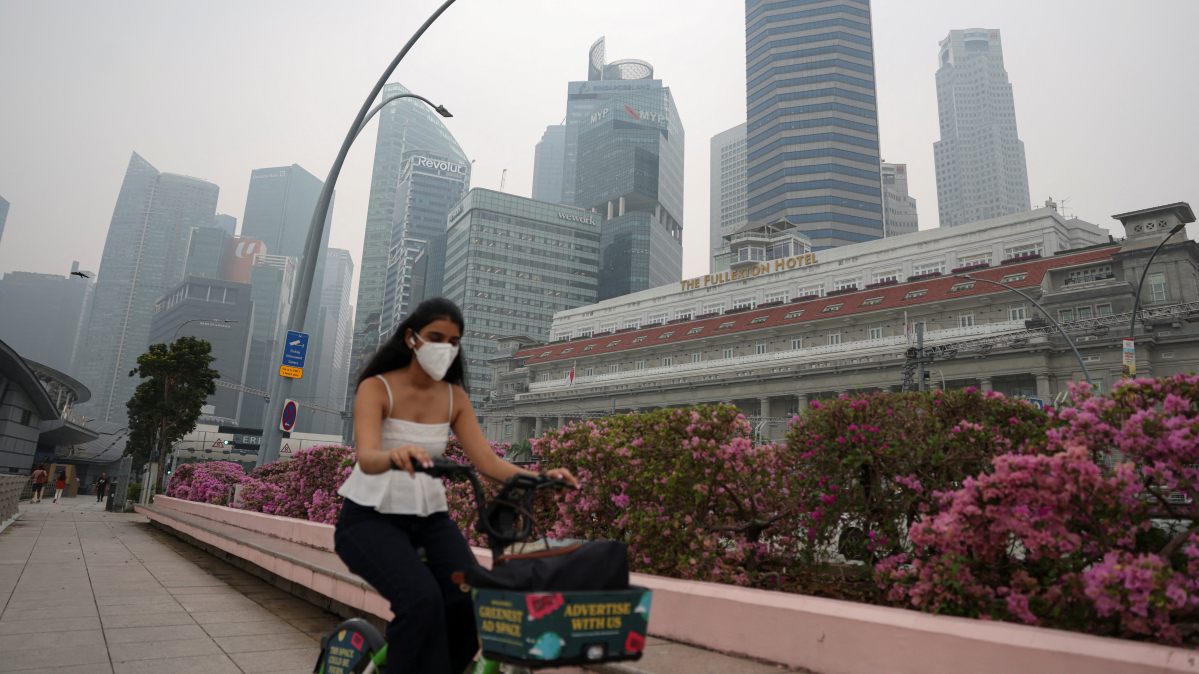
Singapore is experiencing severe haze as smoke from wildfires in Indonesia’s Kalimantan region drifts across the region, disrupting daily life, affecting businesses and prompting Singapore’s National Environment Agency issuing preventive notices to seven companies on 16 October.
The air quality entered the unhealthy range on 4 September, marking Singapore’s first significant episode of poor air quality in about three years, according to government data.
As of 5pm on Sunday (18 October), air quality remained unhealthy across all regions of Singapore, with the 24-hour Pollutant Standards Index (PSI) ranging from 112 to 197.
The haze has also disrupted air travel. According to the Civil Aviation Authority of Singapore and Changi Airport Group, 16 flights were diverted from Seletar Airport between 5 and 11 October as a precaution due to reduced visibility.
Businesses have also been affected. Outdoor dining establishments, including restaurants and bars, have experienced a decline in customers, with some reporting cancelled reservations and fewer walk-ins. Hawker centres have also reported falling sales as customers avoided outdoor dining.
A spokesperson for Marina Bay Sands said certain outdoor activities involving prolonged exposure had been temporarily suspended, adding that the hotel was providing guests with masks and air purifiers.
Singapore’s Minister for Digital Development and Information, Josephine Teo, said the government had begun preparing its response weeks earlier, including plans to distribute masks to those in need and offer assistance to Indonesia.
Singapore takes action against 7 companies linked to haze
Singapore’s National Environment Agency has identified and issued preventive notices to seven companies on 16 October.
Under the Transboundary Haze Pollution Act (THPA), companies are required to deploy firefighting personnel to extinguish or prevent the spread of fires and halt any burning activities on the affected land. Additionally, they must also submit action plans outlining measures to extinguish existing fires and prevent them from recurring.
Introduced in September 2014, the THPA allows Singapore to take action against companies whose activities cause or contribute to haze pollution originating overseas. The law applies when the resulting smoke causes the Pollutant Standards Index (PSI) to remain at 101 or above in any part of Singapore for at least 24 hours.
NEA said it remained committed to taking enforcement action against companies found responsible for causing transboundary haze in Singapore.
Malaysia calls for regional response
The haze has spread beyond Singapore, affecting neighbouring Malaysia and prompting calls for greater regional cooperation. Malaysia’s Second Finance Minister, Amir Hamzah Azizan, said on Wednesday that the worsening conditions required a coordinated response across Southeast Asia. “It is an issue that needs an ASEAN solution,” he said.
Malaysia had offered to deploy water bombers and other resources to help tackle the fires.
Read more:











What is your opinion on this topic?
Leave the first comment