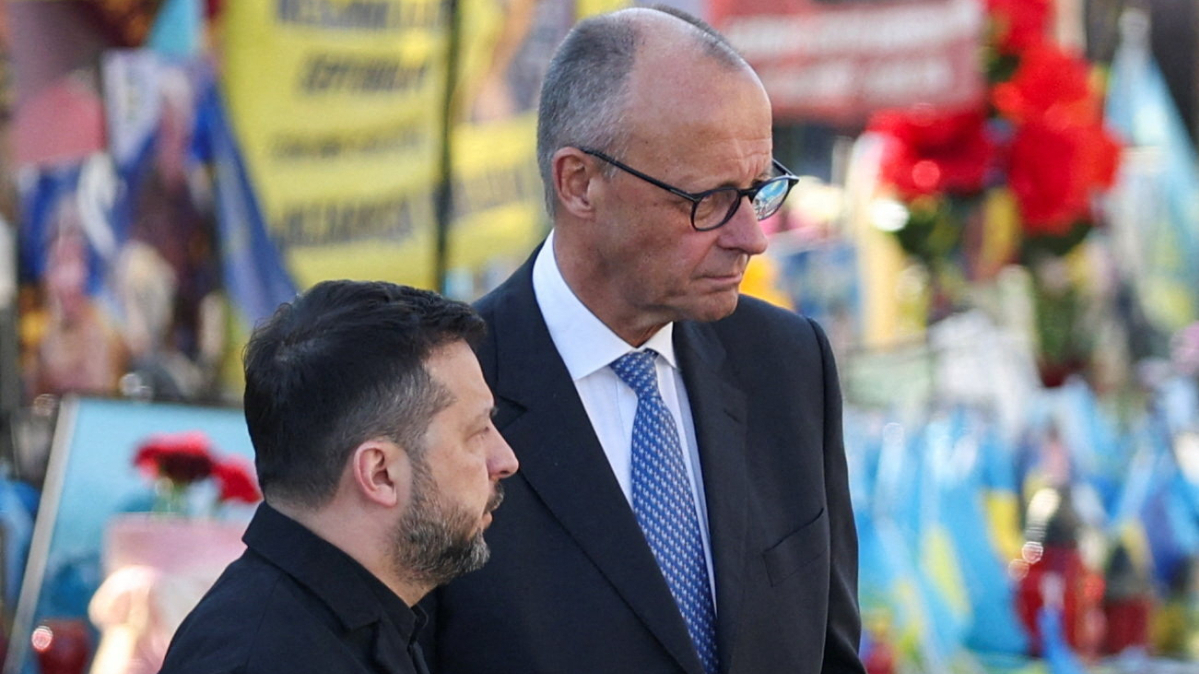
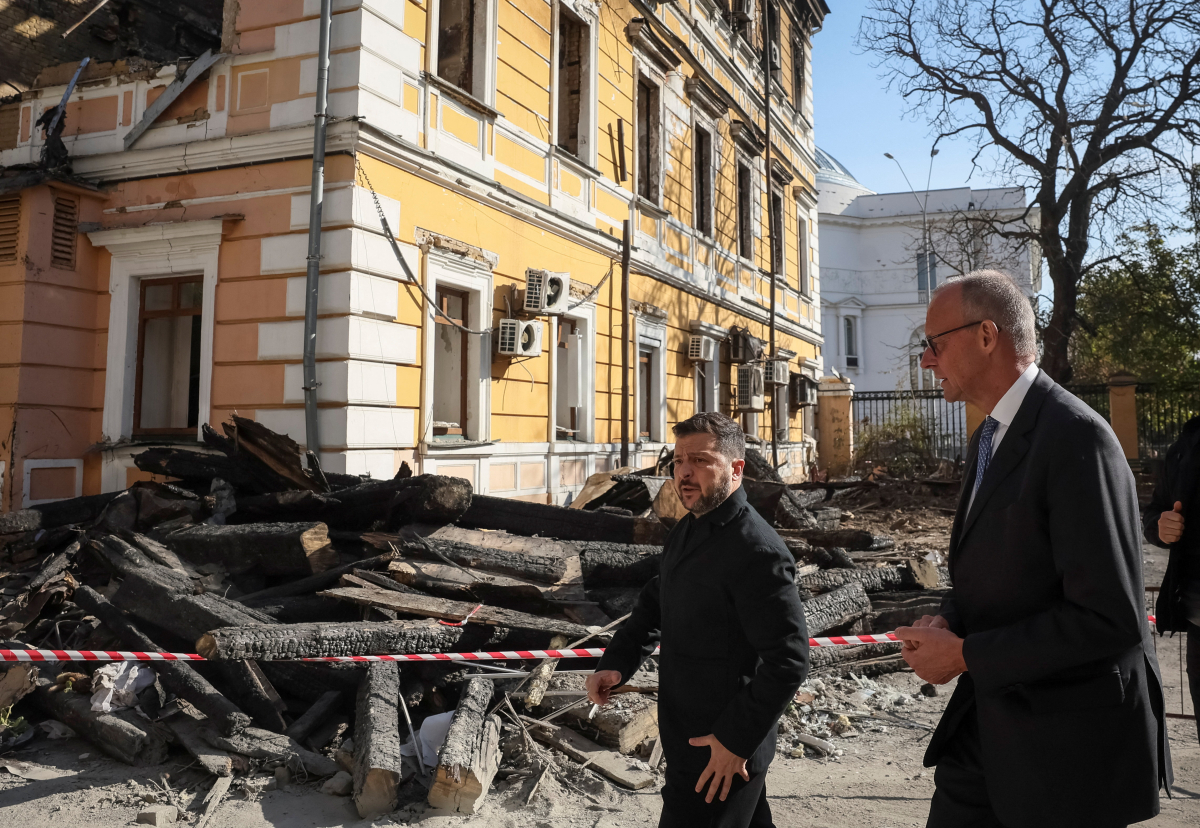
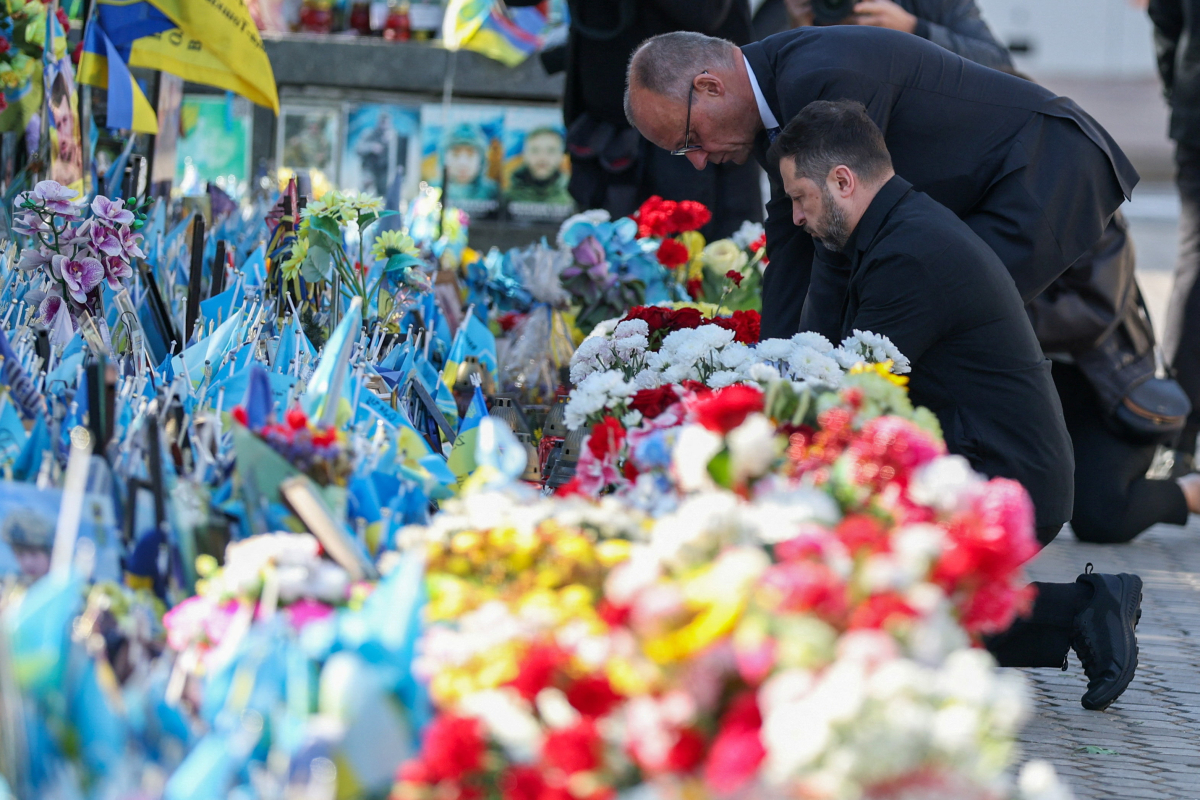
The sound of air raid sirens and explosions rang out in Ukraine's capital Kyiv on Sunday (4 October) as German Chancellor Friedrich Merz arrived for a visit to show support for President Volodymyr Zelenskyy amid escalating Russian attacks.
Merz will announce a package of measures including the release of €1 billion ($1.13 billion) in military aid and €350 million ($394.13 million) for repairs in the energy sector, German government officials said. A deal for joint production of various kinds of drones is also due to be finalised.
“I travelled to Kyiv today because Ukraine needs all our support in the coming weeks,” Merz said, adding that Russian forces were bombing towns, residential buildings and heating plants. “If Russia is not stopped, sooner or later its war machine will turn against us.”
“I will tell President Zelenskyy today: 'You can continue to count on our help,'” Merz said.
Four air raid alerts were heard in Kyiv on Sunday morning, and explosions and air defence systems also sounded across the city.
One of the Russian strikes hit the Northern Bridge across the Dnipro River, damaging its roadway, Kyiv Mayor Vitali Klitschko said on Telegram. He said the strike had also damaged a hot water supply system in the area.
Russia has been attacking Kyiv's bridges since last week in an effort to disrupt links between the capital's two banks and logistics routes between central and eastern Ukraine.
Merz seeks progress on EU-backed reforms
The German chancellor is accompanied by Economy Minister Katherina Reiche and an economic delegation including executives from Siemens Energy, Hensoldt, Diehl Defence, Quantum Systems and other companies.
Merz is also expected to press the Ukrainian government for progress on reforms requested by EU partners, including in the fight against corruption.
Zelenskyy said on Wednesday (30 September), after speaking to Merz by phone, that Ukraine would soon finalise a deal with Germany for the production of drones, missiles and related software.
A key focus of the agreement is expected to be the rapid production of anti-jet drones, which Quantum, a German defence-technology company, has successfully tested. Since the summer, Russia has used dozens of high-speed jet attack drones daily to target civilian and military infrastructure.
In April, Quantum and Ukrainian manufacturer WIY Drones announced the creation of Quantum WIY Industries, a joint venture to produce the Strila interceptor drone and related air-defence technologies.
Increased cooperation on long-range weapons
The deal also involves the joint development and production of weapons with a range of more than 1,000 km (600 miles) that Ukraine can use to launch attacks deep inside Russia.
On Thursday, Merz said Germany would not be intimidated by the rising number of hybrid attacks by Russia on European states.
Russia's Foreign Ministry said on Saturday that Moscow would continue to systematically hit targets in Ukraine in what it said were retaliatory strikes for Ukrainian attacks on Russia in recent months. It warned foreign nationals and diplomatic staff against staying in or travelling to Ukraine.
Zelenskyy told Reuters on Saturday his country's armed forces would double down on their attacks on oil refineries in Russia in response to Moscow's “new doctrine” of escalating attacks on civilian infrastructure, which he said was aimed at forcing residents of Kyiv and other cities to flee.
Latest attacks
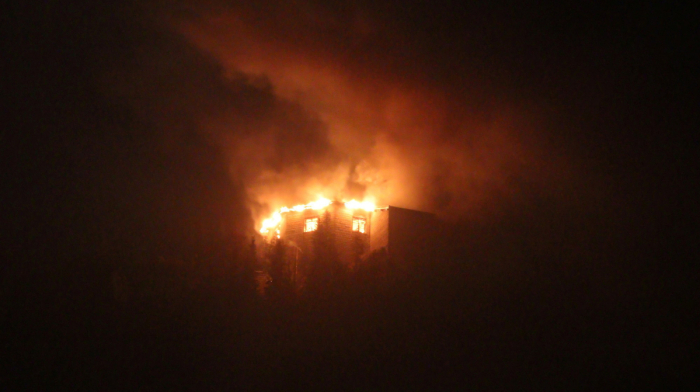
A fire broke out at an industrial site in Russia's Krasnodar region after falling drone debris struck the site in the Temryuk district, regional authorities said on Sunday.
Three people were injured and were receiving medical treatment, while emergency services were working at the scene.
Meanwhile, Russia said it hit a dry cargo vessel east of Odesa overnight that was transporting military equipment for Ukraine's armed forces, according to the Russian Defence Ministry on Sunday.
Russian drones also struck a Nova Poshta logistics centre in Chornomorsk and a data centre in Odesa, the ministry said, without specifying when the targets were hit.
The ministry said air defence forces had intercepted and destroyed 559 Ukrainian drones between 2000 Moscow time (1700 GMT) on Saturday and 0800 Moscow time (0500 GMT) on Sunday over multiple Russian regions and above the Azov and Black seas.
Reuters could not independently verify the claims made by either side of the conflict.
Russian drone hits bridge in Kyiv
An eyewitness video captures the moment a Russian drone struck Kyiv’s North Bridge on 4 October. Mayor Vitali Klitschko said the unmanned aircraft hit the road of the bridge, which had also been attacked a day earlier. Reuters verified the location using satellite and archive imagery, while aftermath footage showed damage at the site. It happened the day Germany’s Chancellor Freidrich Merz visited Kyiv on Sunday.
The Russian Defence Ministry said on Sunday it will step up attacks on military facilities in Kyiv and other parts of Ukraine. Meanwhile, a fire broke out at an industrial site in Russia's Krasnodar region after falling drone debris struck the site in the Temryuk district, regional authorities said on Sunday.
Three people were injured and were receiving medical treatment.
Read more:

















What is your opinion on this topic?
Leave the first comment