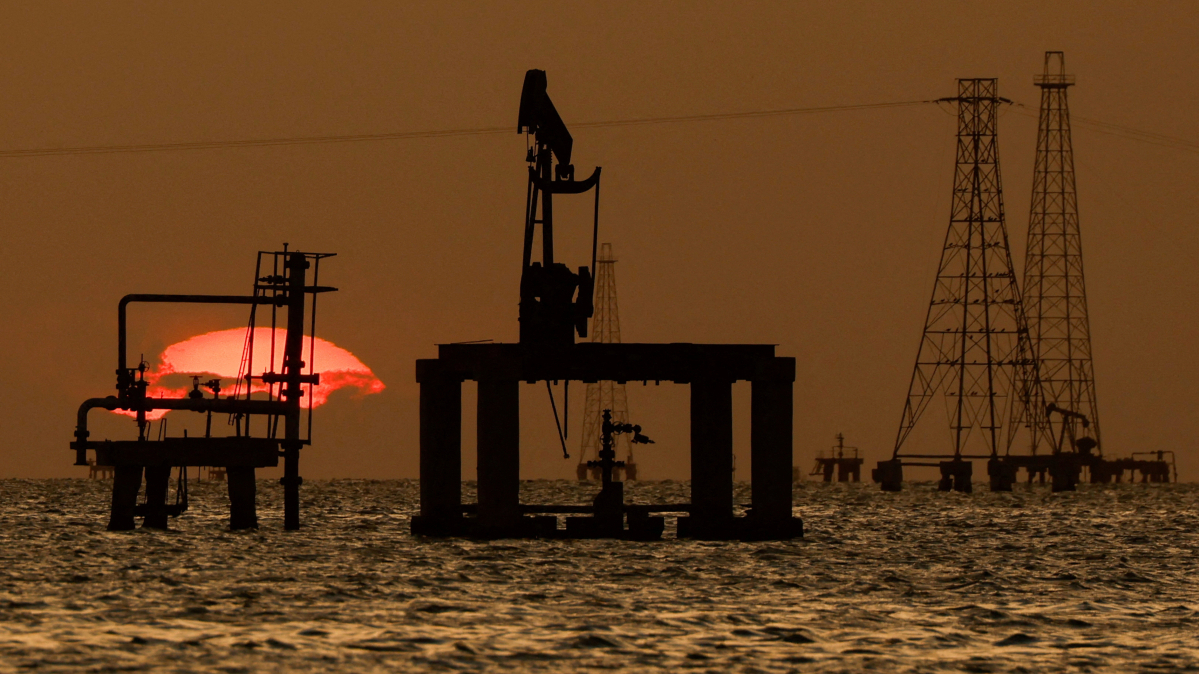
U.S. Energy Secretary Chris Wright said on Tuesday that energy deals expected to be signed in Venezuela this week could more than double the country’s crude oil production over the next few years.
Wright made the comments after arriving in Caracas for a one-day visit, his second trip to Venezuela since U.S. forces seized Venezuelan leader Nicolas Maduro in January.
“The investment in these deals will massively grow available oil production,” Wright told reporters. He said the additional supply could put downward pressure on global oil prices, while adding that refining capacity was currently a bigger factor behind high gasoline and diesel prices.
Wright also said U.S. gasoline prices should fall in the coming weeks as steps taken by the Trump administration to ease regulations on refiners begin to take effect.
Venezuela, a founding member of OPEC, once produced more than 3 million barrels of crude per day in the late 1990s. Production later collapsed amid years of underinvestment, mismanagement and U.S. sanctions. Output has recently stood at around 1.1 million to 1.2 million barrels per day, with production rising slightly since Maduro was captured.
However, at the country's peak of crude oil production it produced more than 3 million barrels per day (bpd) in the late 1990s before declining sharply.
Chevron, the largest U.S. oil producer operating in Venezuela, along with Italy’s Eni, India’s ONGC, Colombia’s GeoPark and U.S.-based GE Vernova are expected to sign agreements on energy projects in the country this week.
U.S.-backed deal raises questions
Wright’s visit comes days after U.S. President Donald Trump announced a separate agreement giving a U.S.-backed private oil company long-term access to a portion of Venezuela’s vast crude reserves.
Under the arrangement, North American Blue Energy Partners (NABEP), controlled by Venezuelan businessman Alejandro Betancourt, would receive a 100-year lease for 17 oilfields holding an estimated 65 billion barrels of reserves.
The agreement was arranged by Washington and Caracas without a competitive bidding process. Reuters reported that the deal has raised concerns among some oil companies considering investments in Venezuela because Betancourt has previously been investigated by U.S. and European authorities, although he was never charged.
Betancourt has denied previous allegations. NABEP commented saying Betancourt has more than 15 years of experience in Venezuela’s oil industry and has a successful track record.
A U.S. official travelling with Wright, defended Betancourt, saying that many of the oilfields included in the NABEP agreement had until recently been controlled by Chinese and Russian interests. The official also said Betancourt had brought oil rigs from Texas to Venezuela, creating jobs in both countries. The official played down the possibility of tensions with China, saying Beijing was unlikely to be surprised by Washington’s increased involvement in Venezuela’s oil sector.
China’s Foreign Ministry said on Tuesday that its cooperation with Venezuela was protected by international law and that its interests in the country must be guaranteed.
Venezuela’s oil potential
Venezuela holds some of the world’s largest proven oil reserves, but years of declining investment and economic turmoil have left its oil industry operating well below its historical capacity.
The new agreements are expected to bring additional investment and technology into the sector as Washington and Caracas seek to expand production.
Read more:


















What is your opinion on this topic?
Leave the first comment