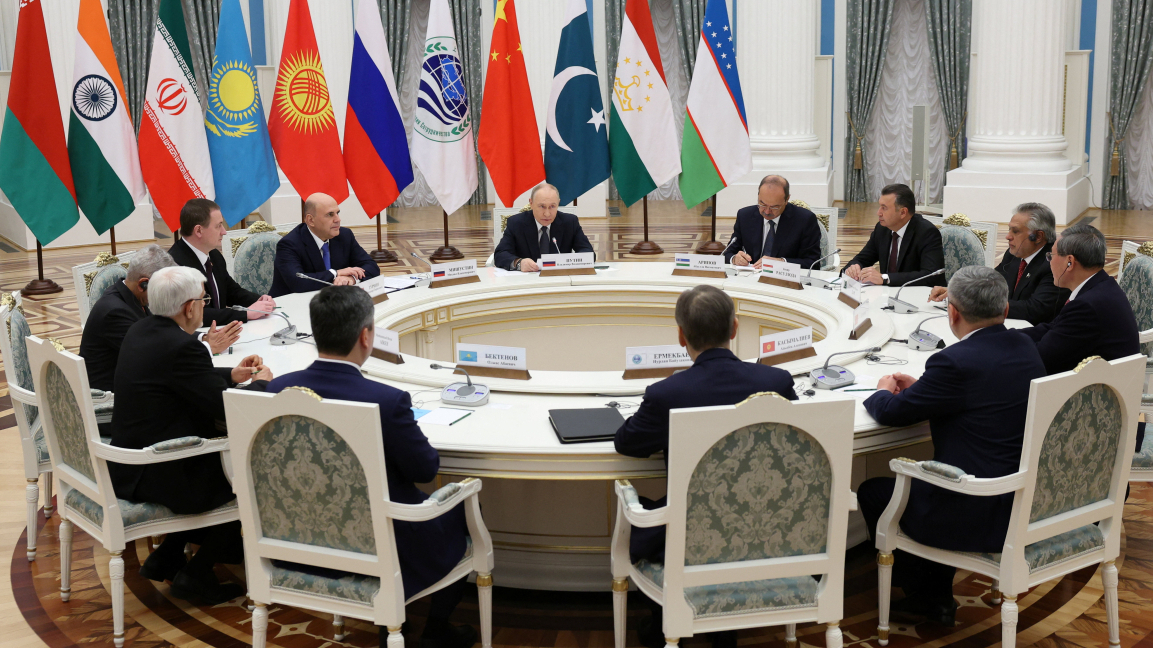
As leaders from across Eurasia gather in Kyrgyzstan for the Shanghai Cooperation Organisation (SCO) summit, the meeting is bringing together countries with very different interests, from China and Russia to India, Iran and Azerbaijan.
The Council of Heads of State of the SCO and a wider SCO Plus summit are due to take place in Bishkek on 1 September.
According to Kyrgyz authorities, leaders of 17 countries and UN Secretary-General António Guterres are expected to attend, including Chinese President Xi Jinping, Russian President Vladimir Putin, Indian Prime Minister Narendra Modi, Iranian President Masoud Pezeshkian and Azerbaijani President Ilham Aliyev.
But what exactly is the Shanghai Cooperation Organisation and why has it attracted so much attention?
What is the SCO?
The SCO is a Eurasian political and security organisation founded in Shanghai in 2001.
Its original members were China, Russia, Kazakhstan, Kyrgyzstan, Tajikistan and Uzbekistan. It grew out of the Shanghai Five, a grouping created in the 1990s to build confidence and settle border issues between China and several former Soviet republics.
India and Pakistan became full members in 2017. Iran joined in 2023, while Belarus became the organisation's 10th full member in 2024.
The organisation's stated priorities include strengthening relations between members, promoting regional peace and security, combating terrorism, separatism and extremism and developing economic, cultural and humanitarian cooperation.
It is important, however, not to confuse the SCO with a military alliance such as NATO. Its members have different foreign-policy priorities and are not bound by a collective-defence commitment.
Decisions are made by consensus, which can make agreement difficult as the organisation grows. An SCO official has acknowledged that reaching consensus becomes more challenging as membership expands.
Who are its members?
The 10 full members are China, Russia, India, Pakistan, Iran, Kazakhstan, Kyrgyzstan, Tajikistan, Uzbekistan and Belarus.
That gives the SCO an unusually broad geographical reach.
China and Russia are its two most powerful members, while India and China are major Asian powers with their own strategic rivalry.
Central Asian states such as Kazakhstan, Kyrgyzstan, Tajikistan, and Uzbekistan are particularly important because the organisation was originally built around security and cooperation in this region.
Iran brings the organisation deeper into the Middle East, while Belarus extends its geographical reach further into Europe.
This diversity is both the SCO's strength and one of its weaknesses.
What does it actually do?
Security was central to the SCO from the beginning.
The organisation has a Regional Anti-Terrorist Structure, known as RATS, based in Tashkent, which focuses on cooperation to counter terrorism, separatism, and extremism.
But its agenda has expanded.
SCO discussions now cover trade, investment, transport, logistics, energy, digital cooperation, environmental issues, culture and humanitarian affairs.
Transport is particularly important for Central Asian members seeking to strengthen connections between China, Russia, South Asia and Europe.
The organisation has also supported China's Belt and Road Initiative, while Russia has promoted wider ideas for Eurasian economic cooperation.
Is it a China-Russia alliance?
Not exactly.
China and Russia cooperate closely within the SCO, particularly on regional stability and their desire for a more multipolar international system.
But their interests are not identical.
China has expanded its economic influence in Central Asia through the Belt and Road Initiative, while Russia has traditionally viewed the region as part of its strategic sphere of influence.
Carnegie Endowment analysis has described their relationship in Central Asia as one in which they cooperate where their interests overlap but compete where they do not.
India adds another layer of complexity.
New Delhi and Beijing are strategic competitors, yet both participate in the SCO. Their presence illustrates why it is difficult to describe the organisation as a single anti-Western bloc.
Carnegie has argued that the SCO's expansion has made it increasingly difficult to turn the organisation into a coherent geopolitical bloc.
Azerbaijan's growing role in the SCO
Although Azerbaijan is not a full member of the Shanghai Cooperation Organisation (SCO), its engagement with the bloc has expanded steadily over the past decade.
Baku became an SCO Dialogue Partner in 2015 after its application was approved at the organisation's summit in Ufa, Russia, with the status formally taking effect following the signing of a memorandum of understanding in Beijing in 2016.
Azerbaijan's cooperation with the SCO is driven by its position at the crossroads of Europe and Asia and its ambition to strengthen its role in regional connectivity.
As the SCO increasingly focuses on trade, transport and economic integration, Baku has sought to position itself as a key link between Asian and European markets through projects such as the Baku-Tbilisi-Kars railway and the Middle Corridor.
The relationship has gained further momentum in recent years. Azerbaijan participates in SCO-related meetings and initiatives and in 2024, submitted an application for observer status, a move that would deepen its engagement with the organisation without requiring full membership.
However, in late 2025, the organisation signed the Tianjin Declaration. This declaration merged the independent "Dialogue Partner" and "Observer State" tiers into a single, unified category called "SCO Partner".
Why does the Bishkek summit matter?
The 1 September meeting comes as the SCO seeks to expand cooperation across a wider range of issues.
The Bishkek summit is expected to address international and regional affairs, the organisation's future development and cooperation in areas including trade, transport, digital technology, the environment and humanitarian affairs.
The meeting is also expected to produce a Bishkek Declaration marking the SCO's 25th anniversary.
Alongside the formal meeting of the 10 member states, the SCO Plus summit will bring in countries outside the core membership.
Among those expected are Azerbaijan, Türkiye, Armenia, Mongolia, Togo, Laos, Vietnam and Egypt, represented at different levels.
The presence of UN Secretary-General António Guterres is also significant, given the SCO's stated interest in international cooperation and the role of the United Nations.
So, how powerful is the SCO?
That depends on what it is being measured against.
It is not a NATO-style military alliance, nor is it an integrated economic union like the European Union.
Instead, it is a platform where major powers and smaller states can meet, negotiate and pursue overlapping interests without having to agree on everything.
For China, the SCO provides an important diplomatic platform for promoting its vision of a more multipolar international system. Chatham House has described China's use of the organisation as part of its effort to showcase an alternative vision of global order.
For Russia, it provides a forum for maintaining influence across Eurasia.
For Central Asian states, it offers a way to engage simultaneously with several major powers.
And for countries such as India and Iran, it provides another diplomatic channel through which to advance their national interests.
That may be the SCO's greatest significance.
It does not necessarily speak with one voice. Its importance lies in the fact that countries that do not always agree still choose to sit around the same table.











What is your opinion on this topic?
Leave the first comment