Türkiye, Saudi Arabia and Pakistan are set to convene the first high-level meeting under their newly established Mecca Joint Defence Agreement, marking an early step in efforts to deepen military and security cooperation among the three countries.
Foreign ministers, defence ministers and military chiefs from the three nations are due to gather in Istanbul on Monday for the inaugural session of the Strategic Political and Defence Committee, the body created to oversee implementation of the pact signed in Mecca earlier this month.
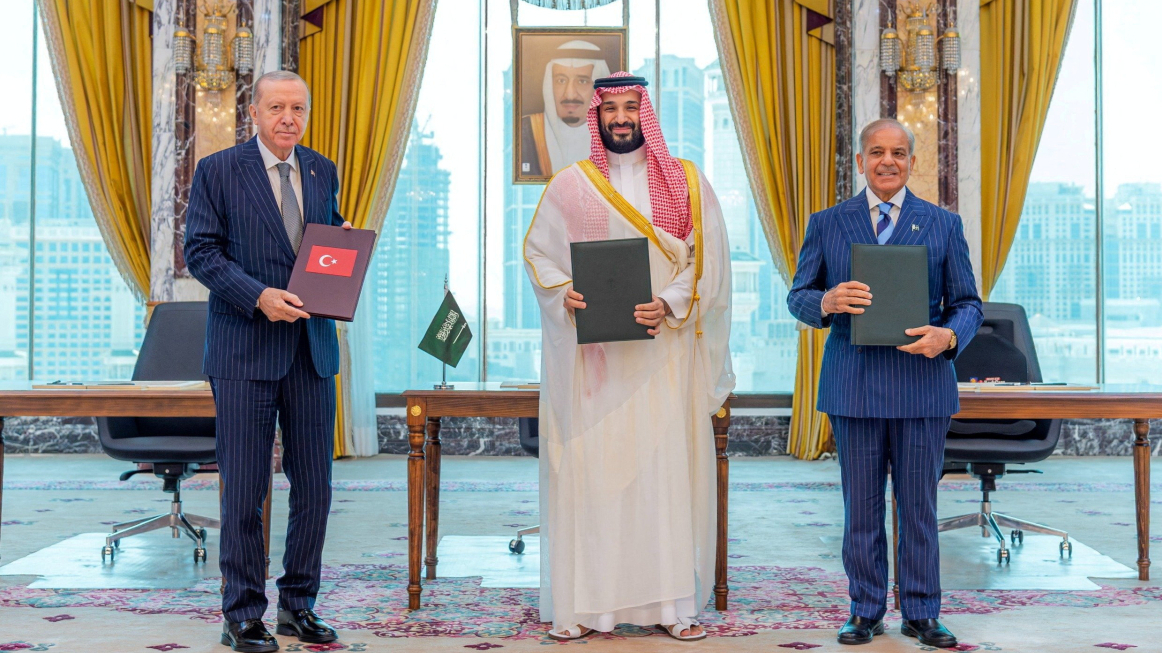
The agreement, endorsed by Turkish President Recep Tayyip Erdoğan, Saudi Crown Prince Mohammed bin Salman and Pakistani Prime Minister Shehbaz Sharif on 7 August, commits the three countries to closer defence coordination at a time of heightened instability across the Middle East and beyond.
Pact modelled on collective defence principles
At the heart of the agreement is a mutual defence commitment under which an attack on one member would be treated as an attack on all three.
Officials have described the arrangement as a mechanism to strengthen collective deterrence and improve coordination in responding to security threats. Turkish officials have emphasised that the pact is intended to complement, rather than replace, existing security alliances and partnerships.
The accord brings together three influential Sunni-majority states that occupy strategic positions across the Middle East and South Asia. Türkiye contributes NATO's second-largest military force, Saudi Arabia is one of the world's leading oil exporters, and Pakistan possesses nuclear weapons and one of the region's largest armed forces.
Broad security agenda expected
The Istanbul meeting is expected to focus on international security issues, regional developments and the practical steps needed to translate the agreement into a functioning security framework.
Participants are expected to examine ways to improve military interoperability, allowing the armed forces of the three countries to operate more effectively together during exercises, operations or potential crises.
Defence industry cooperation is also expected to feature prominently, with discussions likely to cover joint production projects, technology sharing and collaborative research and development initiatives.
Counterterrorism cooperation is another key area on the agenda, reflecting longstanding security concerns shared by all three governments.
Building institutions behind the pact
Beyond policy discussions, officials are expected to begin establishing the structures needed to implement the agreement.
The committee is expected to outline plans for a permanent secretariat and other coordinating mechanisms that will oversee joint initiatives and monitor progress. Delegates are also expected to draw up a roadmap setting priorities for future cooperation.
The Strategic Political and Defence Committee is designed to provide overall direction for activities undertaken under the agreement and is expected to meet regularly as the partnership develops.
Regional tensions provide backdrop
The meeting comes against a backdrop of heightened geopolitical tensions across the Middle East.
The three countries share concerns about regional instability and the broader security environment, including tensions involving Iran and Israel. The agreement was negotiated during a period marked by conflict, missile exchanges and concerns about threats to energy infrastructure and regional trade routes.
Supporters of the pact argue that closer cooperation among regional powers could help strengthen stability and provide an additional layer of security amid growing uncertainty.
Membership could expand
Turkish officials have indicated that the agreement could eventually be opened to other countries that share its objectives and are willing to work within a cooperative security framework.
Egypt has been mentioned by Turkish officials as a potential future participant, although no formal expansion plans have been announced.
Ankara has presented the initiative as an inclusive platform aimed at promoting regional security, economic prosperity and peaceful cooperation, while stressing that it is not directed at replacing existing international alliances.
First test of a new partnership
Monday's gathering will be closely watched as an early test of how far Türkiye, Saudi Arabia and Pakistan intend to take their newly formalised security relationship.
While the agreement's long-term impact remains uncertain, the Istanbul meeting is expected to provide the first indication of the practical military, political and industrial cooperation that could emerge from one of the most significant new defence arrangements announced in the region this year.
Read More:













What is your opinion on this topic?
Leave the first comment