Former Ukrainian Defence Minister Mykhailo Fedorov has called for elections despite the war with Russia, mounting what is widely seen as the biggest domestic political challenge to President Volodymyr Zelenskyy since Moscow launched its full-scale invasion.
Fedorov, 35, said Ukraine must find a legal and secure way to restore its full democratic process, even if the war continues for years.
“Democracy cannot be held hostage by Russia,” Fedorov said in a video posted on YouTube on Tuesday, adding that Ukrainians were fighting because they wanted their country to remain a free European state.
Elections suspended under martial law
Ukraine has been under martial law since Russia launched its full-scale invasion on 24 February 2022, meaning national elections cannot currently be held.
Fedorov did not mention Zelenskyy by name in his address but argued that Ukraine was facing a “systemic crisis of governance”, saying the state had become resistant to change. He also highlighted corruption as a problem undermining the country’s war effort.
He said Ukraine needed a “legal, safe, and realistic mechanism” that would allow a full democratic process to resume during a prolonged conflict.
Any vote would present major logistical and security challenges. Ukraine would have to guarantee voting rights for military personnel, millions of citizens living abroad and people in frontline areas, while safeguarding the security and independence of the electoral process.
Zelenskyy’s five-year presidential term ended in May 2024, but no election has been held because of martial law.
When U.S. President Donald Trump suggested in 2025 that Kyiv was using the war to avoid an election, Zelenskyy said Ukraine was prepared to hold a vote within 60 to 90 days if the U.S. and its European allies could help guarantee security.
Holding a free and safe election while Ukraine remains under repeated Russian bombardment would nevertheless be difficult. Trump’s previous remarks were also criticised by some Ukrainians as echoing Moscow’s claim that Zelenskyy lacks legitimacy.
Fedorov's dismissal triggered protests
Fedorov’s intervention comes just over a month after his unexpected dismissal as defence minister, only six months after he took the post.
His removal triggered protests across Ukraine and exposed growing tensions within the country’s wartime leadership. Fedorov had become a prominent and popular figure during his brief tenure, pursuing reforms aimed at modernising the Defence Ministry, tackling corruption and using battlefield data to improve military performance.
His dismissal was widely linked to tensions with then commander-in-chief of the Ukrainian armed forces Oleksandr Syrskyi over military reforms and the direction of Ukraine’s war strategy.
Within days, Syrskyi was also removed as protests demanding Fedorov’s reinstatement increased pressure on Zelenskyy. Mykhailo Drapatyi replaced Syrskyi.
Fedorov was subsequently offered other government positions, including a role overseeing military innovation, but said he would return only as defence minister.
He gave no indication in Tuesday’s address that he planned to run for president or launch a political campaign.
His election proposal has also drawn criticism from some Ukrainian commentators, including figures who had previously supported his return to the Defence Ministry. Critics argue that even some of Zelenskyy’s strongest opponents recognise the difficulties of organising a credible national election while the country remains at war.
Khmara nominated as defence minister
Fedorov released his video just hours after Zelenskyy formally nominated acting Defence Minister Yevhenii Khmara to take over the ministry permanently.
Ukraine’s parliamentary Committee on National Security, Defence and Intelligence unanimously recommended on Wednesday that lawmakers approve Khmara’s appointment. His nomination was submitted to parliament on 18 August, with a vote expected later on Wednesday.
Zelenskyy has yet to respond publicly to Fedorov’s election proposal.
From digital reform to drone warfare
Before taking charge of the Defence Ministry, Fedorov served as Ukraine’s Minister of Digital Transformation and emerged as a leading figure behind the country’s technology-driven response to Russia’s invasion.
During the early stages of the war, he helped establish the volunteer “IT Army of Ukraine”, which carried out cyber operations targeting Russia.
Fedorov later led the Army of Drones fundraising initiative and helped introduce elements of “gamification” into Ukraine’s military operations, including a system that awarded military units credits for successfully striking Russian targets.
As defence minister, he continued to focus on drones, procurement reform and high-tech warfare, using technological innovation and asymmetric capabilities to help compensate for Russia’s greater conventional resources.
Fedorov also asked SpaceX founder Elon Musk to prevent Russian forces from using Starlink satellite terminals to support drone operations. The restrictions were credited with significantly disrupting some Russian frontline operations.
Shortly after his dismissal, Fedorov said in a Facebook post that he would continue working to defeat Russia through asymmetry, rapid innovation and organisational strength.
Long-range drone strikes intensify
Fedorov’s political intervention comes as Ukraine steps up long-range operations inside Russia, including attacks on oil refineries and logistics infrastructure.
Ukraine has launched hundreds of drones in recent attacks, including strikes on warehouses belonging to Wildberries, Russia’s largest online retailer.
One of the largest recent attacks involved around 600 drones targeting Moscow and other areas, according to Russian officials, while other estimates put the total number launched across Russia even higher.
The strikes have forced Russia to spread its air-defence resources across a much wider area as Ukraine expands its ability to hit targets deep inside Russian territory.
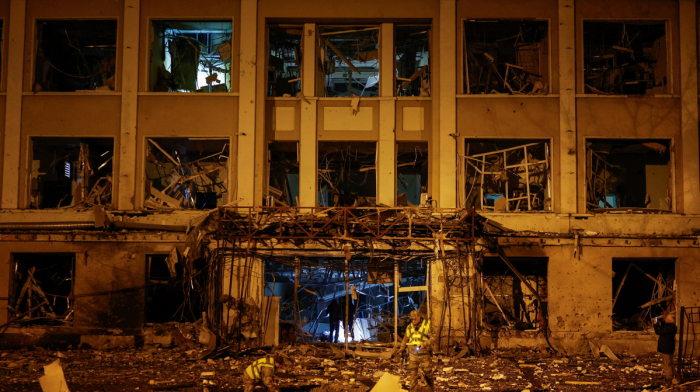
Russian attacks on Ukraine have continued in parallel, with Ukrainian officials saying at least 17 people were killed in the latest wave of Russian missile and drone strikes.
UK reaffirms support for Ukraine
Fedorov’s political intervention comes as Ukraine steps up long-range operations inside Russia, including attacks on oil refineries and logistics infrastructure.
Ukraine has launched hundreds of drones in recent attacks, including strikes on warehouses belonging to Wildberries, Russia’s largest online retailer.
One of the largest recent attacks involved around 600 drones targeting Moscow and other areas, according to Russian officials, while other estimates put the total number launched across Russia even higher.
The strikes have forced Russia to spread its air-defence resources across a much wider area as Ukraine expands its ability to hit targets deep inside Russian territory.
Russian attacks on Ukraine have continued in parallel, with Ukrainian officials saying at least 17 people were killed in the latest wave of Russian missile and drone strikes.








What is your opinion on this topic?
Leave the first comment