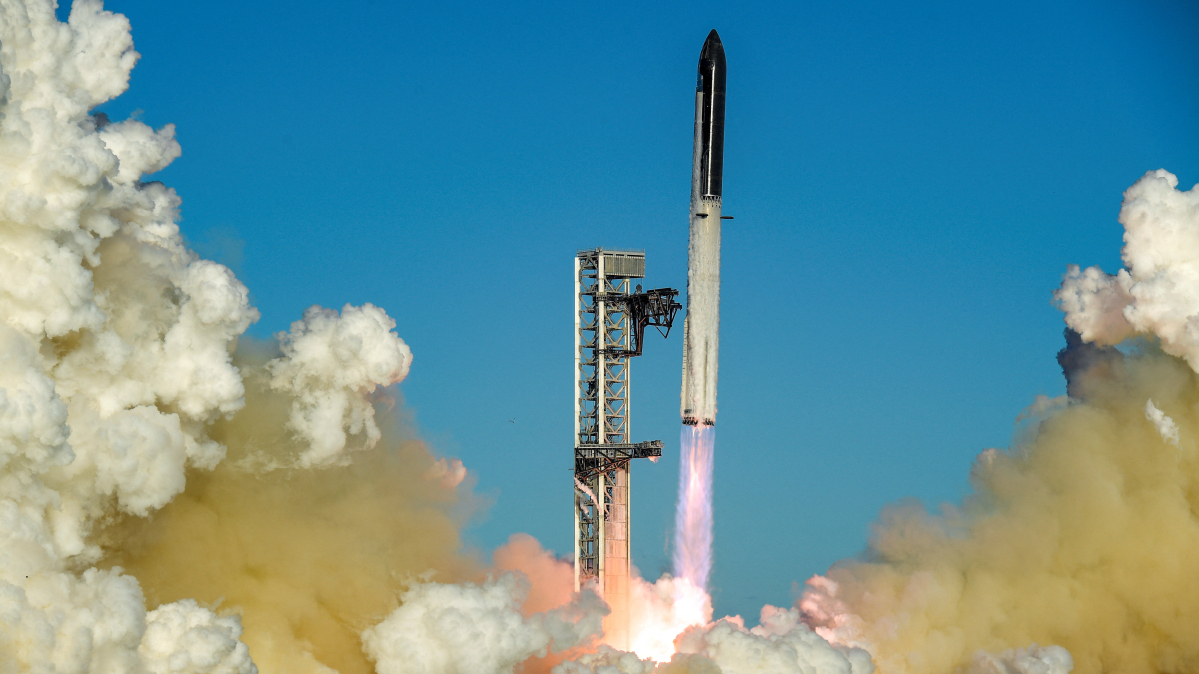
Elon Musk’s SpaceX has launched its latest Starship flight into orbit, but failed to recover the rocket’s giant booster. The 15th test flight lifted off from Starbase in the U.S. state of Texas on Friday (13 November).
SpaceX had planned to bring the Super Heavy booster back to the launch site and catch it, but scrapped that plan. The booster was sent towards the Gulf of Mexico instead, where reports say it exploded just above the sea.
The company wanted to recover both stages using the launch tower’s mechanical arms, known as 'chopsticks.' It has caught the booster this way three times before, most recently in March 2025.
The upper stage, the Starship spacecraft itself, is still in orbit. It is due back in Texas on Saturday afternoon, when SpaceX will try to catch it with the same arms. It will circle the Earth 14 times and come down about 22.5 hours after launch.
A successful catch would be the first time a vertically launched spacecraft has gone into orbit and come back to the exact spot it left. SpaceX has said it would be the first full recovery of an orbital launch system.
All 26 operational Starlink satellites on board were released within the first two hours of the flight, SpaceX added.
Setbacks and ambitions
Starship first reached orbit in September, on the previous flight. However, the mission ended early after some engines malfunctioned. The upper stage splashed down intact in the Pacific before bursting into flames.
Musk has said fully reusable rockets are the way to cut the cost of spaceflight, and he expects weekly Starship launches by the first half of 2027.
SpaceX also needs the rocket to expand Starlink and to build a planned network of AI data centres in orbit.
NASA is relying on Starship too, as the lander for its return to the Moon. The U.S. space agency has put in roughly $3.2 billion since choosing it in 2021, while SpaceX says it has spent at least $15 billion of its own.
A crewed landing is expected by 2028, although analysts have said that unfinished tests, including transferring fuel between ships in orbit, could push that date back.
Read more about space travel:


















What is your opinion on this topic?
Leave the first comment