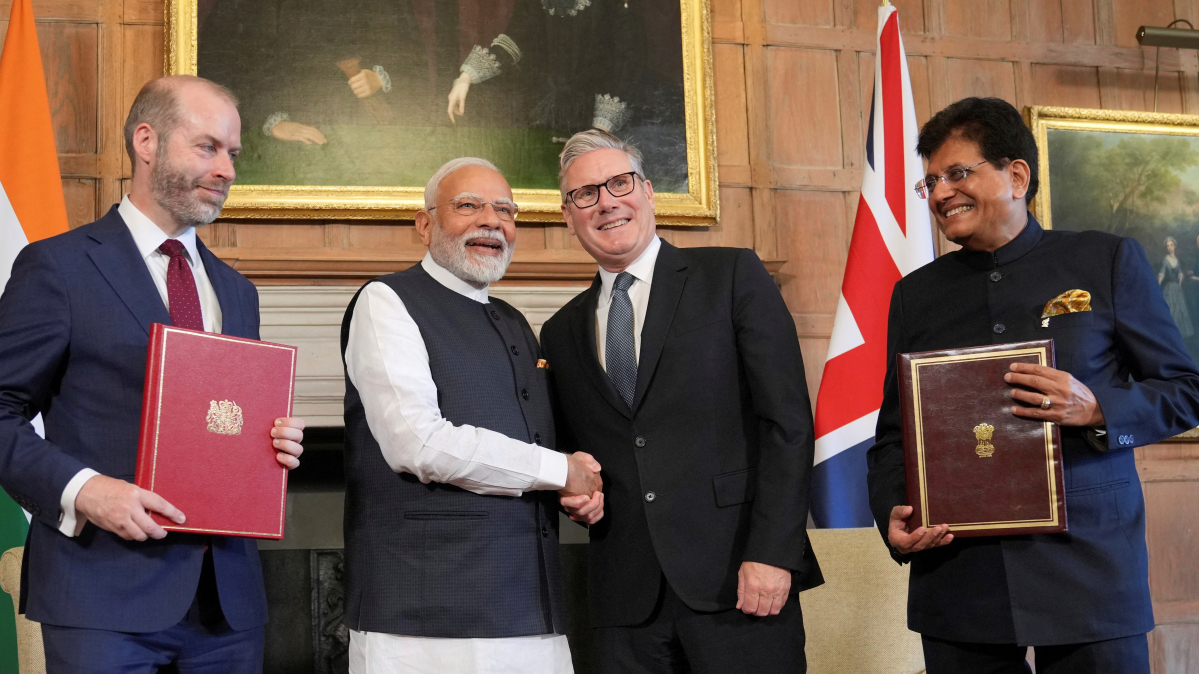
India and the United Kingdom's Comprehensive Economic and Trade Agreement (CETA) came into force on Wednesday, cutting tariffs on thousands of products and creating new opportunities for businesses, investors and professionals in both countries.
The agreement is expected to strengthen bilateral trade by improving market access for goods and services while encouraging greater investment between the world's fifth and sixth-largest economies.
Tariff cuts to benefit key export sectors
Under the agreement, Indian exporters will receive immediate duty-free access to most British tariff lines, providing a significant boost to labour-intensive industries.
Sectors expected to benefit include textiles, leather goods, footwear, marine products, gems and jewellery, and processed foods, where previous UK tariffs ranged from 4 to 20 per cent.
The removal of duties is expected to improve the competitiveness of Indian products in the British market and create new export opportunities.
UK firms gain greater access to Indian market
The agreement also creates wider opportunities for British businesses in one of the world's fastest-growing major economies.
India will immediately eliminate tariffs on 64.1 per cent of tariff lines, with duties on a further 21 per cent to be phased out over time while maintaining protections for sensitive products.
British exporters will benefit from improved access in sectors including automobiles, financial services, insurance, education, professional services and government procurement.
Automobile imports to follow phased approach
As part of the agreement, India will gradually reduce barriers to British passenger vehicle imports through a quota-based system.
Up to 37,000 completely built vehicles will be allowed to enter India each year under preferential tariff arrangements, reflecting a phased opening of the automotive sector.
The deal also provides improved market access for British alcoholic beverages through a gradual reduction in import duties.
Services sector receives major boost
The agreement significantly expands access for service providers across 137 sub-sectors, including information technology, telecommunications, business services, financial services and education.
It also simplifies temporary entry arrangements for business visitors, intra-company transferees, investors, contractual service suppliers and independent professionals, making it easier for companies to operate across both markets.
National Insurance relief for Indian professionals
A linked Double Contribution Convention will exempt eligible Indian professionals and their employers from making contributions to the UK's National Insurance system for assignments lasting up to five years.
Indian officials estimate the arrangement will benefit around 75,000 professionals and approximately 900 employers by reducing the cost of temporary overseas postings.
Expanding trade and investment
India's Commerce and Industry Minister, Piyush Goyal, described the agreement as opening "new avenues for trade, investment and innovation", adding that it would create fresh opportunities for Indian businesses.
According to India's Ministry of Commerce, India exported goods worth 13.44 billion U.S. dollars to the United Kingdom and imported goods worth 11.68 billion U.S. dollars during the 2025–26 financial year. Bilateral services trade reached 35.44 billion U.S. dollars in 2024, with India recording a services trade surplus of nearly 7.9 billion U.S. dollars.
The agreement also opens Britain's government procurement market, valued at around £90 billion, to eligible Indian suppliers, while India is providing reciprocal access to procurement opportunities estimated to be worth approximately 114 billion U.S. dollars.
Strengthening bilateral economic ties
The implementation of the Comprehensive Economic and Trade Agreement marks a significant milestone in India-UK economic relations, with both governments expecting the pact to boost trade, attract investment and deepen cooperation across a wide range of industries in the years ahead.

















What is your opinion on this topic?
Leave the first comment