An ageing, poorly insured shadow armada now accounts for around one-sixth of the world's tanker fleet. Hidden by design and fraught with risk, it operates beyond conventional oversight. A maritime law expert explains how it works, who profits, and why much of the world looks the other way.
It begins with a name change. A tanker registered in Singapore as the Alpine Eternity becomes the Yibao under a Liberian flag. Then it re-registers in Panama. Later, it claims to fly Syria's flag - a flag for which no record exists - before Swedish authorities board it in their own waters. By then, the vessel, now known as the Jinhui, is a ghost ship: technically present, legally untraceable, and very much in operation.
"It started life as the Alpine Eternity, which is probably a legitimate vessel," says Professor Jason Chuah of City St George's, University of London, and Chairman of the Board of Research at the Maritime Institute of Malaysia. "And then, somewhere through the course of its life, it became part of the dark fleet."
What is a shadow fleet?
The shadow fleet, also called the dark fleet or grey fleet, refers to mostly older oil tankers that operate beneath the radar of international oversight. They fly flags of convenience, obscure their ownership through layered shell companies, and are deployed primarily to circumvent economic sanctions on oil exporters such as Russia, Iran, Belarus, North Korea, and Venezuela.
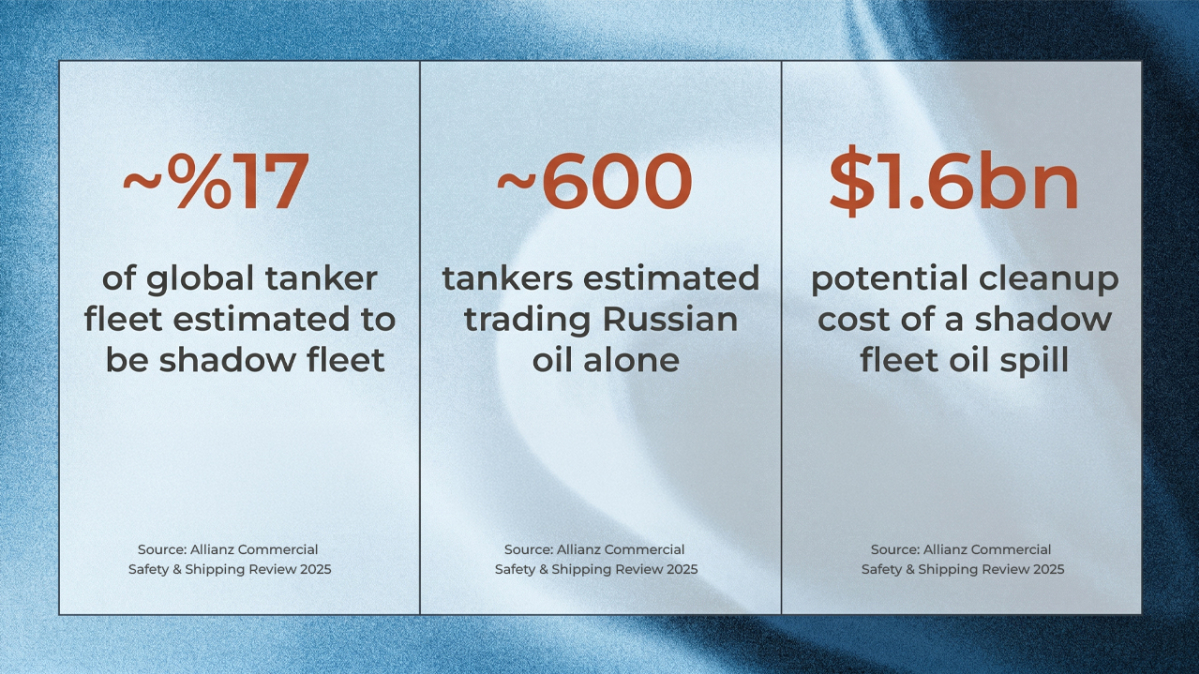
Estimating the fleet's precise size is inherently difficult. Allianz Commercial's Safety and Shipping Review 2025 estimates that the shadow fleet now accounts for roughly 17% of the world's tanker fleet, with approximately 600 vessels trading Russian oil alone.
The International Maritime Organization's (IMO) first formal definition of a "dark fleet" vessel, adopted in December 2023, describes ships that circumvent sanctions by switching off Automatic Identification System (AIS) signals, evading safety and environmental regulations, failing to maintain adequate marine insurance, and taking deliberate steps to avoid detection.
"Some estimates put them at over several hundred, some estimates put them into the thousands," Chuah told Anewz. "And the problem is exacerbated by the fact that once a ship is part of the dark fleet, it doesn't have to remain dark forever. It can become legit and then it can decide to go back into the darkness."
Three ways to disappear at sea
Chuah outlined the three principal methods shadow fleet operators use to evade detection - a toolkit that has grown increasingly sophisticated as enforcement efforts have intensified.
1) AIS blackout
Operators switch off their Automatic Identification System. As Chuah explains, IMO conventions require ships to carry AIS equipment, but the obligation to keep it switched on stems from an IMO resolution, which some argue is not legally binding..
2) GPS Spoofing
Ships broadcast false position data, causing satellites to record them in one location while they operate elsewhere - sometimes thousands of miles away in a different sea.
3) Identity Cloning
A vessel assumes the registered identity of a legitimate ship, using its IMO number, flag and call sign so authorities believe they are tracking a compliant vessel. Such cases appear in IMO databases worldwide.
“With the Jinhui, it changed its registration about three times in the last few years. Some states are very happy to allow you to change your registration as long as you pay a fee. If you carry two million barrels of oil worth $200 million, a $100,000 registration fee is a very small proportion of the value of your cargo.”
Prof. Jason Chua, City St. George’s University of London.
Mapping the shadows
Ship-to-ship transfers, where sanctioned cargo is moved from dark tankers onto nominally legitimate vessels, typically take place in international waters, well beyond any single country’s territorial jurisdiction. The Kerch Strait in the Black Sea, the Strait of Hormuz and the South China Sea are among the most active zones.
"They normally try to do this on the high seas," Professor Chua explains. "And of course, on the high seas, they are just a tiny little dot. They become very invisible to the authorities."
Who profits and who pays?
Chuah is clear that self-interest drives tolerance of the shadow fleet from multiple directions. Sanctioned states sell oil at discounted prices to buyers, many of whom dispute the legitimacy of U.S. and EU sanctions. Flag states collect registration fees, while private shipowners profit by operating vessels that would otherwise be retired.
"There are countries that will benefit from cheaper oil," Chuah says. "And many countries feel that these sanctions are unilateral, imposed by the U.S. or the EU and so they have no compunction in buying oil from sanctioned countries."
“These are countries that operate on the basis that activities take place on the high seas, very far away from their own shores. Even if there should be a marine pollution spillage, it would not affect them. So they’re quite happy for their ships to sail out, collect the oil, and sail home.”
Prof. Jason Chua, City St. George’s University of London.
The environmental time bomb
The greatest under-reported risk posed by the shadow fleet may not be geopolitical but environmental. Shadow fleet vessels have been involved in fires, collisions and oil spills around the world, according to Allianz Commercial's Safety and Shipping Review 2025. The report warns that a major spill involving a shadow tanker could cost up to $1.6 billion to clean up, with taxpayers likely to bear much of the burden because many of these vessels are inadequately insured.
A preview of that risk emerged in December 2024. Two ageing Russian tankers, the Volgoneft-212 and the Volgoneft-239, were caught in a storm at the southern entrance to the Kerch Strait and broke apart. According to the Conflict and Environment Observatory, around 4,000 tonnes of heavy fuel oil (mazut) spilled into the Black Sea, threatening ecosystems across the region. The vessels were carrying a combined 9,200 metric tonnes of oil products, according to TASS, cited by UPI.
"Should there be a disaster," Chua warns, "compensation and cleanup costs will be very difficult indeed. The threat to fisheries, to tourism, to ports, to regional trade would be absolutely devastating."
Who Is accountable?
Enforcement is trapped in what Chuah describes as "jurisdictional fragmentation" - a global system governed by a patchwork of national laws, port states, flag states and coastal states, none of which can act unilaterally on the high seas.
On 6 December 2023, the IMO adopted Resolution A.1192(33), formally defining the dark fleet for the first time and urging member states to enforce oil-spill insurance requirements. However, as the European Parliamentary Research Service notes, the resolution carries no binding legal force.
"It is the high seas, part of their continental shelf, part of their exclusive economic zone areas; those areas also need to be monitored," Chuah says. "Because that is actually where some of these illicit activities take place."
Until ownership structures can be untangled and flag states held accountable, the armada will continue to sail on - changing names, changing flags and generating profits that make the costs of enforcement seem little more than a rounding error.















What is your opinion on this topic?
Leave the first comment