Donald Trump arrived in Beijing on Wednesday evening to a carefully choreographed reception that underscored the significance China is placing on the visit.
Three hundred children in matching blue-and-white uniforms lined the tarmac at Beijing Capital International Airport, waving American and Chinese flags as the U.S. president descended the steps of Air Force One.
China's Vice President Han Zheng, widely seen as Xi Jinping's diplomatic envoy and a figure who attended Trump's 2025 inauguration, led the welcome delegation. He walked alongside Trump on the red carpet as the children chanted in Mandarin: "Welcome, welcome, enthusiastically welcome."
It was a carefully choreographed beginning to a visit that both governments had spent months preparing for — one carrying significance far beyond the usual diplomatic pleasantries.
Trump arrived not only with his national security and economic team, including Secretary of State Marco Rubio, Defence Secretary Pete Hegseth and Treasury Secretary Scott Bessent, but also with more than a dozen of America's most prominent business leaders.
Among them were Apple's Tim Cook, Tesla's Elon Musk, Boeing's Kelly Ortberg, and executives from BlackRock, Blackstone, Goldman Sachs, Mastercard, Qualcomm, Citi and Visa.
Nvidia chief executive Jensen Huang, whose initial absence from the invite list had been widely noted given the sensitivity of semiconductor policy between the two countries, joined the delegation at the last minute, boarding Air Force One during a refuelling stop in Alaska.
Formal talks begin
Thursday brought the formal ceremonies. President Xi Jinping walked down the stairs of the Great Hall of the People to shake hands with Trump, with China's top diplomat Wang Yi and economic planning chief Zheng Shanjie among the Chinese representatives in attendance.
The two leaders then held a bilateral meeting lasting just over two hours, with Rubio, Hegseth and the business executives seated alongside them.
Trump described the talks as "extremely positive" during a toast at the opening of a lavish state banquet held in his honour that evening, and invited Xi to visit the United States later this year.
Xi, for his part, said both leaders believed Chinese-American relations were the most important bilateral ties in the world and that the two countries should be partners rather than rivals.
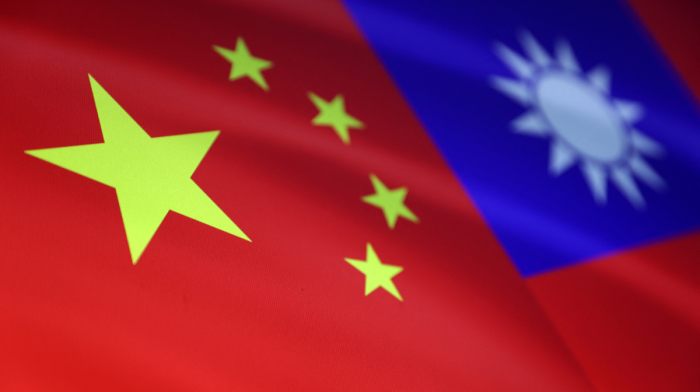
Xi warned that Taiwan remained the most important issue in U.S.-China relations and said that, if mishandled, it could push the relationship into dangerous territory.
He also posed a pointed rhetorical question to his guest — whether the United States and China could avoid what historians call the Thucydides Trap, the pattern in which a rising power and an established one historically drift towards conflict.
Business leaders meet Chinese officials
Away from the formal talks, all 17 business executives in Trump's delegation held a separate meeting with Chinese Premier Li Qiang in the north wing of the Great Hall of the People.
Musk, Cook, Huang and their counterparts from major financial and industrial firms discussed supply chains, artificial intelligence, electric vehicles and semiconductor policy with Chinese officials.
Xi told the executives that China "will only open its door wider" and that economic and trade ties between the two countries are "mutually beneficial and win-win in nature" — a message clearly designed to reassure American companies with significant exposure to China that Beijing remains open for business.
Temple of Heaven visit
The afternoon brought a change of scenery as Trump and Xi visited the Temple of Heaven together, one of Beijing's most iconic historic landmarks. Eric Trump and Lara Trump also joined the visit.
The summit continues on Friday with a bilateral tea and working lunch before Trump returns to Washington. The agenda still has significant ground to cover including trade terms, technology restrictions, Taiwan, Iran, and the question of what a more stable long-term relationship between the world's two largest economies might actually look like.
Thursday gave both sides a foundation to work from. Whether Friday produces anything concrete is the question both capitals are watching closely.















What is your opinion on this topic?
Leave the first comment