The Antalya Diplomacy Forum 2026 concluded with renewed focus on regional stability, connectivity and diplomacy amid deepening global uncertainty.
The fifth Antalya Diplomacy Forum (ADF 2026), held from 17–19 April under the patronage of Recep Tayyip Erdoğan and hosted by Türkiye’s Ministry of Foreign Affairs, once again positioned Antalya as a key venue for global diplomacy. Convened under the theme “Mapping Tomorrow, Managing Uncertainties,” the forum addressed rising geopolitical tensions and the weakening of traditional international frameworks.
Speaking at the closing press conference, Turkish Foreign Minister Hakan Fidan said the three-day event brought together 23 heads of state and government, 13 deputy leaders and 50 ministers, as well as representatives from 150 countries and 66 international organisations. More than 6,400 participants attended 52 sessions covering crises from the Middle East and Europe to Africa, Central Asia and Latin America.
Türkiye’s expanding mediation role
Fidan underscored Türkiye’s growing role as a diplomatic and mediation hub. President Erdoğan and senior officials held numerous bilateral meetings, while several key diplomatic gatherings took place on the forum’s margins. According to Fidan, the forum demonstrated Türkiye’s commitment to dialogue at a time when global polarisation is increasingly displacing diplomacy.
South Caucasus peace and strategic connectivity
A key focus was the South Caucasus. Fidan stated that Armenia and Azerbaijan have made significant progress towards a peace agreement, describing both sides as sincere. He stressed that a final deal would stabilise the region, advance Türkiye–Armenia normalisation and strengthen strategic connectivity.
Emphasising the importance of the Middle Corridor and the Zangezur Corridor linking Azerbaijan to Nakhchivan, Fidan said peace would unlock major gains in trade, energy security and regional development. He added that stability in the South Caucasus is essential for the security of these routes and noted ongoing cooperation with the European Union.
High‑level participation and regional engagement
ADF 2026 featured broad international participation, including Pakistani Prime Minister Shehbaz Sharif, Georgian Prime Minister Irakli Kobakhidze, Kazakhstan’s President Kassym-Jomart Tokayev and North Macedonian President Gordana Siljanovska-Davkova. Leaders and representatives from the Arab world, the Gulf, the Islamic world and the European Union also contributed to discussions on regional politics and security.
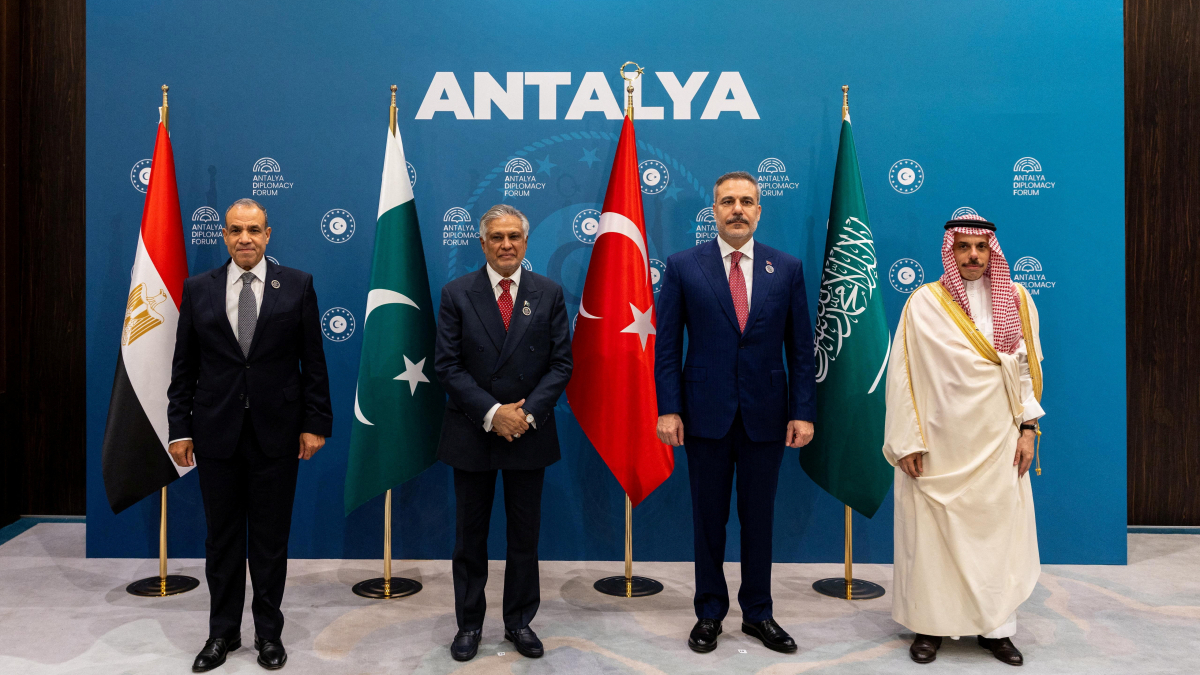
On the sidelines, a trilateral meeting between Ilham Aliyev, President Erdoğan and Prime Minister Sharif addressed regional stability and economic cooperation. Additionally, Türkiye hosted a quadrilateral meeting with Pakistan, Saudi Arabia and Egypt focused on regional stability, maritime security and cooperation. Fidan rejected claims of military alignment, stressing the group’s emphasis on development and conflict resolution.
Azerbaijan’s expanding diplomatic profile
President Aliyev’s participation reinforced Azerbaijan’s commitment to dialogue-oriented, multi-vector diplomacy. Analysts noted that the forum provided important opportunities to present Azerbaijan’s positions on the post-conflict agenda in the South Caucasus, regional normalisation and economic cooperation.
Gaza, Ukraine and broader global crises
Fidan said forums and six-country meetings addressed the Gaza peace plan, warning that Israel’s actions pose not only a regional but a global security threat. He reaffirmed Türkiye’s readiness to host further Russia–Ukraine peace talks, cautioning against global attention drifting away from Ukraine and Gaza.
He also highlighted Türkiye’s diplomacy in Africa, energy security projects and coordination among middle powers, concluding that the Antalya Diplomacy Forum has become a rare platform for dialogue, solutions and trust-building in an increasingly uncertain world.











What is your opinion on this topic?
Leave the first comment