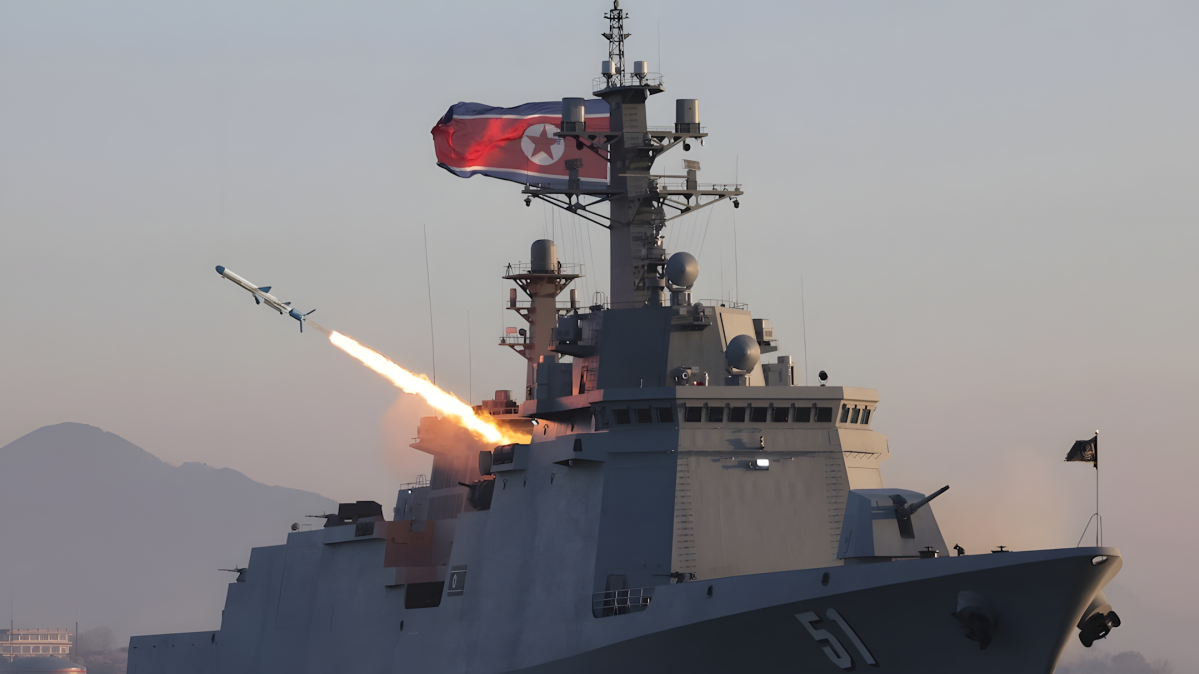
North Korea conducted a complex test-firing of strategic cruise missiles and advanced anti-warship munitions on Sunday. The drills, reported by state media on Tuesday, were framed as critical operational efficiency trials for Pyongyang's newest major surface combatant, the destroyer Choe Hyon.
According to the official Korean Central News Agency (KCNA), Supreme Leader Kim Jong Un personally observed the high-stakes test from an undisclosed location, flanked by senior defence officials and top-ranking naval commanders.
The weekend trials were highly technical in nature, according to analysts, designed to stress-test the warship's newly installed combat architecture. KCNA reported that two strategic cruise missiles - weapons potentially capable of carrying miniaturised nuclear warheads - and three conventional anti-warship missiles were fired from the deck of the Choe Hyon.
The news report said that the primary objective of the drill was to comprehensively check the warship's "integrated weapons command system." Furthermore, the live-fire exercise served to train naval crews in rapid missile-launch procedures under simulated combat conditions.
KCNA said that the tests were aimed to verify the pinpoint accuracy and, significantly, the anti-jamming performance of the missiles' upgraded navigation systems in the face of theoretical electronic countermeasures.
The projectiles were launched over the waters off the country's western coast. According to the state media report, the strategic cruise missiles remained in flight for an extended duration, ranging from 7,869 to 7,920 seconds (more than two hours), demonstrating significant loitering and range capabilities.
The anti-warship missiles recorded flight times of approximately 1,960 to 1,973 seconds before striking their designated maritime targets with what KCNA boasted was "ultra-precision accuracy."
Building a modern destroyer flotilla
Meanwhile, the KCNA report noted that on the same day as the drill, Kim Jong Un was formally briefed on the weapons system integration plans for two additional destroyers currently under construction at domestic shipyards.
This shows that preparations are underway for the launch of the third and fourth vessels of the Choe Hyon class.
Pyongyang first shocked regional defence analysts by test-firing weapons from the inaugural 5,000-ton Choe Hyon-class warship in April 2025, revealing a surface vessel significantly larger and more capable than anything previously seen in the North Korean fleet.
Subsequently, in June of that year, Kim announced ambitious plans to build two additional destroyers by the end of 2026, with the ultimate goal of commissioning two ships of the same, or a more advanced, class annually.
Lim Eul-chul, a prominent professor at Kyungnam University in South Korea, pointed out that the explicit reference to a fourth destroyer appears to be the first official, public acknowledgment that construction on that specific vessel has progressed beyond the initial planning stages announced last year.
"The mention of the third and fourth destroyers suggests North Korea is accelerating the formation of a destroyer flotilla rather than fielding isolated platforms," Lim observed.
He added that the rapid transition from initial platform testing to follow-on mass production typically only occurs once a military regime is highly confident that the core technology is reliable and successful.
Exploiting global distractions
During his observation of the drills, Kim Jong Un reiterated that strengthening the country's "nuclear war deterrent" remained his absolute top priority. He called upon his naval commanders to focus relentlessly on improving both strategic and tactical strike capabilities, demanding a posture of rapid-response readiness across the fleet.
This aggressive naval modernisation programme is not occurring in a vacuum. Regional analysts believe that Pyongyang is highly attuned to the shifting dynamics of global geopolitics and is strategically timing its military advancements.
Professor Lim suggested that North Korea's weapons development appears to be speeding up across multiple, simultaneous fronts, from solid-fuel ICBMs and spy satellites to this new class of heavy destroyers. The isolated regime, Lim argued, is actively seeking to exploit global strategic distractions, most notably the ongoing conflict in the Middle East and the protracted war in Ukraine.
By capitalising on periods when Washington and its allies are heavily focused elsewhere, North Korea aims to push ahead with irreversible, generational advances in its nuclear and conventional delivery capabilities without facing immediate, coordinated diplomatic or military pushback he said.
The North Korean embassy in Beijing did not immediately respond to a request for comment regarding the Sunday missile tests.














What is your opinion on this topic?
Leave the first comment