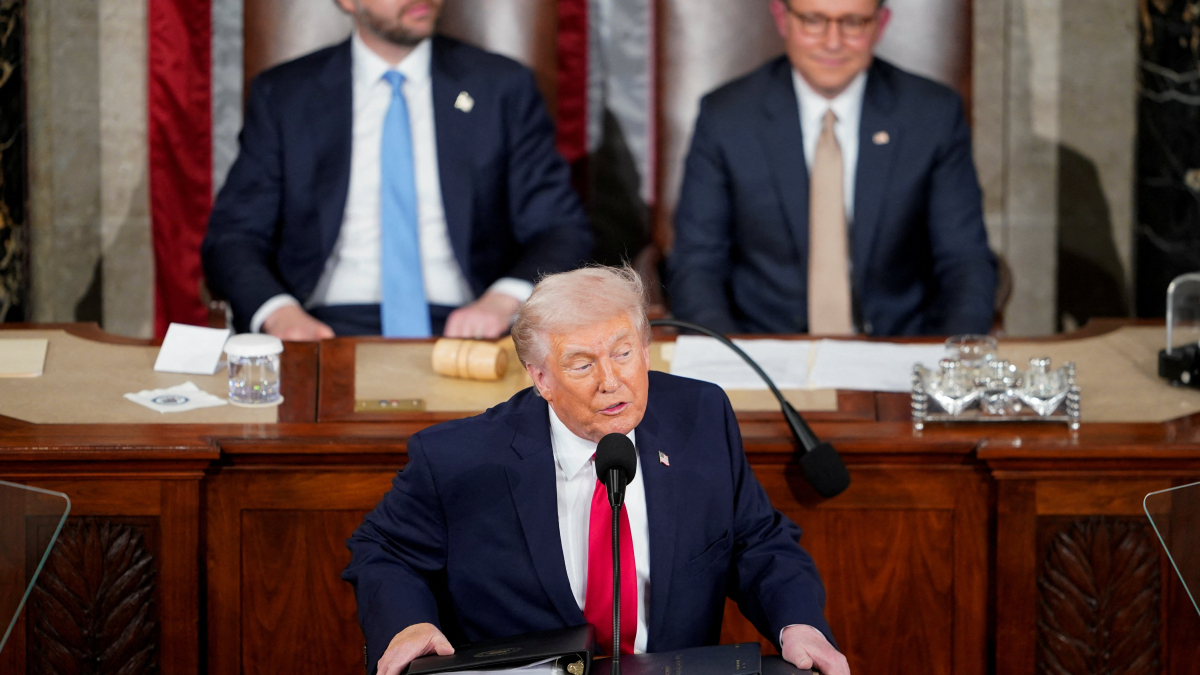
U.S. President Donald Trump’s latest State of the Union address set out a second-term agenda built on economic protectionism, military strength and a hard line on Iran, signalling a strategy that pairs diplomatic engagement with firm red lines, Assoc. Prof. Orkhan Valiyev told AnewZ Daybreak.
Valiyev said Trump’s position on Iran was one of the clearest elements of the address. While the president expressed a preference for diplomacy, he reiterated that Washington would not allow Tehran to develop nuclear weapons.
“Trump wants to contribute to the establishment of peace globally,” Valiyev said.
Firm stance on Iran ahead of Geneva talks
With talks between U.S. and Iranian officials scheduled in Geneva, Valiyev cautioned that although diplomatic engagement is under way, the outcome remains uncertain.
He noted that both sides have sent mixed signals in recent weeks, while wider regional dynamics further complicate predictions. Regional actors also hold differing positions. Turkey, for example, has publicly opposed any intervention in Iran.
“Turkey's position is clear. Turkey doesn't want any kind of intervention with Iran”, he mentioned.
As Turkish Foreign Minister Hakan Fidan has stressed, Iran’s stability is closely linked to maintaining stability across the wider region.
Valiyev characterised the U.S. approach as open to negotiation but conditional, with Iran expected to halt nuclear development as a prerequisite for any broader regional agreement.
Tariffs central to economic agenda
Beyond foreign policy, the address placed significant emphasis on economic reform. Trump reaffirmed his commitment to expanding tariffs, potentially raising them to 15 percent globally, despite legal resistance, including a ruling by the Supreme Court of the United States challenging aspects of his trade measures.
Valiyev said the administration continues to frame tariffs as essential to correcting what it describes as a weakened economy inherited from the previous government. In his view, Trump is unlikely to retreat from this position, as economic restructuring remains a core pillar of his agenda.
“Trump repeatedly mentioned that his administration inherited the weak economy from the previous administration, therefore it seems that solving this issue seems to be one of the main priorities of the Trump administration,” Valiyev added.
‘Peace through strength’ and NATO tensions
On defence, the president reiterated a “peace through strength” doctrine, highlighting military readiness and urging greater burden-sharing within NATO.
Valiyev noted that Trump’s approach towards European allies remains more confrontational than that of previous administrations, particularly over defence spending commitments. He said the message of the speech was clear: the United States intends to maintain the world’s most capable military while pressing allies to assume a larger share of responsibility.











What is your opinion on this topic?
Leave the first comment