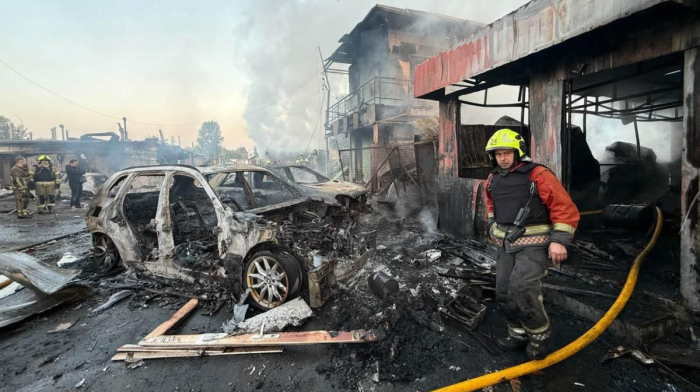
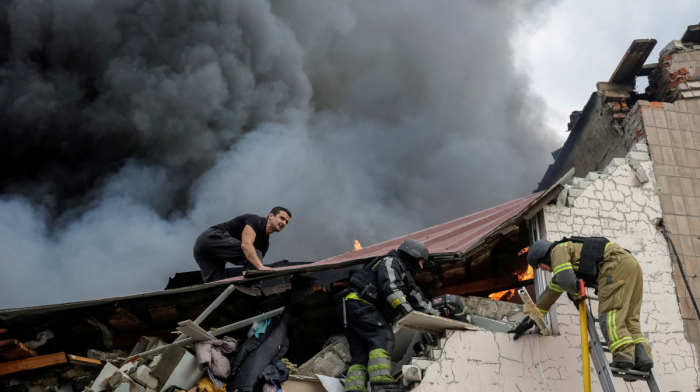
Russia launched overnight drone and missile strikes across Ukraine, targeting energy infrastructure in multiple regions, Ukrainian authorities said on Sunday (22 February).
The overnight strikes hit Kyiv and the surrounding region, the Black Sea port of Odesa and parts of central Ukraine.
President Volodymyr Zelenskyy said on X that the strikes also targeted the Dnipro, Kirovohrad, Mykolaiv, Poltava and Sumy regions. He said the main target was the energy sector, but residential buildings and railway infrastructure were also damaged.
“Moscow continues to invest in strikes more than in diplomacy,” Zelenskyy wrote, adding that Russia had launched more than 1,300 drones, more than 1,400 guided aerial bombs and 96 missiles against Ukraine this week alone.
The U.S. has been trying to broker a peace deal between Russia and Ukraine, but progress has been slow.
Moscow has demanded that Kyiv withdraw from parts of the eastern Donbas region still under Ukrainian control, a position Ukraine has rejected.
Their most recent talks, held in Geneva on 17 and 18 February, did not produce a breakthrough.
In the Kyiv region, at least one person was killed and five were wounded, with damage reported in five districts where more than a dozen houses were hit, regional governor Mykola Kalashnyk said on Telegram.
Odesa governor Oleh Kiper said a nighttime drone attack on the region’s energy facilities caused fires that were later extinguished.
Ukraine’s air force said Russia launched 50 missiles and 297 drones in the overnight attacks, and that air defence units shot down or neutralised 33 missiles and 274 drones.
“This terror cannot be normalised; it must be stopped. Russia cannot wag the world, just as the tail cannot wag the dog,” Ukrainian foreign minister Andrii Sybiha said on X, calling on the international community to impose tougher sanctions on the Kremlin.
Russia has targeted Ukraine’s energy system almost daily, striking thermal power plants and electrical substations.
Attacks on power stations, the energy transmission system and the gas sector have been central to Russia’s military campaign since February 2022.
Moscow denies targeting civilians but says Ukraine’s civil infrastructure is a legitimate target because hitting it can reduce Kyiv’s ability to wage war.
Kyiv says the aim is to harm civilians and break the country’s will.
Police officer killed in Lviv blast as suspect detained
Separately in Lviv, the National Police said a police officer was killed and 24 people injured when homemade explosive devices detonated around midnight.
“It has been preliminarily established that homemade explosive devices detonated,” the police said on the Telegram messaging service.
Police said the first explosion occurred after a patrol responded to a report of a suspected shop break-in. A second device exploded shortly afterwards.
Lviv mayor Andriy Sadovyi described the incident as “a terrorist act”.
President Volodymyr Zelenskyy said on X that police had detained a suspect, but did not provide further details.










What is your opinion on this topic?
Leave the first comment