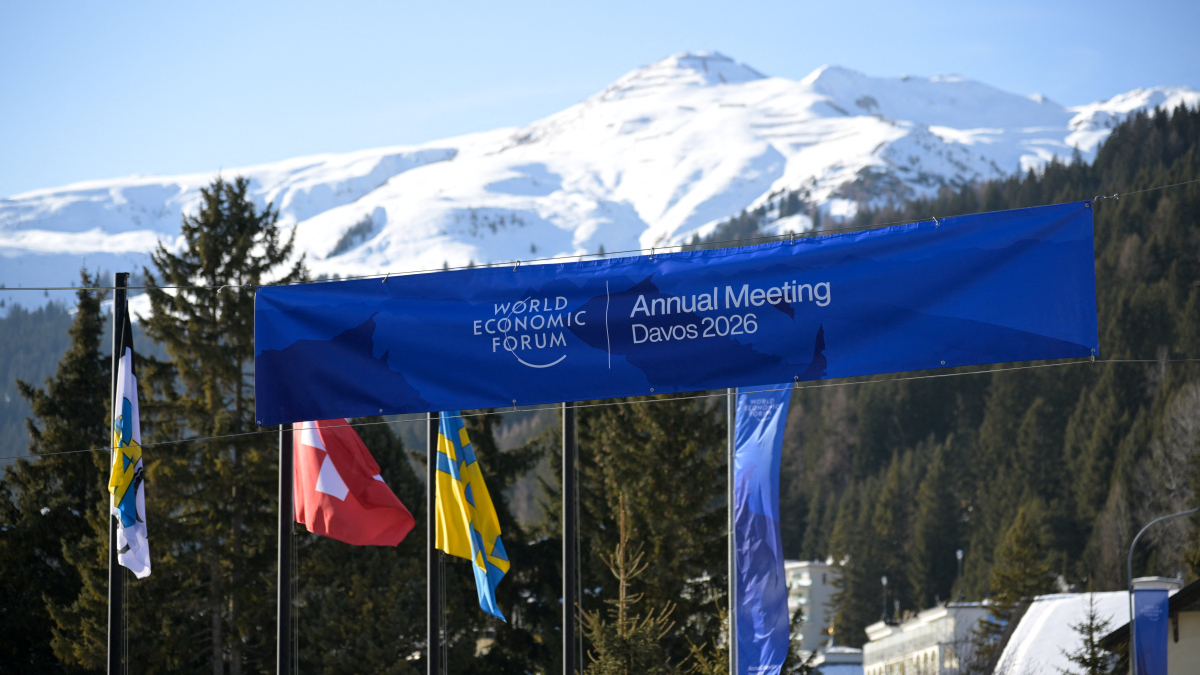
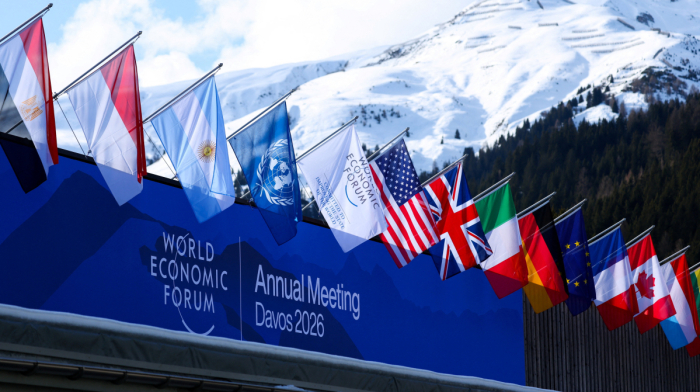
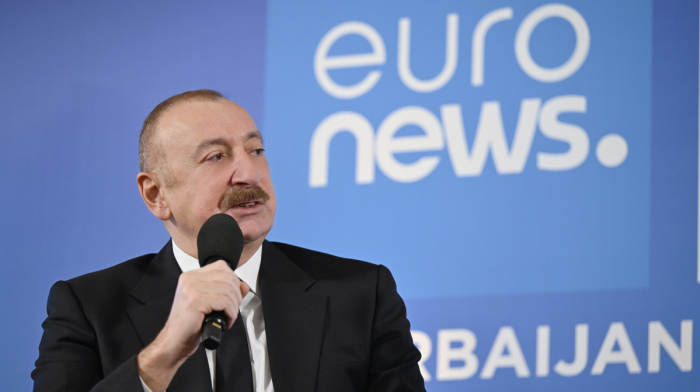
President of Azerbaijan, Ilham Aliyev outlined Azerbaijan’s economic priorities, investment strategy and regional connectivity role while speaking at the Euronews Davos Azerbaijan Executive Breakfast on the sidelines of the World Economic Forum.
Addressing international investors and policymakers, President Aliyev said Azerbaijan would continue to supply global energy markets but stressed that diversification beyond oil and gas was now the country’s top priority.
He said the non-energy sector had become the main focus of reforms, with growing interest in renewable energy, data centres and mining.
“We will definitely have more to offer to international markets,” Aliyev said, adding that diversification of the economy was now “number one priority” for the government.
Renewables and data centres
President Aliyev said Azerbaijan had already inaugurated two major renewable power stations and planned a sharp expansion in solar and wind capacity over the coming years. By 2032, he said, Azerbaijan expects to reach eight gigawatts of renewable energy generation, driven by favourable natural conditions.
Several renewable projects have already been contracted, while work has begun on storage facilities and transmission lines. Aliyev said the country’s long-term goal was to export green energy to international markets.
He also highlighted Azerbaijan’s potential as a regional hub for data centres, citing low energy costs and surplus electricity capacity. Azerbaijan currently has around two gigawatts of unused electricity capacity, which is expected to rise to eight gigawatts within six years.
“No country in our region has this extra capacity,” he said, adding that Azerbaijan offered maximum efficiency for data-intensive investments. He said discussions with international partners on this issue were already under way in Davos.
Mining and new investment areas
Aliyev identified mining as a newer but increasingly important sector, noting that much of Azerbaijan’s rare metals potential is located in territories restored to Azerbaijani control following the end of Armenian occupation.
He said large-scale geological surveys were now under way using modern technology, replacing outdated Soviet-era data. Mining, renewable energy, artificial intelligence and data centres, he said, were among the main targets for attracting foreign investment.
Connectivity and Central Asia
Turning to regional connectivity, President Aliyev said Azerbaijan’s experience building major oil and gas pipelines had shaped its broader transport strategy. As a landlocked country, Azerbaijan had been forced to develop complex cross-border projects, including a 3,500-kilometre gas pipeline stretching from Baku to Italy, which has been operational for five years.
Building on those partnerships, Azerbaijan invested heavily in rail, road, port and airport infrastructure linking the country to Georgia, Türkiye, Europe and the Mediterranean. The focus is now shifting eastward.
Aliyev noted that Azerbaijan became a full member of the Central Asian Consultative Council last year, transforming the C5 format into C6. He described the decision as recognition of Azerbaijan’s role as a reliable and neutral corridor at a time when alternative routes are constrained by sanctions.
“Avoiding Azerbaijan today means going through sanctioned areas,” he said, adding that Azerbaijan had become the safest and most practical route linking Europe with Central Asia. He also pointed to the European Union’s Global Gateway initiative, saying Azerbaijan would play a key role in its success.
Peace, trade and Armenia
President Aliyev said connectivity also served the cause of peace, noting that Azerbaijan had lifted all transport restrictions after achieving peace with Armenia. Cargo shipments from Kazakhstan and Russia have already passed through Azerbaijan to Armenia, he said, and Azerbaijan has begun supplying Armenia with critical oil products at lower prices.
He said integrating Armenia into regional transport networks would reduce isolation, create economic incentives and strengthen long-term stability through shared interests.
Aliyev says Azerbaijan faced unjust criticism over hosting COP29 and Eurovision
President Ilham Aliyev said Azerbaijan was unfairly targeted with criticism when it hosted major international events such as COP29 and Eurovision, arguing that the scrutiny went beyond what other countries faced. Speaking about COP29, Aliyev said Azerbaijan was criticised for being an oil-producing country, despite the fact that many past and future host countries produce significantly more oil.
He stressed that having oil should not be treated as a fault, saying countries should instead be judged by how they manage their resources and how fairly revenues are distributed within society. Aliyev said the intense criticism, particularly from some media outlets, was so aggressive that it was at times demoralising during the year-long preparations for COP. Despite this, he said Azerbaijan remained committed to delivering a successful summit. Aliyev added that the event proved effective both in organisation and outcomes, noting that agreements were reached on issues such as the functioning of the carbon market and the loss and damage fund, achievements he said had been stalled for a decade.
He also said the strong turnout at COP served as a response to calls for a boycott.
Growing middle class and domestic demand
Responding to questions on domestic growth, Aliyev said unemployment and poverty had both been reduced to around five per cent, helping expand Azerbaijan’s middle class and purchasing power.
He pointed to large-scale urban projects in Baku, including White City and Seabreeze, where more than 70 per cent of property buyers are local residents. This, he said, demonstrated rising incomes and confidence in the economy, while also making Azerbaijan increasingly attractive to foreign buyers.
Although overall GDP growth remains constrained by declining oil production, Aliyev said non-energy sectors continue to expand. Last year, non-oil industry grew by 5.5 per cent, while the broader non-energy economy grew by more than two per cent.
Earlier, President Ilham Aliyev held bilateral meetings and participated in a Euronews-hosted panel on the sidelines of the forum.
The Azerbaijan Executive Breakfast event was opened by Pedro Vargas David, who began his remarks by recalling the 36th anniversary of Black January, paying tribute to the more than 130 Azerbaijanis killed during the Soviet military intervention in Baku in 1990.
Vargas David praised Azerbaijan’s post-conflict stability, diplomatic role and economic reforms, describing the country as a rising investment destination and “one of the great stars for the future”. He also suggested that the leaders of Azerbaijan and Armenia deserved international recognition for achieving peace, saying the most meaningful peace prize was the support and trust of their own people.











What is your opinion on this topic?
Leave the first comment