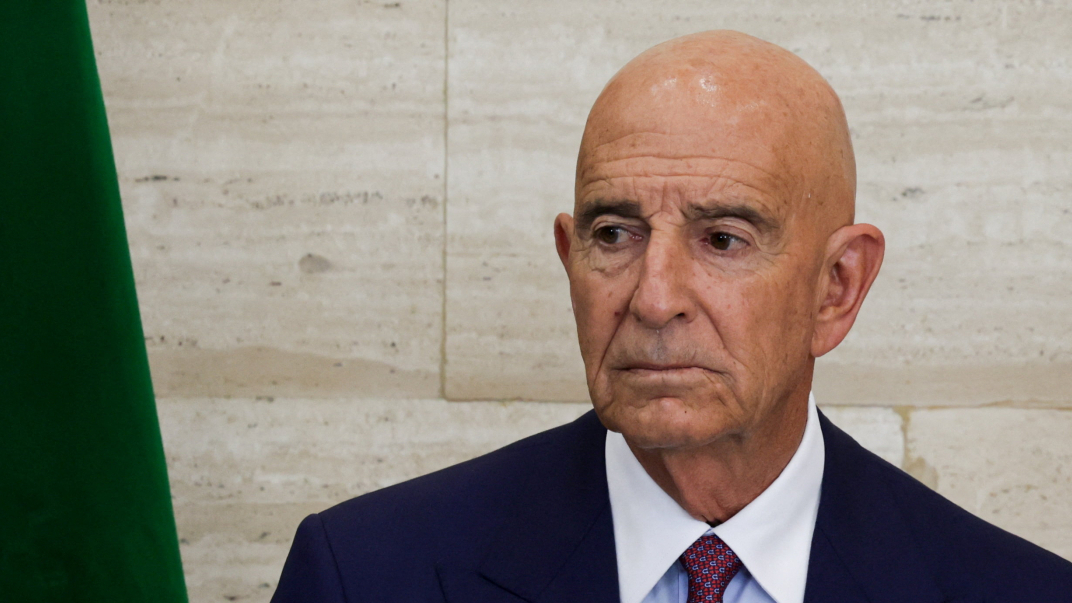
Tom Barrack, U.S. Ambassador to Türkiye and Special Envoy for Syria, expressed confidence on Friday that unresolved issues between Washington and Ankara could be resolved within four to six months, describing the relationship as strong and stable.
Speaking at a Milken Institute conference in the UAE, Barrack highlighted the close personal rapport between U.S. President Donald Trump and Turkish President Recep Tayyip Erdoğan, describing it as an “exceptional bond” that has shaped the countries’ partnership.
He underscored Türkiye’s strategic role as NATO’s second-largest ally after the European Union and criticised Europe for not seriously considering Türkiye’s accession prospects.
On Israel, Barrack said that Prime Minister Benjamin Netanyahu does not pursue a “Greater Israel” agenda, adding that the country faces multiple pressures. He argued that prosperity and trade, rather than military ambition, are the key to achieving stability.
Defence and sanctions
Barrack discussed the U.S. sanctions imposed under the Countering America’s Adversaries Through Sanctions Act (CAATSA) and long-running disputes over F-16 and F-35 fighter jets, noting that the debate has stretched over a decade. He explained that President Trump viewed the sanctions as counterproductive and acknowledged Türkiye’s defence production capabilities, including drone exports to Ukraine.
Although the U.S. has not delivered fighter jets to Türkiye, Barrack noted that Ankara has purchased Eurofighter Typhoons and remains an important participant in the F-35 programme. Türkiye’s four F-35 jets are currently in a hangar, unavailable for operational use.
He criticised short-term U.S. political cycles, pointing out that American elections occur every two years, while strategic rivals such as China and Russia plan decades ahead. “Long-term planning and technological advantage are now essential in geopolitics,” he said.
NATO and regional security
Addressing tensions within NATO, Barrack described the situation as “madness,” noting that Europe expects Türkiye to help defend the continent while simultaneously resisting Ankara acquiring advanced weapons over concerns about Russia.
He recalled a White House meeting between Trump and Erdoğan, during which six key defence issues were discussed, most of which were resolved, including matters concerning the S-400 missile system.
Barrack expressed confidence that the remaining issues could be settled within four to six months.
He also highlighted Türkiye’s role in countering Syria’s Assad regime and noted U.S. support for the new Syrian administration. He emphasised that future energy corridors linking Türkiye with Syria and Azerbaijan would offer major strategic benefits.
Referring to the Türkiye–U.S. liquefied natural gas (LNG) agreement, Barrack said LNG has become increasingly important. On the South Caucasus, he expressed hope that ongoing peace efforts between Azerbaijan and Armenia could lead to the eventual reopening of the Türkiye–Armenia border, signalling renewed regional connectivity and stability.










What is your opinion on this topic?
Leave the first comment