President Donald Trump suggested the U.S. could lift sanctions on Türkiye and allow it to buy U.S. F-35 jets as he kicked off talks with Turkish President Tayyip Erdoğan, but said he wanted Ankara to stop purchases of Russian oil.
Erdoğan's first visit to the White House in about six years comes at a time when Ankara is keen to take advantage of a U.S. administration eager to make deals in return for big-ticket arms and trade agreements.
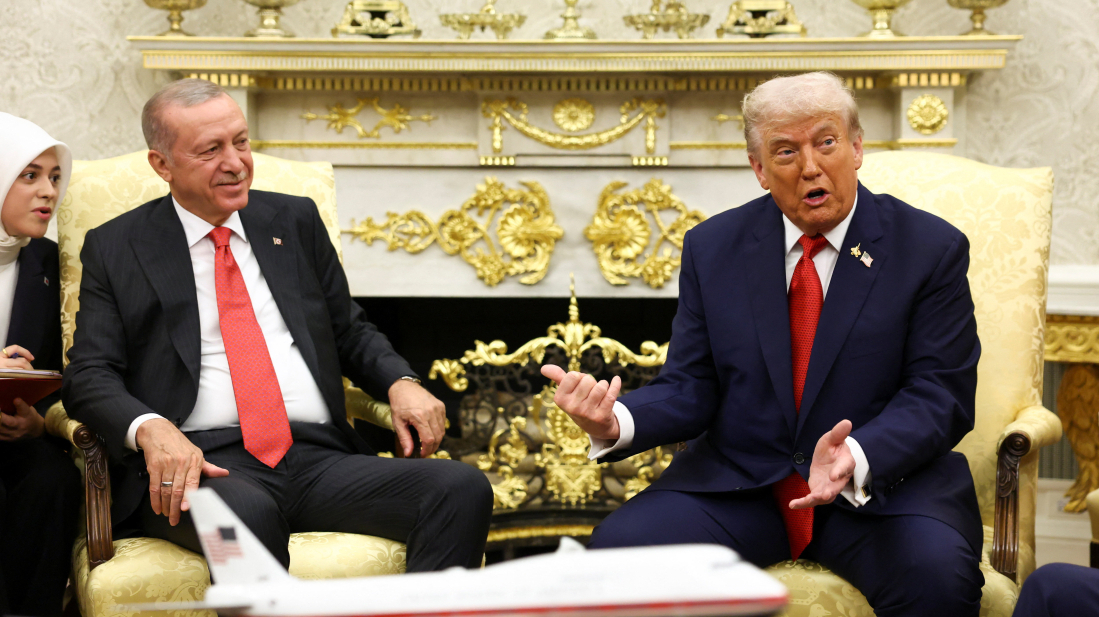
Seated side by side in the Oval Office, Trump called Erdoğan a "very tough man" and said he would like to see Turkey stop purchases of Russian oil.
Türkiye, Hungary and Slovakia are the main European purchasers of Russian oil and Trump is pressing for them to stop.
"I'd like to have him stop buying any oil from Russia while Russia continues this rampage against Ukraine," Trump said of Erdoğan.
Asked whether he was willing to make a deal to sell F-35s to Türkiye, Trump told reporters, "I think he'll be successful in buying the things that he wants to buy."
Trump also said he could lift sanctions against Türkiye "very soon," and that "if we have a good meeting, almost immediately."
He said they would discuss the issue in their Oval Office talks followed by lunch.
Former President Joe Biden had kept Türkiye at arm's length partly over what it saw as the fellow NATO member's close ties with Russia. Under Trump, who views Moscow more favorably and has closer personal ties with Erdoğan, Ankara is hoping for a better relationship.
Trump and Erdoğan, both seen as increasingly autocratic by their critics at home, had a checkered relationship during the Republican president's first term.
But since his return to the White House, their interests have aligned on Syria, source of the biggest bilateral strain in the past, where the U.S. and Türkiye now both strongly back the central government.
They remain sharply at odds over U.S. ally Israel's attacks on Gaza, which Ankara calls a genocide, a potential wild card in what are otherwise expected to be friendly and transactional talks in the Oval Office.
The mood shift has renewed Turkish hopes that Trump and Erdoğan, who have exchanged mutual praise, can find a way around U.S. sanctions imposed by Trump himself in 2020 over Turkey's acquisition of Russian S-400 missile defences.
That, in turn, could pave the way for Ankara to buy Lockheed Martin's advanced LMT.N F-35 fighter jets, for which it was both a buyer and manufacturer until it was barred over the S-400s.
Erdoğan has said the defence industry, including the topic of F-35s and ongoing negotiations over 40 F-16 jets Ankara also wants, would be a focus of the meeting, along with regional wars, energy and trade.
The U.S. has drafted a statement of intent for arms sales to Türkiye, including upgraded F-16s, but F-35s remain blocked due to Türkiye's S-400 missiles. Ankara seeks to boost air power amid regional security concerns.










What is your opinion on this topic?
Leave the first comment