A pall of mourning hangs over Hong Kong ahead of this weekend’s legislative elections, with the city struggling to process the scale of a tragedy that has claimed over 150 lives.
Sunday's poll, restricted exclusively to "patriots" vetted by Beijing, was already facing the prospect of historic apathy.
However, the mood in the financial hub has shifted from indifference to collective trauma following the catastrophic fire at Wang Fuk Court in Tai Po, now confirmed as the city’s deadliest blaze in decades.
Turnout is expected to plummet, with political campaigning appearing incongruous and subdued as the population reels from the disaster.
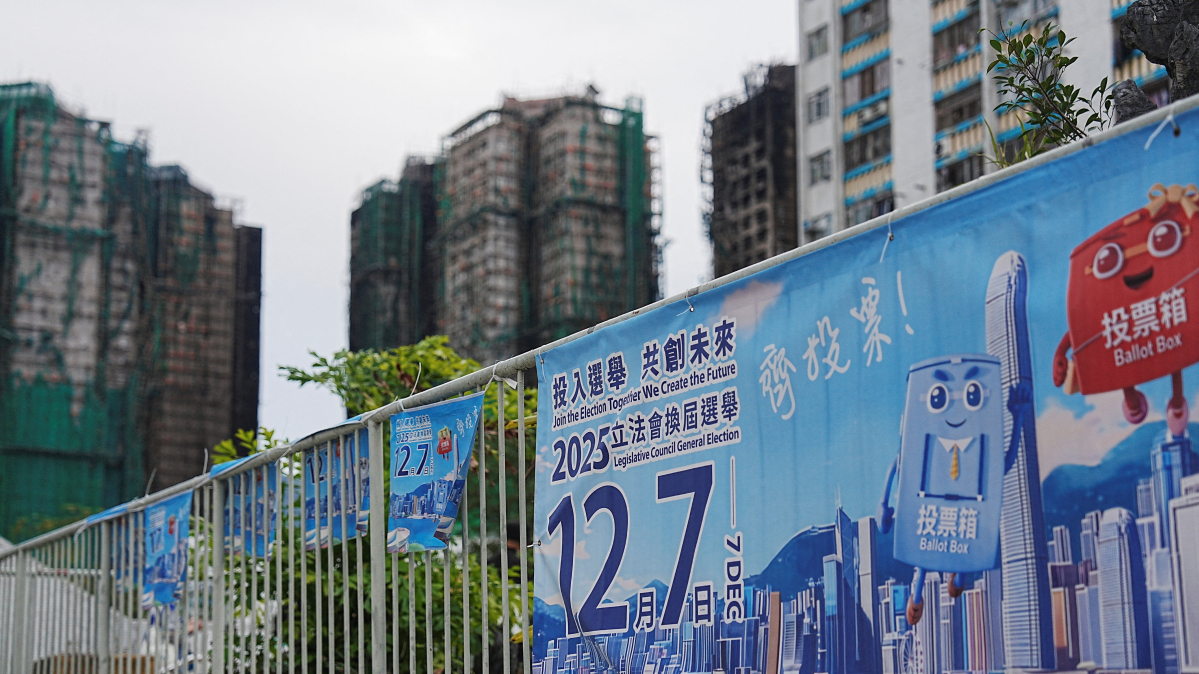
Volunteers tentatively handed out flyers and hung banners outside subway stations and crowded intersections on Friday, but they were largely ignored by residents. Campaigning activities were suspended for a few days following the fire earlier this week.
"This accident, of course, can influence the attendance of the election... [Hong Kongers] don't have the interest, the eagerness to elect people," said C.K. Lau, an 82-year-old retiree.
The vote is viewed by international analysts as a crucial test of legitimacy for the Hong Kong government. The administration is currently attempting to navigate a dual crisis: soothing public fury over the fire while overseeing an ongoing national security crackdown that has reshaped the city’s civic landscape.
Public anger has intensified after authorities admitted that substandard building materials used during renovation work at the high-rise estate in the northern Tai Po district were responsible for fuelling the inferno.
For many, the tragedy has exposed cracks in local governance, overshadowing the government's narrative of stability.
"Everyone's mood is so heavy right now," said May Li, 48. "How can we still talk about holding an election under these circumstances? It definitely has to be postponed."
Despite calls for a delay to focus on disaster relief, the government has pressed on. The current term of the Legislative Council ends on 31 December; officials argue that a delay could create a legislative vacuum, hindering the passage of emergency funds and reconstruction laws.
"Patriots Only" System
The election takes place under a revamped political system imposed by Beijing in 2021 to ensure only "patriots" administer Hong Kong. The reforms drastically reduced the number of directly elected seats and introduced a screening mechanism that effectively barred pro-democracy candidates from running.
Consequently, Pan-democrat voters—who traditionally made up about 60 per cent of Hong Kong's electorate—have largely shunned the polls. The last Legislative Council elections in 2021 recorded a turnout of just 30.2 per cent, the lowest since the former British colony returned to Chinese rule in 1997.
The number of registered voters for Sunday's polls has dropped to 4.13 million, marking the fourth consecutive annual decline since the 2021 peak of 4.47 million.
Security and Stability
In a bid to rally support, Hong Kong's national security office urged residents on Thursday to "actively participate in voting," framing the ballot as a critical step in supporting government post-disaster reconstruction efforts.
"Every voter is a stakeholder in the homeland of Hong Kong," the statement read. "If you truly love Hong Kong, you will vote sincerely."
However, tensions remain high. National security authorities have repeatedly warned against attempts by hostile forces to "exploit" the fire to incite another "colour revolution," a reference to the massive pro-democracy protests that roiled the city in 2019.
Enforcement has been swift. Four people were arrested for inciting others not to vote, the city's anti-corruption body confirmed on Thursday.
A further three were arrested for the same offence on 20 November. Under the electoral changes, publicly inciting a vote boycott is a criminal offence.
As workers on Friday began removing the charred mesh and bamboo scaffolding from the blackened skeleton of Wang Fuk Court, the city prepared for a vote that few seem eager to cast.
















What is your opinion on this topic?
Leave the first comment