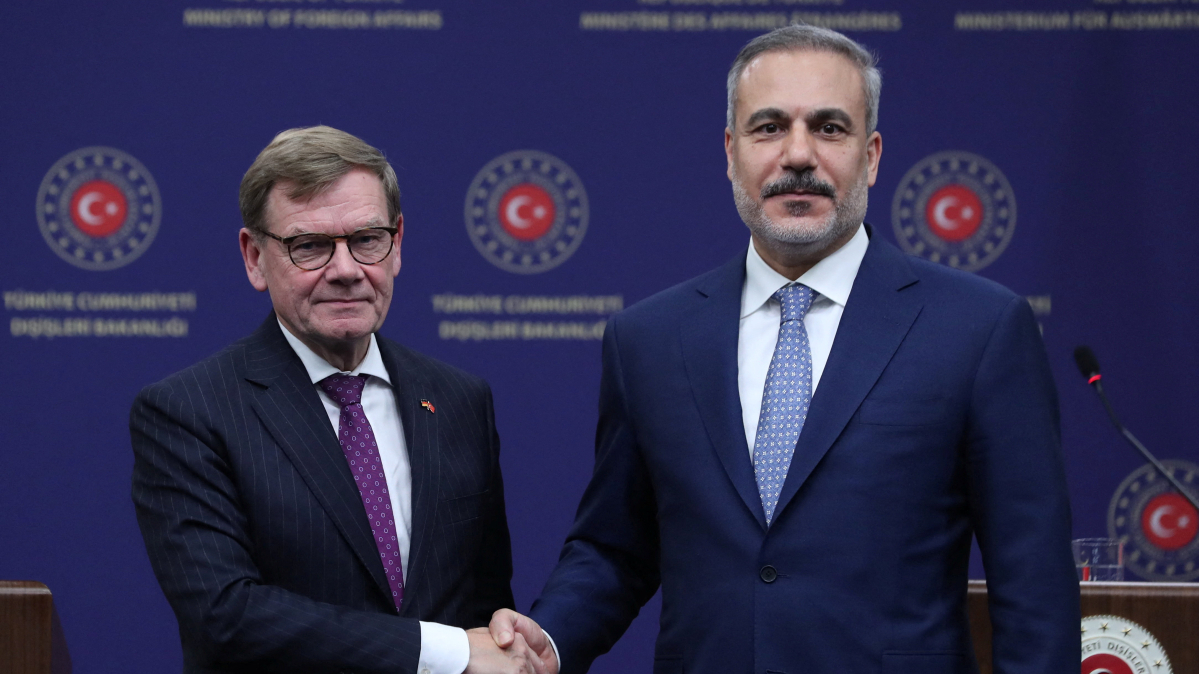
Türkiye and Germany are preparing to deepen bilateral cooperation across political, economic, and security fields, Turkish Foreign Minister Hakan Fidan said Friday during an official visit to Berlin.
Speaking at a joint press conference with German Foreign Minister Johann Wadephul, Fidan emphasised renewed momentum in relations and a shared willingness to “take cooperation to a new level.”
“There is a very strong will to advance Türkiye–Germany relations, as well as Türkiye–EU relations, even in these uncertain and crisis-driven times,” Fidan said. “As foreign ministers, we are carrying out the necessary planning and coordination.”
He noted that recent high-level visits — including trips to Türkiye by Wadephul and German Chancellor Friedrich Merz — demonstrate a shift towards stronger engagement. The next session of the Türkiye–Germany Strategic Dialogue Mechanism is expected in the first half of 2026.
Economic Cooperation Expanding
Fidan highlighted Germany’s role as Türkiye’s largest export destination globally and its top market in Europe. Bilateral trade, he said, is rising towards $60 billion, with further potential for growth.
“There is significant potential in sectors shaping the 21st century such as renewable energy, artificial intelligence, high technology, and digitalisation,” he noted.
Upcoming meetings, including the Joint Economic and Trade Committee and an energy–mining forum, are expected to accelerate investment and commercial ties.
EU Membership: Türkiye Pushes for Progress
The Turkish foreign minister reiterated Türkiye’s commitment to EU membership and urged Brussels to reopen stalled negotiation chapters.
“Türkiye has no issue with criteria-based assessments. The problem is that the accession process is not progressing,” he said, calling for renewed engagement on Customs Union modernisation, visa liberalisation, and Schengen restrictions affecting Turkish citizens.
“Our expectation remains that the EU reopens accession chapters and moves forward with Türkiye in the most normal way possible,” he added.
Security and SAFE Programme
A major focus of the talks was defence cooperation and Europe’s evolving security architecture. Fidan stressed that Türkiye must be included in the EU’s emerging SAFE (Security Action for Europe) programme, citing the country’s industrial capacity and military experience.
“European security concerns all of us,” he said. “Türkiye is not seeking cooperation under SAFE merely to be a market for defence products. Our goal is to meet strategic security needs together.”
Shared Regional Priorities
Fidan said the two ministers exchanged views on key geopolitical crises — including Ukraine, Syria, Gaza, the Balkans, and the Caucasus — where both sides share overlapping interests.
On Gaza, he called for urgent steps to implement a sustainable peace plan and avoid “a return to destruction and violence.”
On Ukraine, he reaffirmed Türkiye’s support for diplomatic solutions and said Ankara remains ready to host renewed peace talks.
Germany Calls Türkiye a ‘Geostrategic Partner’
German Foreign Minister Johann Wadephul expressed support for closer cooperation between the EU and Türkiye, calling the country an “important and reliable NATO ally.”
He said Türkiye should have a place in the EU’s $173 billion joint defence procurement programme and emphasised mutual interests in strengthening communication and collaboration.
“Now is the time to turn a new page,” Wadephul said, while noting that EU membership remains contingent on meeting standards related to democracy, the rule of law, and human rights.
A New Phase in Relations
Both ministers signalled readiness to build a more constructive partnership shaped by security challenges, economic integration, and shared regional interests.
“We have strong foundations and strong political will,” Fidan concluded. “Türkiye and Germany are ready to move forward.”











What is your opinion on this topic?
Leave the first comment