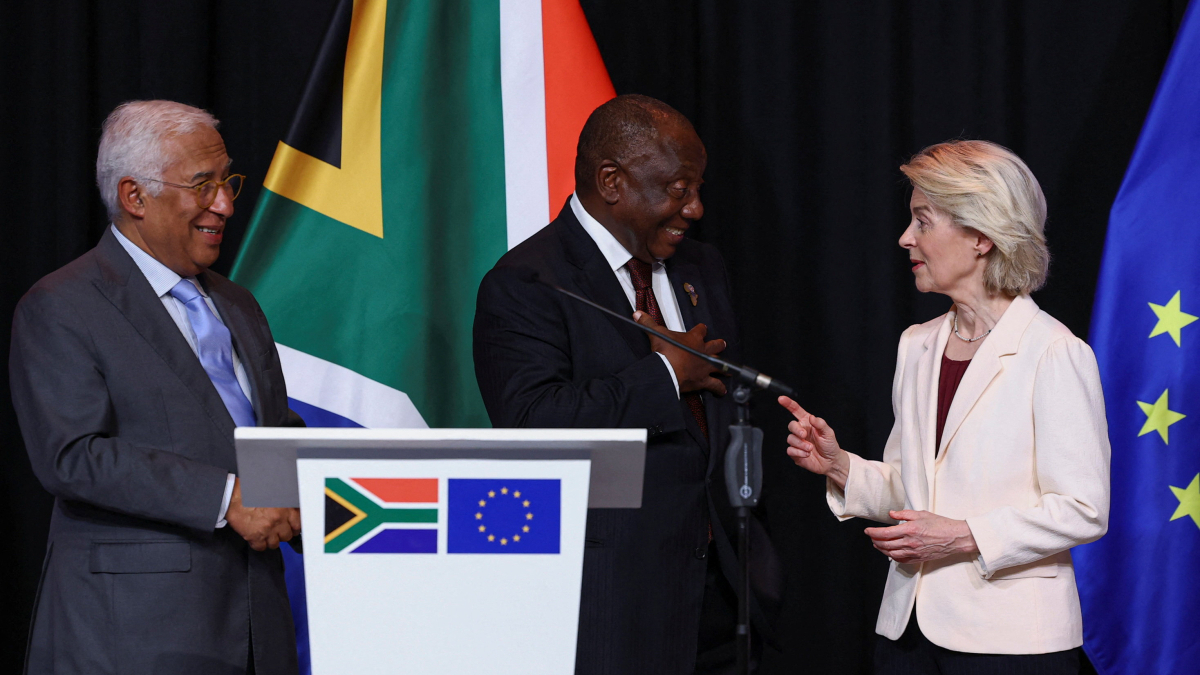
South Africa and the European Union vowed to defend multilateralism on Thursday (20 November), ahead of the G20 summit, as they signed a partnership on critical minerals.
South Africa is hosting this year's G20 gathering amid a boycott by its most powerful member, although President Cyril Ramaphosa said the United States was now considering attending in some capacity.
Analysts see a U.S. absence or any obstructive move as an opportunity for South Africa to build closer ties to the European Union and China, its two largest trading partners.
While it seems increasingly unlikely that the meeting will culminate in a substantive declaration, the first G20 in Africa is a showcase for a continent that has fast-growing economies and vast mineral wealth.
"We are signing an unprecedented agreement," Ramaphosa said at a news conference with European Commission President Ursula von der Leyen and European Council President António Costa, after Ramaphosa's mines minister Gwede Mantashe signed the memorandum of understanding.
"We are no longer going to rely on extracting minerals only. We will want to extract those minerals, have them processed at the point of extraction ... so that South Africa begins to move up the value chain," Ramaphosa said.
EU leaders are scrambling to secure dozens of metals that are vital to the world's transition away from fossil fuels to renewable energy, for the revolution in computing and for defence, as it faces potentially damaging restrictions on supply from China, the world's main supplier of rare earths.
The EU's plans include stockpiling rare earths before rivals, including the United States, and developing a 9-million-euro joint purchasing mechanism.
"We need these inputs to power the clean-energy transition both here and in Europe. So the future of our economy depends on fair and reliable supply chains," von der Leyen said.
South African officials are hoping the summit can keep multilateralism alive in international affairs, even as U.S. President Donald Trump's administration rejects this form of diplomacy.
"We agreed to stand together in defence of democracy, in defence of multilateralism, human rights and the rule of law," Ramaphosa said, in sentiments echoed by his counterparts.











What is your opinion on this topic?
Leave the first comment