South Korea faces a political crisis as acting President Han Duck-soo faces impeachment, following suspended President Yoon's controversial martial law attempt.
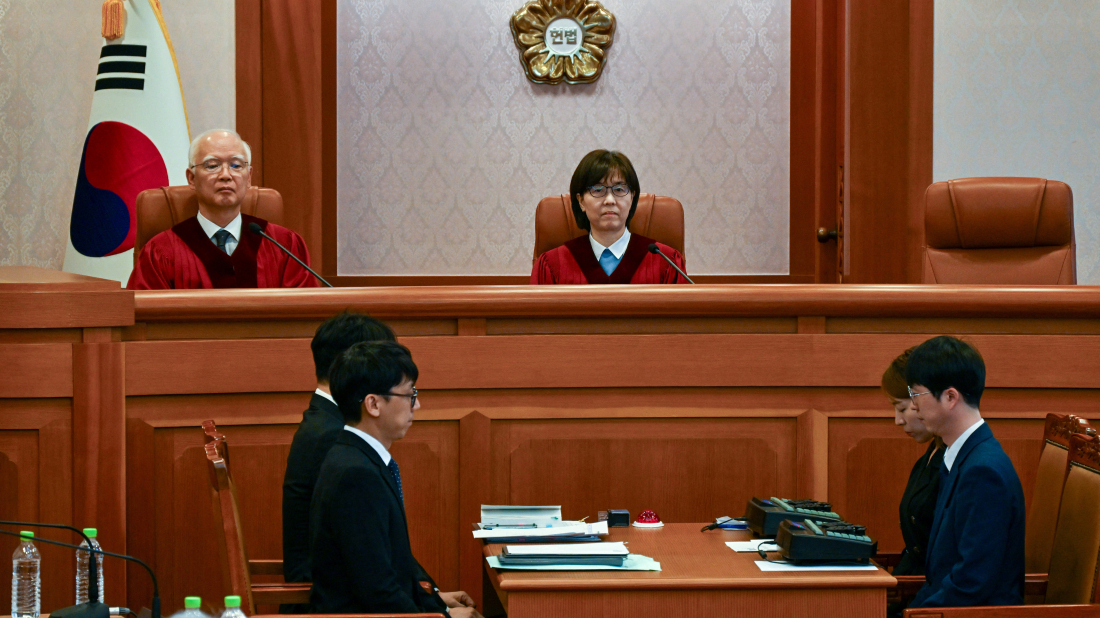
South Korea's acting president faces an impeachment vote on Friday, intensifying a political crisis as the Constitutional Court meets for its first hearing on suspended President Yoon Suk Yeol's short-lived martial law declared on Dec. 3.
The push to impeach Prime Minister Han Duck-soo, who has been acting president since Yoon was impeached on Dec. 14, has thrown South Korea's once-vibrant democratic success story into uncharted territory and watched with concern by allies.
Opposition leader Lee Jae-myung said his Democratic Party, which has majority control of parliament, will go ahead with the plan to impeach the acting president, accusing Han of "acting for insurrection".
"The only way to normalise the country is to swiftly root out all the insurrection forces," Lee said in a fiery speech, adding the party was acting on the public order to eradicate those who have put the country at risk.
There has been overwhelming public support for Yoon's removal, according to opinion polls conducted after his martial law attempt.
The plan for a vote to impeach Han was unveiled on Thursday by the main opposition Democratic Party after he declined to immediately appoint three justices to fill vacancies at the Constitutional Court, saying it would exceed his acting role.
It remained unclear how many votes are needed to impeach Han as acting leader. The threshold for a prime minister is a simple majority, while a two-thirds majority is needed for a president. It is also unclear whether Han and the ruling party would accept any outcome.
If Han is suspended, Finance Minister Choi Sang-mok will assume the acting presidency by law.
Lee's pledge to remove Han came minutes after Choi warned that impeaching the acting president would seriously damage the country's economic credibility and asked political parties to withdraw the plan.
"The economy and the people's livelihoods are walking on thin ice under a national state of emergency and it cannot cope any greater political uncertainty that will result from another acting president assuming the acting presidency," he said.
Choi spoke for the country's cabinet, flanked by ministers.
Early on Friday, the South Korean won weakened to its lowest since March 2009, as analysts said there was little to reverse the negative sentiment stemming from the political uncertainty.
The vote to determine Han's fate comes around the time the Constitutional Court on Friday will hold its first hearing in a case reviewing whether to reinstate Yoon or remove him permanently from office, after parliament's impeachment vote. It has 180 days to reach a decision.
After weeks of defiance ignoring requests by the court to submit documents as well as summons by investigators in a separate criminal case over his martial law declaration, a lawyer for Yoon said his legal representatives would attend Friday's hearing.
Seok Dong-hyeon, a lawyer advising Yoon, named two lawyers for Yoon's legal team, one a former prosecutor and the other a former spokesman for the Constitutional Court.
Yoon is not required to attend the hearing. If he is removed from office, a new presidential election would be held within 60 days.
WORST POLITICAL CRISIS IN DECADES
The events following the Dec. 3 martial law declaration have plunged the country into its gravest political crisis since 1987, when widespread protests forced the ruling party of former military generals into accepting a constitutional amendment bringing in direct, popular vote to elect the president.
The turmoil has also spilled over into financial markets.Yoon shocked the country and the world with a late-night announcement on Dec. 3 that he was imposing martial law to overcome political deadlock and root out "anti-state forces".
The military deployed special forces to the national assembly, the election commission, and the office of a liberal YouTube commentator.
It also issued orders banning activity by parliament and political parties, as well as calling for government control of the media.
But within hours 190 lawmakers had defied the cordons of troops and police and voted against Yoon's order. About six hours after his initial decree, Yoon rescinded the order.
Yoon and senior members of his administration also face criminal investigations for insurrection.











What is your opinion on this topic?
Leave the first comment