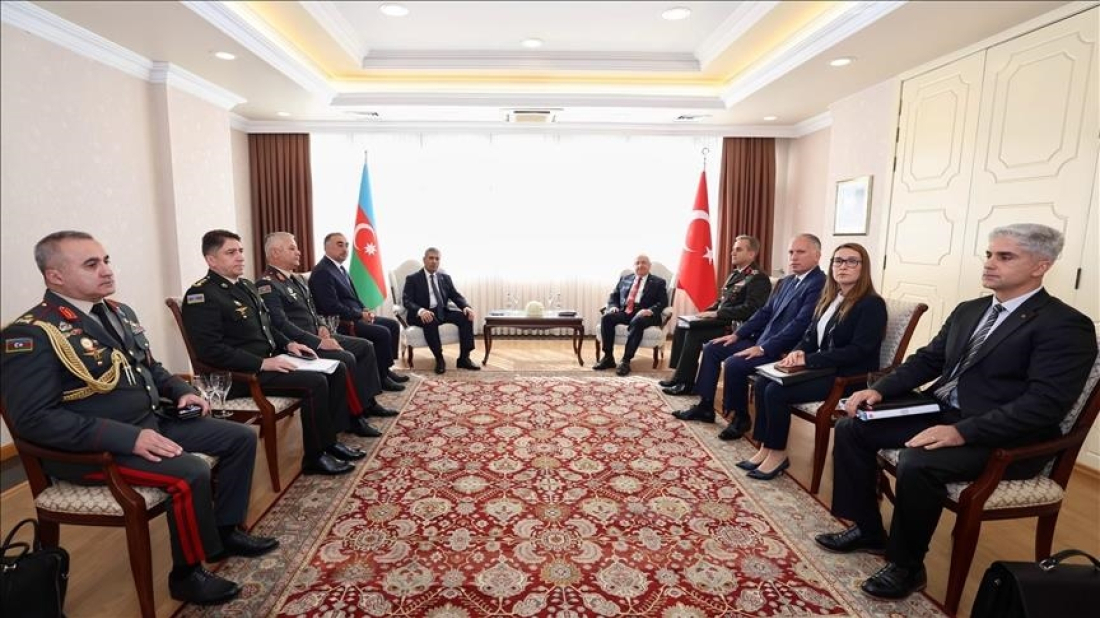
Defence ministers from Türkiye, Azerbaijan and Georgia meet in Ankara, Türkiye on Thursday which included the signing of bilateral and trilateral agreements on boosting regional security.
The Türkiye-Azerbaijan-Georgia defence ministerial meeting convened in Ankara on Thursday, Türkiye’s National Defense Ministry said.
This year’s meeting, hosted by Turkey, brings together Chikovani, Turkish Defense Minister Yaşar Güler, and Azerbaijani Defence Minister Colonel General Zakir Hasanov.
The ministers are expected to discuss strategic partnership priorities, regional defence cooperation, and collective security mechanisms, followed by the signing of a joint declaration and joint press statements.
The trilateral defence format established in 2012 has evolved into one of the most important regional security frameworks in the South Caucasus.
It aims to strengthen defence collaboration, enhance interoperability, and promote regional stability through coordinated exercises and training initiatives.
In 2023, the previous meeting held in Baku emphasised deepening defence-industrial cooperation, expanding joint drills, and aligning the three nations’ responses to regional threats.
Earlier summits in Batumi (2022) and Kars (2021) focused on border security, counterterrorism, and maritime safety in the Black Sea–Caspian corridor.
The timing of this year’s meeting carries diplomatic weight. The South Caucasus remains a region of shifting power dynamics, from the aftermath of the Nagorno-Karabakh conflict to increasing Russian military influence and regional uncertainty driven by global security tensions.
For Georgia, the trilateral framework complements its Euro-Atlantic aspirations by strengthening regional resilience while maintaining balanced relations with key neighbours. As Tbilisi faces complex internal and external pressures, defence cooperation with Turkey and Azerbaijan provides both strategic depth and political stability.
Experts note that while Georgia continues to pursue integration with NATO and the European Union, robust regional partnerships offer an essential pragmatic counterbalance, with joint military planning and intelligence sharing with Turkey and Azerbaijan viewed as stabilizing factors for Georgia’s national defence posture.
Azerbaijan will host the next session in 2026, continuing the annual rotation among the three partners.
The Turkey–Azerbaijan–Georgia triangle remains a cornerstone of regional diplomacy — linking defence, energy, and infrastructure interests such as the Baku–Tbilisi–Kars railway and South Caucasus gas corridor.
Analysts say the renewed focus on trilateral cooperation reflects a broader regional understanding: security and connectivity in the Caucasus are increasingly interdependent, and sustained dialogue among neighbours is essential for balancing influence from larger powers.
As part of the visit, Turkish Defence Minister Yasar Guler held separate bilateral talks with his Azerbaijani counterpart, Zakir Hasanov, and Georgian Defence Minister Irakli Chikovani.
Guler and Chikovani signed a protocol on military health and training cooperation, according to the ministry. The agreement is expected to enhance joint preparedness and institutional ties between Türkiye and Georgia’s armed forces.











What is your opinion on this topic?
Leave the first comment