China is set to intensify its recent push in strategic diplomacy and power projection as it hosts its annual security forum this week amidst heightened regional tensions.
Foreign diplomats and security experts expect Chinese officials to use the Beijing Xiangshan Forum to promote President Xi Jinping’s vision of the international order, unveiled earlier this month, which calls for unity against “hegemonism and power politics” – a clear swipe at the United States.
According to China’s state news agency Xinhua, around 1,800 participants from 100 countries – including government officials, military figures, and academics – will take part in the three-day forum opening on Wednesday.
For many foreign delegates, particularly from Western and neighbouring states, the gathering offers a rare opportunity to gain insights into China’s military modernisation and the workings of the People’s Liberation Army (PLA), the world’s largest armed force.
James Char, a security scholar at Singapore’s S. Rajaratnam School of International Studies, noted: “We can be sure foreign participants at this year’s Xiangshan will try to extract more technical information about some of the weapon systems from their counterparts in the PLA.”
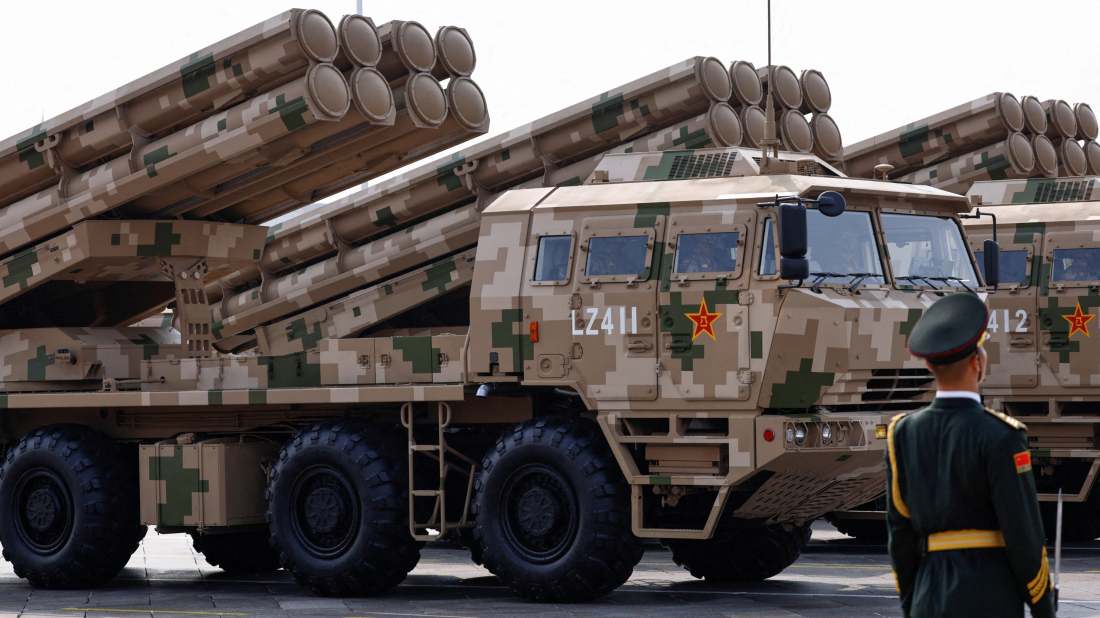
China recently showcased a range of new weaponry at its 3 September military parade, including hypersonic missiles, large underwater drones and a revamped long-range nuclear missile. However, analysts remain uncertain about their operational readiness and battlefield effectiveness.
The PLA has also undergone a turbulent period, with more than a dozen senior generals – many of them once close to Xi – purged in the past two years. Diplomats say the forum provides an opportunity to better understand the command dynamics inside the Central Military Commission, the PLA’s top decision-making body.
This comes at a time of heightened tensions across East Asia, highlighted by sea trials of China’s third and most advanced aircraft carrier in the contested South China Sea, alongside U.S. and Japanese drills in Okinawa involving the Typhon anti-ship missile system.
Despite the scale of the forum, Western and allied militaries are sending only lower-level representatives, continuing to prioritise the Shangri-La Dialogue in Singapore as the region’s premier informal security gathering. The Pentagon confirmed that Washington would be represented by the defence attaché from its Beijing embassy, a step down from last year’s deputy assistant secretary of defence.
Singapore’s Defence Minister Chan Chun Sing and Malaysia’s Defence Minister Mohamed Khaled Nordin will both be present, while South Korea will send a delegate from its state-run National Defense University. China’s Defence Ministry has confirmed delegations from Russia, France, Brazil, Nigeria, Singapore and Vietnam.











What is your opinion on this topic?
Leave the first comment