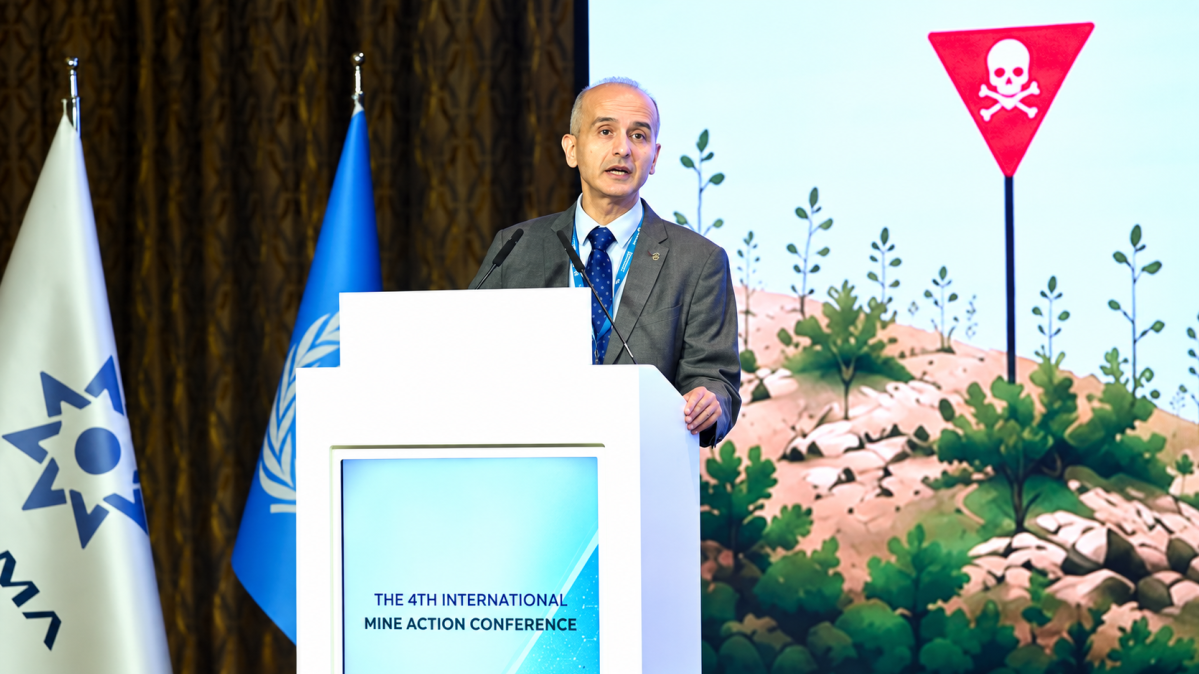
The final day of the 4th International Mine Action Conference in Baku put international cooperation, new technology and national expertise at the heart of efforts to clear landmines and support post-conflict recovery.
Hosted by Azerbaijan’s Mine Action Agency (ANAMA) and the United Nations, the conference brought together officials, development experts and mine action specialists from around the world to explore how faster and safer demining can accelerate reconstruction, enable displaced people to return home and support long-term development.
International partners reaffirm support for Azerbaijan
Several international partners used the conference to reaffirm their support for Azerbaijan's demining efforts.
Chinese Embassy Counsellor Shen Jian said cooperation between Beijing and Baku has continued to expand since the signing of a memorandum on humanitarian cooperation last year.
According to Shen, China has already provided two million yuan in financial support and plans to continue assisting Azerbaijan under the agreement. He said China has provided mine action assistance to more than 40 countries, trained over 1,000 specialists and helped return large areas of contaminated land to productive use.
The European Union also highlighted its long-term commitment to mine action in Azerbaijan. EU Ambassador Marijana Kujundžić said Brussels strongly supports Azerbaijan's approach of linking mine clearance with reconstruction, population return and regional development.
She said collective EU support for mine action in Azerbaijan has reached €22 million and described demining as a vital step towards creating safe conditions for communities and sustainable economic growth.
Demining seen as key to lasting peace
Azerbaijan's Representative for Special Assignments, Elchin Amirbayov, said mine contamination remains one of the most significant obstacles to peacebuilding in the South Caucasus.
“When we talk about peace in the South Caucasus, we should discuss not only borders but also mines,” Amirbayov said.
Although the conflict has ended, he said more than 13 per cent of Azerbaijan's territory remains contaminated with mines and unexploded ordnance. He warned that mine explosions continue to delay reconstruction and the return of people who were internally displaced.
Amirbayov called for greater international support, noting that the vast majority of mine clearance funding currently comes from Azerbaijan's state budget. He stressed the importance of investing in advanced technologies, including drones and artificial intelligence, to accelerate operations and make them safer.
Despite the scale of the challenge, he said Azerbaijan continues to carry out one of the world's largest post-conflict reconstruction programmes, with homes, schools, hospitals and transport infrastructure being rebuilt across areas affected by the conflict.
Recovery planning begins after clearance
Participants emphasised that mine clearance is only the first stage of a much broader recovery process.
Anna Soave, Head of the UN-Habitat Office in Azerbaijan, said demining activities are closely linked to the country's Great Return programme and long-term development plans.
More than 103,000 hectares (1,030 square kilometres) have already been cleared for residential settlements and supporting infrastructure, she said, while additional land has been prepared for roads, energy projects and other strategic facilities.
“New planning is underway in more than eight cities and hundreds of towns and villages, and mine clearance is merely the first step,” Soave said.
She added that integrating mine action, reconstruction and population return is helping transform cleared land into areas that can attract investment and support economic development.
Technology reshaping mine action
Innovation and technology featured prominently in the conference's discussions.
Fatih Yel of Türkiye's Mine Action Centre said technological advances are significantly reducing risks for deminers. He highlighted the growing use of drones, remote-controlled systems and artificial intelligence to identify areas that may be contaminated.
According to Yel, several mine clearance machines tested in Türkiye are capable of scanning underground areas with powerful sensors and producing detailed images of buried objects.
These systems can be mounted on unmanned ground vehicles and operated remotely, reducing personnel's direct exposure to danger. Artificial intelligence can then analyse the collected data and help identify the type of explosive present.
Speakers said such technologies are becoming increasingly important as countries seek quicker and safer ways to tackle large-scale contamination.
Building national capacity
A recurring theme throughout the conference was the importance of developing national expertise rather than relying solely on international assistance.
Elise Becker, Executive Director of the Marshall Legacy Institute, pointed to Azerbaijan as an example of successful capacity-building in mine action.
She said cooperation between the institute and ANAMA began more than two decades ago, with more than 100 mine-detection dogs provided to support operations over that period.
According to Becker, Azerbaijan has evolved from a recipient of international assistance into a country with its own highly developed mine-detection capabilities.
“It is about fostering knowledge, strengthening institutions, and ultimately ensuring national ownership and self-reliance,” she said.
She added that ANAMA has become a recognised expert in the use of mine-detection dogs and now manages the capability independently.
Lessons from other countries
The conference also provided a platform for countries affected by landmines to share lessons from their own experiences.
Tarik Serak of the Bosnia and Herzegovina Mine Action Centre outlined his country's progress since the 1992–1995 war. He said more than 80 per cent of contaminated land has been cleared since initial assessments were conducted three decades ago.
Despite the progress, he stressed that mine action remains a long-term challenge requiring sustained international support, public awareness campaigns and specialist training.
His remarks underlined a central message from the conference: effective mine action relies not only on technology and funding but also on strong institutions, skilled personnel and international cooperation.
Conference ends with call for cooperation
As the conference drew to a close, participants stressed that mine action must remain closely connected to wider recovery, development and peacebuilding.
From China's support and EU funding to technological innovation and national capacity-building, the final day highlighted the need for a coordinated international response to one of the world's most persistent post-conflict challenges.
The discussions ended with a clear message: mine clearance is not only about removing explosive hazards. It is also about allowing people to return home safely, rebuild communities and create the foundations for a more sustainable future.
Read More:












What is your opinion on this topic?
Leave the first comment