Georgia could gain a direct electricity link to Europe under plans for a new overland energy corridor connecting Azerbaijan, Georgia, Türkiye and Bulgaria, potentially reshaping regional power flows.
Georgia’s Deputy Minister of Economy and Sustainable Development, Inga Pkhaladze, said the four governments are working together on the initiative, which would capitalise on Georgia’s strategic position between the Caspian region and Europe.
A new route to European markets
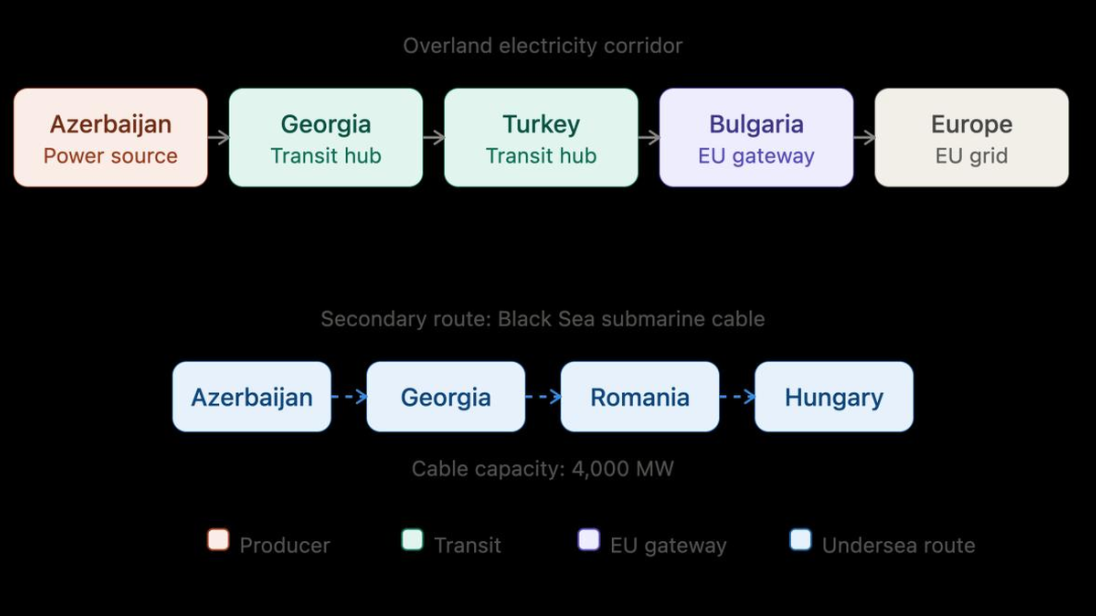
The proposed corridor would create an overland route allowing electricity to flow from Azerbaijan through Georgia and Türkiye to Bulgaria, providing access to the wider European electricity grid.
The route would not be limited to Azerbaijani electricity, potentially allowing other countries in the region to export power to European markets.
Georgia’s location makes it an important part of the project. Sitting between energy-producing Azerbaijan and European markets, the country is well placed to serve as a transit hub. However, Georgia does not border an EU member state, leaving Türkiye and the Black Sea between it and the bloc.
The proposed infrastructure could provide the direct connection that has so far been missing.
The overland project would complement another planned route involving an undersea electricity cable across the Black Sea connecting Azerbaijan, Georgia, Romania and Hungary. The cable is designed to carry up to 4,000 megawatts of electricity.
Together, the two projects form what officials are calling the "Green Energy Corridor."
Georgia targets electricity exports
Pkhaladze said the project is not solely intended to carry electricity generated elsewhere through Georgia. The country also plans to export its own power, potentially creating new opportunities for domestic energy producers and supporting further development of the sector.
The project also has a broader strategic dimension. Officials have highlighted stronger energy connectivity as a way to bolster national stability and reduce reliance on any single source of power amid the region’s complex geopolitical environment.
Plans gather momentum
The initiative has been under development for more than a year. Energy ministers from the four countries signed a memorandum of understanding in April 2025, laying the groundwork for cooperation on green electricity trade.
The project took another step forward in May 2026, when the countries agreed in Istanbul to establish a joint company to oversee financing and construction. A feasibility study is expected to begin soon.
Türkiye’s energy minister has described the project as "the TANAP of electricity."
The reference is to the Trans-Anatolian Natural Gas Pipeline, which has carried Azerbaijani gas through Türkiye towards Europe since 2018. The proposed electricity corridor would perform a similar transit role, but for power rather than natural gas.
Regional experts describe Azerbaijan as the electricity supplier, with Georgia and Türkiye providing the overland transit route and Bulgaria serving as the gateway to the EU electricity market.
Questions remain over funding and capacity
Despite the project’s ambitions, questions remain over its financing and potential capacity. Russian energy analyst Alexander Frolov has raised doubts over where the necessary funding will come from and how much electricity the corridor could realistically carry.
Frolov estimates the potential volume at between one billion and two billion kilowatt-hours, compared with France’s annual electricity exports of between 70 billion and 80 billion kilowatt-hours.
The project’s eventual scale will depend on financing, technical planning and the amount of renewable electricity the region can generate. For now, the corridor remains at the negotiation and planning stage.

















What is your opinion on this topic?
Leave the first comment