Greenland temperatures surge in warmest January on record
Greenland registered its warmest January on record, sharpening concerns over how fast-rising Arctic temperatures are reshaping core parts of the islan...
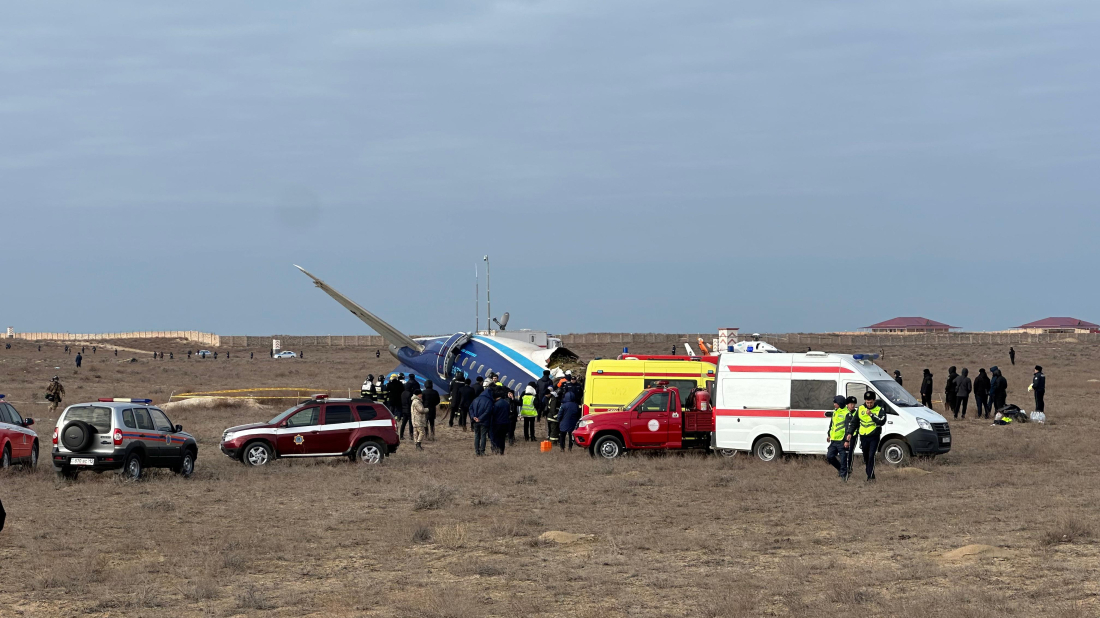
One month after the Azerbaijan Airlines crash near Aktau, the investigation suggests fuselage damage from an anti-aircraft missile. Black box data has been decoded, and results are expected next week.
Today marks one month since the Azerbaijan Airlines plane crash near Aktau, which claimed the lives of 38 people, including three crew members.
Following the tragedy, the aircraft’s black boxes were sent to Brazil’s Accident Investigation and Prevention Center for analysis before being returned to Kazakhstan. The investigation remains ongoing, but the leading theory suggests that the aircraft’s fuselage was damaged by striking elements of an anti-aircraft missile while flying over Grozny.
The preliminary results of the investigation are expected to be announced next week, according to a briefing attended by Deputy Prime Minister Kanat Bozumbayev. The investigation, conducted in accordance with International Civil Aviation Organization (ICAO) standards, involves approximately 18 experts from Kazakhstan, Azerbaijan, and Russia, along with ICAO representatives.
The black boxes have been fully decoded and remain under the supervision of the Prosecutor General’s Office investigation team. Bozumbayev stated that releasing the investigation materials would help dispel speculation surrounding the crash.
Bozumbayev also addressed circulating transcripts online, asserting that they differ significantly from the actual content of the black box recordings. He cautioned against drawing conclusions based on unverified online reports, emphasising that only official findings should be considered reliable.
The wreckage of the Embraer 190 is currently stored in a hangar in Aktau, where international experts continue their examination. Officials anticipate that the release of expert conclusions will clarify uncertainties and put to rest many speculations.

Cuba’s Deputy Foreign Minister Carlos Fernández de Cossío has denied that Havana and Washington have entered formal negotiations, countering recent assertions by U.S. President Donald Trump, while saying the island is open to dialogue under certain conditions.
Talks with the U.S. should be pursued to secure national interests as long as "threats and unreasonable expectations" are avoided, President Masoud Pezeshkian posted on X on Tuesday (3 February).
Mexico said it will stop sending oil to Cuba as U.S. President Donald Trump ramped up pressure on the Caribbean nation.
Elon Musk’s rocket company SpaceX has acquired his artificial intelligence firm xAI, as the billionaire moves to bring more of his technology businesses under one structure.
Ukrainian President Volodymyr Zelenskyy accused Russia on Tuesday (3 February) of exploiting a U.S.-backed energy ceasefire to stockpile weapons and launch large-scale drone and missile attacks on Ukraine ahead of peace talks.
Another shipment of grain was sent to Armenia via transit through Azerbaijani territory on 4 February. The latest delivery consisted of eight wagons carrying 560 tonnes of grain dispatched from Azerbaijan to Armenia.
Azerbaijan and Armenia used a high-profile international platform in Abu Dhabi on Tuesday to underline growing trade ties, expanding cooperation and what both leaders described as an irreversible turn towards peace after decades of conflict.
Afghan officials and international partners met in Kabul on Wednesday (4 February) for the fourth meeting of the Doha Process Working Group on Counter-Narcotics, with officials citing a reduction in poppy cultivation to “nearly zero” as efforts to curb drug production and trafficking were reviewed.
Uzbekistan is accelerating plans to expand uranium production and deepen international nuclear cooperation, positioning the sector as a pillar of long-term industrial growth and resource security.
Kazakhstan President Kassym-Jomart Tokayev is visiting Pakistan as both countries seek to expand trade and unlock new transport routes linking Central Asia to the Indian Ocean, despite ongoing security and infrastructure challenges.
You can download the AnewZ application from Play Store and the App Store.
What is your opinion on this topic?
Leave the first comment