A Russian general personally ordered the missile strike that brought down an Azerbaijan Airlines passenger plane last December, according to an investigative report by Minval Politika.
According to the outlet, the fatal strike was ordered by Russian Major General Alexander Tolopilo, who commanded the 51st Air Defense Division.
Citing internal military communications and official sources, Minval Politika reconstructed a timeline of the incident. At 03:26, a “Drone Threat” alert was issued across regions in the North Caucasian Federal District of the Russian Federation. The alert remained active until 12:00 that day.
The warning was passed through the chain of command — including Colonel Gennady Eremenko of the 4th Guards Air and Air Defense Army, Lieutenant Colonel Nikolai Orlyansky, and other regional and central situation centers.
At 08:05, a heightened alert known as "Carpet" was activated in North Ossetia–Alania to protect civilian aviation. Orlyansky reported this to Colonel Eremenko, Colonel P.A. Gusev of the Aerospace Forces, and General Tolopilo.
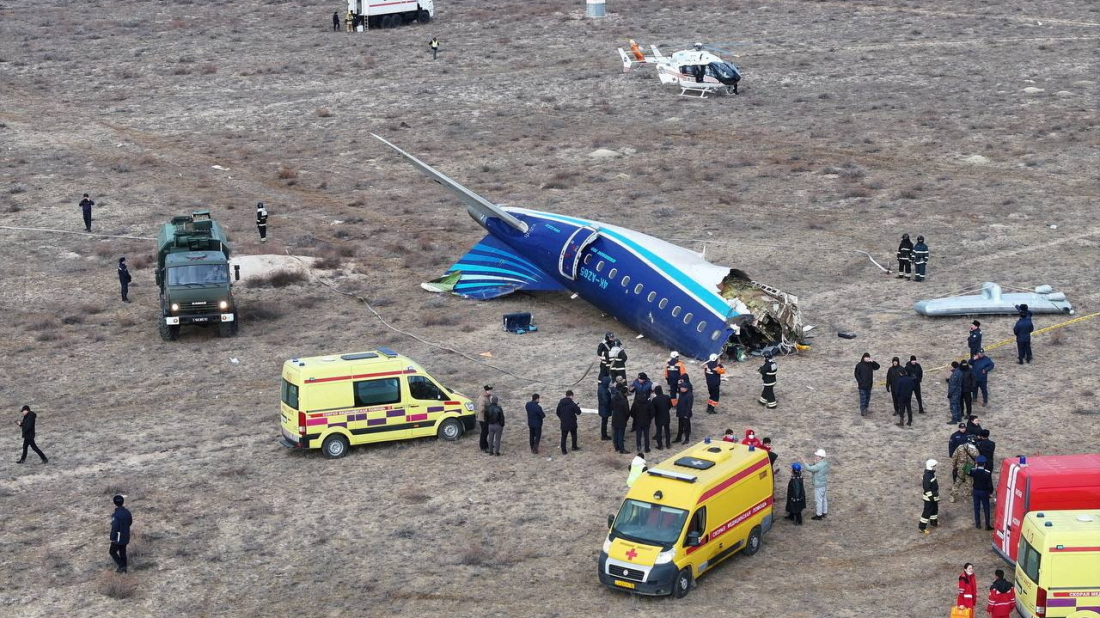
Later that morning, a civilian aircraft — AZAL flight Embraer 190 — was mistakenly identified as a threat. A voice recording obtained by Minval Politika captures the moment of the missile launch. The speaker is identified as Captain Dmitry Paladichuk, the officer who carried out the strike. According to the outlet, the audio messages were recorded by Paladichuk himself and were intended for his fellow servicemen in response to their questions about the incident.
In the recording, Paladichuk receives real-time commands and then reflects on the aftermath:
“Azimuth 338. Distance 7000. Altitude 490. Speed 118. Bearing 230. Yes, distance is already 7. Fire! I said fire!... There’s a hit. Missed. Again. There’s the hit...”
He later admits:
“My azimuth and distance were completely off — the plane was in a different direction entirely. I fired… And then they said the plane fell somewhere there.”
The audio, which contains heavy use of explicit language, offers a direct and unfiltered account of the strike. Paladichuk acknowledges targeting errors, describes how the missiles may have locked onto the aircraft by default, and suggests the decision was made without full situational awareness. The aircraft was reportedly not under radar tracking at the time.
Minval Politika reports that the plane was possibly downed at a range of 500–600 kilometers, and that the strike was carried out based on assumptions rather than confirmed threat identification.
The Embraer 190 flight carried a total of 67 people (62 passengers and 5 crew). Of those, 38 were killed and 29 survived the crash near Aktau, Kazakhstan. Official Russian sources have not publicly confirmed or denied the findings of this investigation.


















What is your opinion on this topic?
Leave the first comment