With its EU accession talks frozen and its strategic partnership with Washington suspended, Tbilisi has formalised a new alliance with Astana centred on trade, transport and a shared vision for Eurasia's next major trade corridor.
A strategic shift east
Georgia and Kazakhstan have signed a strategic partnership agreement in Astana, marking the most significant formal alliance Tbilisi has concluded in years - and arguably its most geopolitically significant.
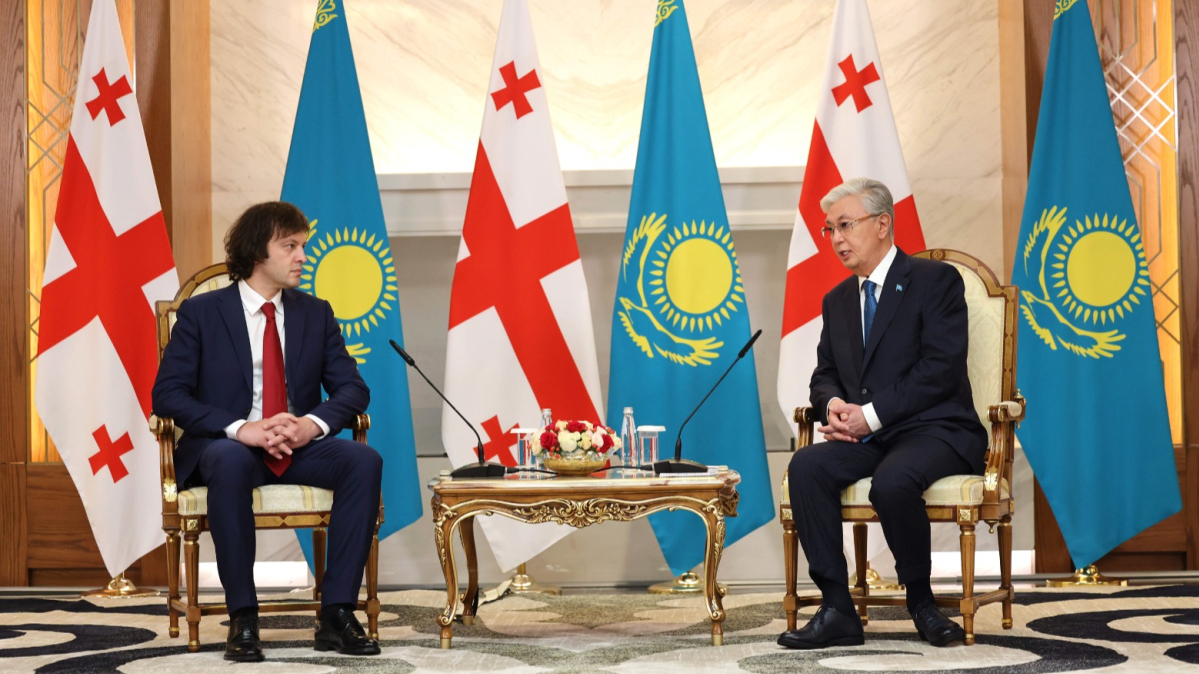
Georgian Prime Minister Irakli Kobakhidze met Kazakh President Kassym-Jomart Tokayev at the Presidential Palace to sign the joint declaration, elevating bilateral ties to an unprecedented level.
The agreement comes at a time when Georgia's traditional Western partnerships are under severe strain. Its EU accession process has been suspended until at least 2028, the U.S. has ended its strategic partnership with Tbilisi, and both Brussels and Washington have imposed sanctions on Georgian Dream officials.
Against that backdrop, the alliance with Kazakhstan is more than a trade agreement - it is a clear statement of strategic direction.
What the agreement covers
The partnership agreement was signed by Kobakhidze and Tokayev after both a private meeting and expanded talks involving the full delegations from both governments.
Georgia's delegation included Deputy Prime Minister and Foreign Minister Maka Bochorishvili, Economy Minister Mariam Kvrivishvili, and Environment and Agriculture Minister Davit Songulashvili.
Alongside the strategic declaration, the two sides signed memoranda of understanding covering cultural cooperation, information technology and tourism. A separate meeting between Kobakhidze and Kazakh Prime Minister Olzhas Bektenov, attended by ministers from both countries, focused on trade and transport links.
Tokayev awarded Kobakhidze the Order of Friendship, First Class - Kazakhstan's highest state honour for contributions to bilateral relations.
The Georgian prime minister thanked Kazakhstan for its explicit support for Georgia's sovereignty and territorial integrity, a politically significant position given Georgia's ongoing disputes over the Russian-occupied regions of South Ossetia and Abkhazia.
Georgia's deteriorating Western ties
In November 2024, Georgian Dream announced it would suspend EU accession talks until 2028, triggering mass protests that police dispersed by force.
The U.S. responded by suspending its strategic partnership with Georgia and imposing sanctions on key figures, including oligarch Bidzina Ivanishvili, widely regarded as Georgian Dream's de facto leader.
The EU halted Georgia's accession process and threatened additional measures. By mid-2025, Georgia had refused Western budgetary support and withdrawn from European parliamentary structures. More than 250 Georgian officials remained under Western sanctions.
Relations with Moscow, meanwhile, quietly deepened, including a notable increase in Russian gas imports.
The Middle Corridor: the real prize
Beneath the diplomatic ceremony lies a far more significant strategic objective.
Both countries have invested considerable political and financial capital in the Middle Corridor - formally known as the Trans-Caspian International Transport Route - a multimodal network of railways, roads and maritime links connecting China with Europe via Kazakhstan, the Caspian Sea, Azerbaijan, Georgia and Türkiye, bypassing Russian territory altogether.
For Kazakhstan, Georgia is more than a friendly partner. It is the essential western gateway through which Kazakh exports reach the Black Sea and European markets.
For Georgia, Kazakhstan provides the vast hinterland that underpins its ambitions as a regional transport hub.
The economic relationship has expanded rapidly.
Rail freight between the two countries exceeded 159,500 tonnes during the first half of 2025, up 67 per cent compared with the same period a year earlier.
Kazakhstan has also invested directly in Georgian infrastructure. A Kazakh-operated container terminal at the port of Poti, with an annual design capacity of 120,000 TEU, represents the country's first major infrastructure project at one of Georgia's principal maritime gateways.
Astana describes the terminal as part of a unified logistics network linking East Asia and Europe, complementing facilities it already operates in the Chinese cities of Lianyungang and Xi'an.
"Once goods cross the Caspian through Azerbaijan, Georgia becomes the main gateway connecting Central Asia to Black Sea ports and European markets."
The energy dimension is equally important.
Both governments have expressed support for establishing a unified energy corridor linking Central Asia with Europe by combining Kazakhstan's Trans-Caspian energy project — developed alongside Azerbaijan and Uzbekistan — with Georgia's planned high-voltage Black Sea electricity cable.
If realised, the project would create a significant new export route for Kazakh energy to European markets while reducing reliance on infrastructure crossing Russian territory.
Kazakhstan's calculated westward strategy
For Astana, the partnership with Georgia fits into a broader geopolitical repositioning.
Kazakhstan has entered the world's top 50 economies, with GDP expected to approach US$320 billion in 2026. Its leadership increasingly seeks to define the country not simply by its geography, but by the strategic advantages that geography provides.
The Middle Corridor sits at the heart of that strategy, offering a way to diversify export routes, reduce dependence on both Russia and China, and strengthen economic links with Europe.
In 2025, Kazakhstan became one of the EU's three largest crude oil suppliers alongside Norway and the U.S., reflecting Europe's drive to reduce Russian energy imports and Kazakhstan's growing production.
Georgia, positioned at the western end of the corridor, is therefore not a peripheral partner but a strategic necessity.
However, analysts caution that ambition still outpaces reality.
Capacity constraints at Caspian ports, railway bottlenecks, customs inefficiencies, limited ferry services and fragmented cross-border coordination continue to hinder progress.
The route also struggles to compete with northern corridors on both cost and transit times.
Whether the strategic partnership translates into the sustained investment needed to make the Middle Corridor genuinely competitive remains an open question.
Georgia's shifting geopolitical compass
For Georgia, the partnership cannot be separated from domestic politics.
Once regarded as one of the Eastern Partnership's success stories, Georgia's EU integration has effectively stalled since June 2024.
Georgian Dream insists it remains committed to EU membership, but only on its own timetable and conditions.
Critics, including the European Parliament and several human rights organisations, argue that this amounts to a broader geopolitical realignment.
Although Georgia received EU candidate status in 2023, Georgian Dream later announced it would postpone efforts to open accession negotiations until at least 2028 - a self-imposed delay widely viewed as signalling greater distance from Western integration.
Meanwhile, Georgia has steadily strengthened ties further east.
It signed a strategic partnership with China in 2023, and the agreement with Kazakhstan continues that trend.
Countries once regarded as peripheral are becoming strategically indispensable, and Georgia is among the clearest examples as its position along the Eurasian transit route increases its geopolitical value beyond its military or economic weight.
For Georgian Dream, that geography is an asset that can be leveraged independently of Western support.
For critics, it represents strategic leverage that is being squandered - or redirected.
The Trans-Caspian International Transport Route stretches from China through Kazakhstan, crosses the Caspian Sea by ferry to Azerbaijan, then continues through Georgia to Türkiye and European markets.
Its principal advantage is that it avoids Russia entirely - a feature that became commercially significant after 2022.
However, a World Bank assessment has highlighted persistent logistical and cost challenges.
Experts remain divided over whether the corridor can develop into a genuine alternative to northern trade routes or remain a supplementary route carrying only a small share of Eurasian freight.
What happens next
The practical significance of the Astana declaration will ultimately depend on implementation.
Strategic partnerships establish frameworks for cooperation and signal political intent, but they do not build ports, railways or harmonise customs procedures.
The real test will lie in delivering the agreements signed alongside the declaration, accelerating infrastructure investment and coordinating effectively enough to reduce the bottlenecks that continue to limit freight volumes.
Kazakhstan accounted for 12.8 per cent of Georgia's total exports in 2025, making it the country's second-largest export destination - a position that would have seemed improbable a decade ago.
The commercial relationship is already substantial.
Whether this strategic partnership accelerates that growth or remains largely symbolic will shape both countries' positions on the emerging Eurasian trade map over the coming decade.













What is your opinion on this topic?
Leave the first comment