Hundreds of protesters and emergency services clashed in a remote Northern Territory town overnight following the arrest of a man suspected of abducting and murdering a five-year-old Indigenous girl, police confirmed on Friday.
The suspect, 47-year-old Jefferson Lewis, was subjected to vigilante violence before authorities could apprehend him. Northern Territory Police Commissioner Martin Dole said Lewis was found by residents and beaten unconscious late on Thursday night.
"He presented himself to one of the town camps in Alice Springs last night. As a result of presenting himself, members of that town camp decided to inflict vigilante justice upon Jefferson," Commissioner Dole said at a Friday morning news conference.
The victim, a five-year-old girl now referred to by her family as Kumanjayi Little Baby in line with Indigenous cultural customs surrounding the deceased, went missing from her home on the outskirts of Alice Springs late on Saturday.
After a large-scale community search, her body was found on Thursday afternoon by a volunteer in bushland near the town, a key gateway for tourists visiting the Australian outback.
Police had identified Lewis as the main suspect earlier in the week. Authorities confirmed he has previous convictions for serious assault and had recently been released from prison, fuelling anger over the justice and parole systems.
Suspect moved to Darwin amid hospital unrest
Tensions escalated on Thursday evening as news spread of the suspect’s capture and hospitalisation.
An estimated 400 people gathered outside Alice Springs Hospital, where Lewis was being treated for his injuries. Commissioner Dole told public broadcaster ABC that the crowd attempted to force entry into the facility.
Footage broadcast by ABC showed groups of Indigenous people calling for “payback” - a term referring to traditional forms of punishment within Aboriginal communities.
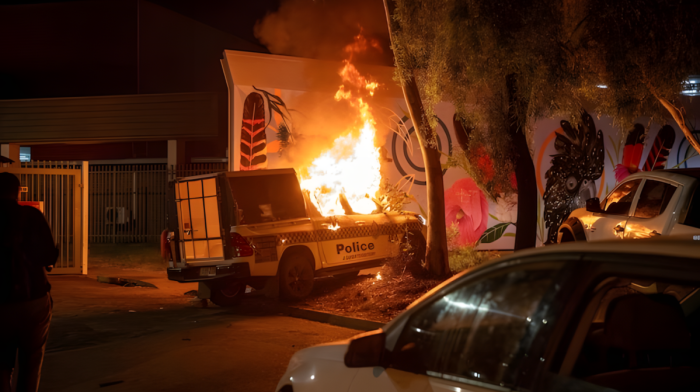
Police deployed tear gas to prevent the crowd from entering the hospital. The move intensified the confrontation, with some protesters throwing projectiles and lighting fires in the street.
Several police officers and medical staff were injured, and emergency vehicles, including ambulances and fire trucks, were damaged.
"There is absolutely no excuse for violence against emergency services that are just doing their job," Dole said. "I just call for calm across the community today ... I'd like to think that what we saw last night is an aberration."
Due to concerns for his safety, Lewis was transferred from the hospital and flown to Darwin in the early hours of Friday.
Government response and wider tensions
The violence has drawn national attention. Prime Minister Anthony Albanese said he understood "people's anger and frustration" but urged the community to remain peaceful.
Northern Territory Chief Minister Lia Finocchiaro announced a one-day ban on takeaway alcohol sales and confirmed additional police would be deployed from Darwin.
Alcohol restrictions are already in place in Alice Springs on certain days as part of efforts to reduce domestic violence and crime.
However, the incident highlights deeper, long-standing issues. Australia has struggled to address inequalities affecting its First Nations people, who have lived on the continent for around 50,000 years but were dispossessed and marginalised following British colonisation.
Indigenous Australians make up about 3.8% of the population. They face significantly poorer outcomes in health, education and employment, and higher rates of suicide, chronic illness and incarceration.
Many Indigenous families, including the victim’s, live in “town camps” on the outskirts of Alice Springs. These communities often experience overcrowding, poor housing and limited access to essential services.
For some residents, concerns over police response times and the release of violent offenders have reinforced a belief that Indigenous lives are not valued equally - a sentiment that contributed to the unrest outside the hospital.











What is your opinion on this topic?
Leave the first comment