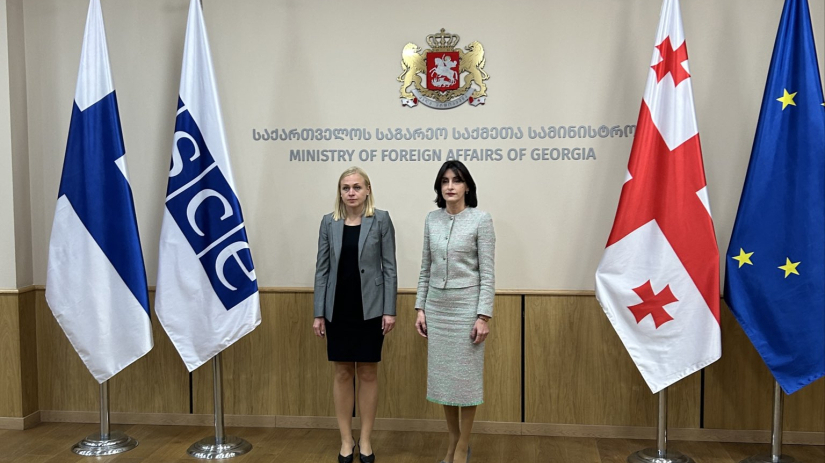
A planned meeting between Georgian Prime Minister Irakli Kobakhidze and the OSCE Chairperson-in-Office, Finnish Foreign Minister Elina Valtonen, was abruptly cancelled this week.
The Georgian government announced that the meeting was called off “due to participation in an illegal rally and false statements” by Valtonen, who had visited a demonstration outside the Parliament building in Tbilisi a day earlier.
Officials accused the Finnish minister of violating Georgian law and the Vienna Convention, claiming her actions amounted to open support for what they called “radical groups.”
Parliament Speaker Shalva Papuashvili said Valtonen had “insulted Georgian society” and accused her of “instrumentalizing international institutions” against Georgia’s democracy. Several lawmakers echoed those remarks, calling her visit a “violation of sovereignty.”
Valtonen firmly rejected the accusations. According to Finnish media, she said the meeting’s cancellation was initiated by her delegation because of scheduling changes. She added that her brief stop at the protest was intended to observe ongoing demonstrations and express support for freedom of speech — a key OSCE principle.
“I was there to see the demonstrations that have been taking place for weeks and to express my support for freedom of speech.
"In this spirit, as Chair of the OSCE and 50 years since the signing of this document, I invite you,
@PM_Kobakhidze to come to Finland, meet the free press and observe any demonstration to your liking" she said in a post shared on her X account.
During her stay, the OSCE Chair also visited the occupation line near the village of Odzisi, praising the work of the EU Monitoring Mission and reaffirming Finland’s “firm support” for Georgia’s sovereignty and territorial integrity. In her words, “We call on Russia to fulfil its obligations under the 2008 agreement and return to its pre-conflict positions.”
However, Georgian officials saw a contradiction in her message. “What is the value of a statement of support for sovereignty in Odzisi when you yourself violate sovereignty on Rustaveli Avenue?” Papuashvili said, referring to Valtonen’s earlier appearance at the protest site in central Tbilisi.
The Georgian Ministry of Internal affairs has also announced that Valtonen was fined 5000GEL (about $1800) for blocking the road on Rustaveli Avenue.
The incident underscores growing strain between the Georgian government and Western institutions over democratic standards, rule of law, and freedom of assembly — issues that have fuelled ongoing protests and political polarization inside the country.
Valtonen’s visit to Georgia came as part of a wider South Caucasus tour. In neighbouring Azerbaijan and Armenia, her meetings took place at the highest political levels — a stark contrast to the tense atmosphere in Tbilisi.
In Baku, she was received by President Ilham Aliyev and Foreign Minister Jeyhun Bayramov, with discussions focused on regional peace efforts, OSCE cooperation, and post-conflict stabilisation. In Yerevan, Valtonen met Prime Minister Nikol Pashinyan and Foreign Minister Ararat Mirzoyan, where talks centred on reconciliation and border issues.
While in both capitals the OSCE Chair emphasised dialogue and cooperation, her trip to Georgia highlighted how increasingly defensive Tbilisi’s relationship with Western partners has become.
What was meant to be a routine OSCE chairmanship tour has turned into a revealing snapshot of Georgia’s shifting diplomatic posture, a government increasingly wary of Western criticism, and a Europe still trying to engage a key partner in a region on edge.














What is your opinion on this topic?
Leave the first comment