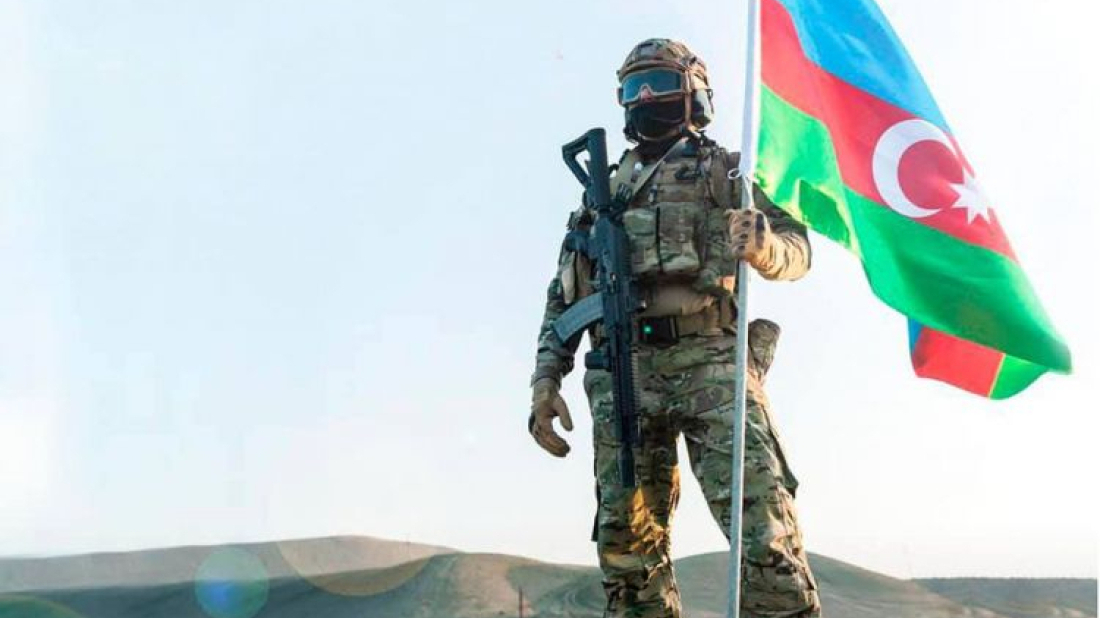
On 27 September 2020, under the leadership of the Glorious Supreme Commander Ilham Aliyev, the Azerbaijani Armed Forces launched a full-scale counteroffensive along the front line to repel military provocations by Armenian forces.
The operation, launched in response to Armenia’s large-scale attacks, later became known as “Iron Fist” and evolved into the Patriotic War. Throughout the conflict, President Aliyev regularly addressed the nation, uniting the people and laying the groundwork for successive victories.
On 8 November 2020, President Aliyev announced the liberation of the historic city of Shusha. Following this, Armenia accepted defeat and signed a capitulation agreement on 10 November with the leaders of Azerbaijan, Armenia, and Russia.
Within 44 days, Azerbaijani territories long held under occupation were liberated, and the country’s territorial integrity was restored.
Equipment captured from the Armenian forces was displayed at a military parade in Baku on 10 December and is now exhibited at the Military Trophy Park.
Large-scale reconstruction and rehabilitation work is currently underway in the liberated territories, including measures to facilitate the return of residents to their homes. State sovereignty and the constitutional order have been fully restored throughout Azerbaijan.
The 44-Day Patriotic War and Victory
During the conflict, the Azerbaijani Armed Forces employed modern military strategies to reclaim occupied territories, including the historic city of Shusha.
Armenia signed a capitulation agreement, ending hostilities. The victory was not only military but also diplomatic, reflecting the coordinated efforts of the government, armed forces, and nation.
Throughout the war, the slogan “Either victory or nothing!” symbolised the unity and bravery of the Azerbaijani people.
Honouring the Fallen
27 September serves both to honour the memory of fallen soldiers and to symbolise the Azerbaijani people’s determination for freedom and national unity. Remembrance Day is dedicated to the country’s martyrs.
The state provides social support, awards, and medals to veterans and families of the deceased. Initiatives such as Baku’s Victory Park are tangible reminders of Azerbaijan’s commitment to honour its heroes.
As in previous years, this year martyrs will be remembered in mosques, churches, and synagogues, with prayers offered for their souls. At 12:00 local time, a minute of silence will be observed across the country in memory of the fallen.
Azerbaijan on the global stage
Following the conflict, President Aliyev addressed the UN General Assembly, the Non-Aligned Movement, and other international platforms, highlighting Armenia’s occupation policies and calling on the global community to uphold justice and international law.
Azerbaijan also constantly promotes new avenues for peace and cooperation in the region.
Reconstruction and Development
Large-scale reconstruction and infrastructure projects are underway in liberated territories, including new roads, airports, railways, and “smart city” and “smart village” initiatives.
The designation of Karabakh and Eastern Zangazur as a “green energy zone” underscores Azerbaijan’s commitment to sustainable development and technology-driven economic growth.
Looking Ahead
27th September represents both a day of remembrance for the fallen and a reaffirmation of national unity and resilience.
Government-led reconstruction and economic initiatives underscore Azerbaijan’s strength, modernity, and confidence in the future.
The victory achieved in the war marks a turning point in the country’s contemporary history, demonstrating the determination of its people on the international stage.










What is your opinion on this topic?
Leave the first comment