Russian missile strike on Kyiv kills 12, Poland activates air defences
Russian ballistic missile strikes on Ukraine’s capital Kyiv has killed at least eight people and injured more than two do...
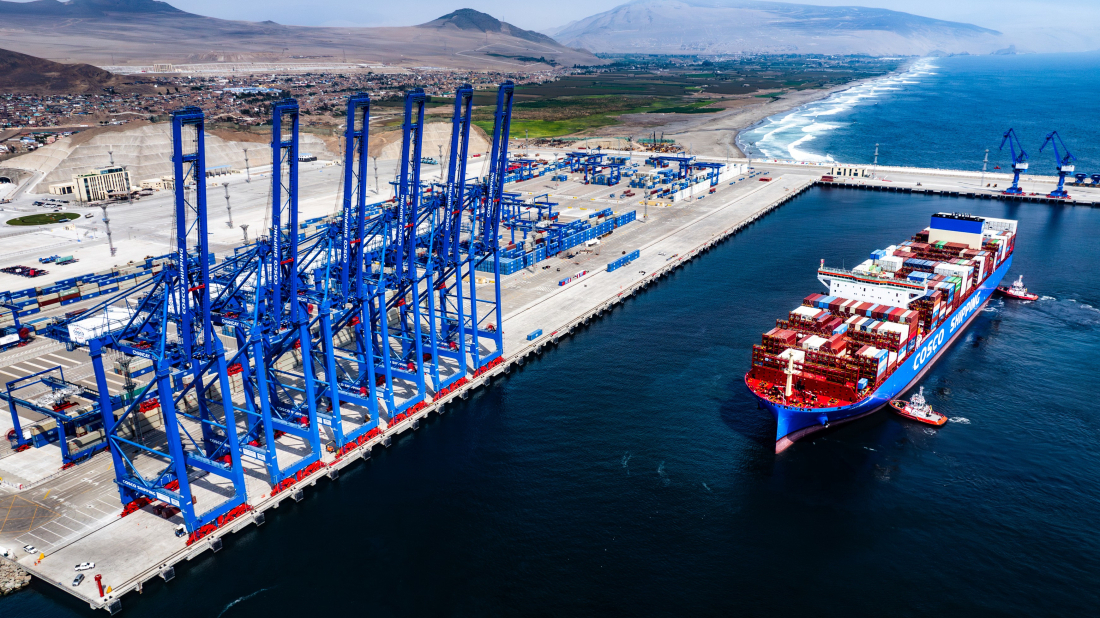
China has launched its first direct break-bulk shipping service to Peru’s Chancay port, marking a new stage in connectivity between Asia and South America under the Belt and Road Initiative.
The inaugural shipment set sail from Suzhou, an eastern Chinese manufacturing hub, and is expected to arrive in Chancay in the coming weeks.
Chancay port, located about 80 kilometers north of Lima, is one of the most significant Chinese-backed infrastructure projects in Latin America. Developed by Chinese state-owned shipping giant COSCO in partnership with local firms, the deep-water port is designed to handle large volumes of container and bulk cargo, with the goal of turning Peru into a regional logistics hub.
Unlike containerized cargo, break-bulk shipping involves goods loaded individually, such as machinery, steel, or oversized equipment that cannot fit into standard containers. The new direct service from Suzhou is expected to reduce transit times and costs for exporters, while opening new opportunities for South American markets to receive Chinese industrial goods more efficiently.
The launch comes as trade between China and Latin America continues to expand. China is now Peru’s largest trading partner, importing copper, fishmeal, and agricultural products, while exporting electronics, machinery, and manufactured goods. With Chancay port set to become operational later this year, Peruvian officials have described it as a “game-changer” for regional commerce, providing a direct gateway for Asian goods into South America’s Pacific coast.
For China, the project highlights the growing reach of the Belt and Road Initiative beyond Asia and Africa, into Latin America. By establishing direct shipping routes and investing in port infrastructure, Beijing is seeking to secure supply chains and expand trade corridors that bypass traditional hubs such as the Panama Canal.
Once fully operational, Chancay port is expected to rival other major Pacific gateways in the Americas, offering deep-water berths for the largest cargo vessels and integrated logistics parks for warehousing and distribution.

The collective-defence agreement between Türkiye, Saudi Arabia and Pakistan signals that regional powers no longer want to rely solely on external security guarantees. Whether it becomes a stabilising deterrent or another axis of rivalry remains unresolved.
Shipping through the Strait of Hormuz has slowed, according to the latest data, as uncertainty over the waterway’s reopening kept most shipowners away. Six commodity vessels crossed the strait on Tuesday, down from nine the day before and below the 10-day daily average of 11.
Iran has said the Strait of Hormuz will remain closed until the U.S. fulfils the terms of an interim deal, including lifting the maritime blockade and sanctions and releasing Iran’s frozen assets.
Start your day informed with AnewZ Morning Brief. Here are the top news stories for the 19th of August, covering the latest developments.
Shipping traffic through the Strait of Hormuz remains limited on Thursday, with no increase in vessel crossings as U.S.-Iran talks to resolve the conflict remained stalled. Nine commodity vessels transited the key waterway on Wednesday, unchanged from the previous day, according to Kpler data.
Two days inside Uzbekistan’s newsrooms, hospitals, factories and technology hubs reveal a country eager to show how it is changing — while that transformation is still under way.
Syrian Foreign Minister Asaad al-Shaibani arrived in Islamabad on Wednesday for a two-day visit, marking the first trip by Syria’s top diplomat to Pakistan in 19 years as Damascus seeks to deepen ties with the country.
More than a year after Pakistan and India were involved in their most serious military confrontation in decades, a key airspace restriction between the nuclear-armed neighbours remains in force.
Uzbekistan has unveiled a sweeping package of business reforms, including easier access to loans, $1 billion in export support, a three-year moratorium on most inspections and stronger protections for entrepreneurs.
Afghan business representatives are seeking new trade and investment opportunities at Iran’s 26th International Building Industry Exhibition, as they look to expand ties with Iranian and international companies.
You can download the AnewZ application from Play Store and the App Store.
What is your opinion on this topic?
Leave the first comment