Kazakhstan scales up its nuclear power goals
Kazakhstan has approved plans for a second nuclear power plant in a significant scaling up of the country's nuclear ambitions. It comes a year after a...
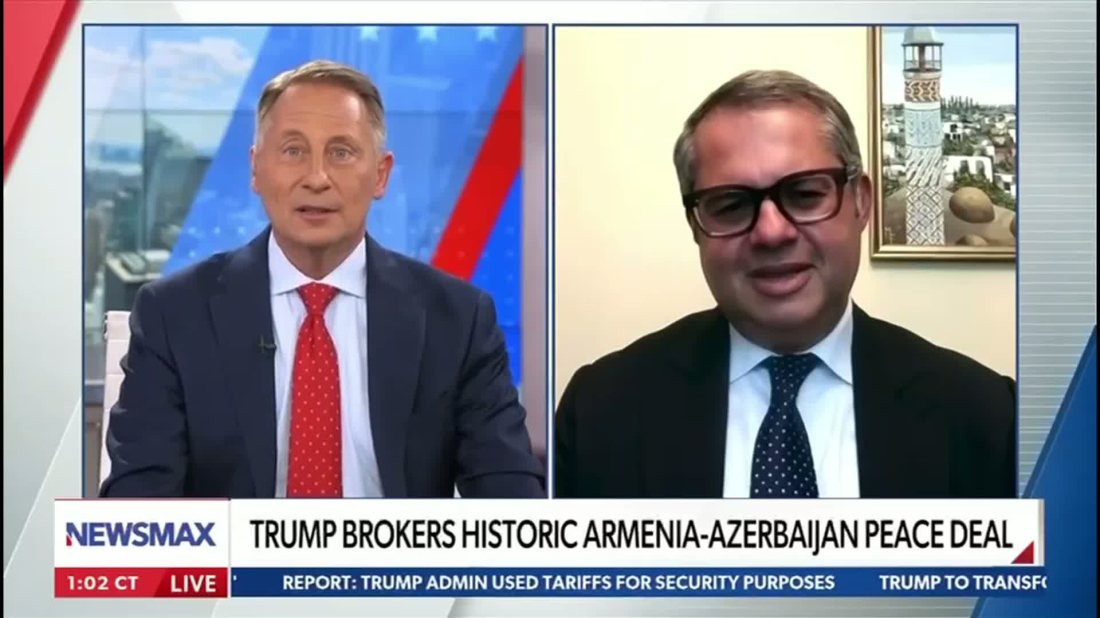
U.S.-based Newsmax television channel has aired a special programme devoted to the landmark Washington summit between the leaders of Azerbaijan and Armenia, mediated by U.S. President Donald Trump.
The broadcast explored the significance of the meeting, its regional and global implications, and Washington’s role as a key mediator in securing the agreement.
The guest on the programme was Azerbaijan’s ambassador to the United States, Khazar Ibrahim, who hailed the summit as “a historic moment.”
“As my president said, it happened in the number one capital in the world under the leadership of President Trump, who is a peacemaker,” Ibrahim told Newsmax. “It’s quite notable that here, Azerbaijan and Armenia signed this joint declaration. Now the doors, windows, hearts-everything is open to have real peace in the region, to integrate not only with neighbours, but with the entire world.”
The ambassador reflected on more than three decades of conflict, including the occupation of Azerbaijani territories, ethnic cleansing, and the displacement of refugees and internally displaced persons (IDPs) who still cannot return home due to landmines. He contrasted years of unsuccessful negotiations mediated by the OSCE with what he described as a “diplomatic miracle” achieved through President Trump’s involvement.
“Within a very short period of time, President Trump managed to help us,” Ibrahim said, crediting both direct talks between Baku and Yerevan and Trump’s personal role in advancing the process.
“When you talk to each other, that’s very important, because at the end of the day, it’s you who are going to live with each other,” he added. “But at the same time, when you have a statesman, a leader, and a peacemaker like Donald Trump, it always helps.”
Ibrahim concluded that with the signing of the joint declaration, “all the roads are open for peace and prosperity of the region.”

Heavy snow continued to batter northern and western Japan on Saturday (31 January) leaving cities buried under record levels of snowfall and prompting warnings from authorities. Aomori city in northern Japan recorded 167 centimetres of snow by Friday - the highest January total since 1945.
The United States accused Cuba of interfering with the work of its top diplomat in Havana on Sunday (1 February) after small groups of Cubans jeered at him during meetings with residents and church representatives.
A daylight robbery at a jewellery shop in Richmond, one of London’s most affluent and traditionally quiet districts, has heightened security concerns among residents and local businesses.
Talks with the U.S. should be pursued to secure national interests as long as "threats and unreasonable expectations" are avoided, President Masoud Pezeshkian posted on X on Tuesday (3 February).
Early voting for Thailand’s parliamentary elections began on Sunday (1 February), with more than two million eligible voters casting ballots nationwide ahead of the 8 February general election, as authorities acknowledged errors and irregularities at some polling stations.
Kazakhstan sharply increased oil shipments to Europe in January, exporting 310,000 tonnes to Germany and sending a further 106,000 tonnes via the Baku–Tbilisi–Ceyhan (BTC) pipeline.
Kazakhstan has approved plans for a second nuclear power plant in a significant scaling up of the country's nuclear ambitions. It comes a year after a referendum, which suggested more than 71 per cent support for the project, but which was also accompanied by allegations of irregularities.
Armed boats tried to intercept a vessel north of Oman on Tuesday in waters near the Strait of Hormuz, where heightened military activity and U.S.–Iran tensions are fuelling maritime security concerns.
Turkish President Recep Tayyip Erdoğan has begun a two-day visit to Saudi Arabia and Egypt, seeking to deepen political and economic cooperation as regional tensions over Gaza, Iran and wider Middle East stability dominate the agenda.
Talks with the U.S. should be pursued to secure national interests as long as "threats and unreasonable expectations" are avoided, President Masoud Pezeshkian posted on X on Tuesday (3 February).
You can download the AnewZ application from Play Store and the App Store.
What is your opinion on this topic?
Leave the first comment